
Workers’ Comp vs. Health Insurance: Do You Need Both?
If you already pay for a group health plan, it is natural to wonder why you also need workers’ comp. Both pay doctors. Both cover injuries. But they answer different questions, they are triggered by different events, and the law treats them very differently for a small employer.
The short version: workers’ comp is usually mandatory once you hire; health insurance is usually optional until you are much larger. Having one does not replace the other. Below are the most common beliefs owners have about the two, and what is actually true.
| Workers’ comp | Health insurance | |
|---|---|---|
| What triggers it | An injury or illness from the job | Medical care for any cause in everyday life |
| Pays lost wages? | Yes, part of the paycheck | No |
| Deductible or copay | None for the employee | Usually yes |
| Required for a small employer? | Usually, once you hire (thresholds vary by state) | Not under federal law below 50 full-time equivalent employees |
| Taxes on benefits | Wage benefits are exempt from federal income tax | Not applicable |
Myth 1: “Our health plan already covers injuries, so we’re fine.”
Fact: Health insurance covers an employee’s medical care in everyday life, whatever the cause. Workers’ comp covers medical care and part of lost wages, but only when the injury or illness comes from the job. Many group health plans exclude work-related injuries or try to recover what they paid once a workers’ comp carrier is identified, because workers’ comp is expected to pay first. Check your own plan document for its exact wording.
And the health plan never pays lost wages. An employee who misses six weeks after a fall from a ladder needs income, not just treatment. That income replacement only comes from workers’ comp (or from a separate disability policy, if you offer one).
Myth 2: “Small businesses have to offer health insurance.”
Fact: Not under federal law, unless you are an “applicable large employer.” The IRS explains that the Affordable Care Act’s employer shared responsibility rules apply only to employers that had an average of at least 50 full-time employees, counting full-time equivalents, during the preceding calendar year. The IRS also notes that the vast majority of employers fall below that threshold.
Workers’ comp works on a different scale. Many states require it from the first employee, and the rest set low thresholds. Some examples from our state guides: Georgia at 3 or more employees counting officers, Florida at 4 or more (1 or more in construction), Tennessee at 5 or more outside construction. Check the 50-state comparison table for your state.
Myth 3: “If we skip health insurance, we save on workers’ comp too.”
Fact: The two are unrelated. Your workers’ comp duty depends on your state, your industry and how many employees you have. Whether you offer health benefits has no effect on it.
Myth 4: “An employee can choose which one to use.”
Fact: For a work injury, the workers’ comp claim is the right path. If an employee uses a health insurance card for a job injury, the provider or the health plan may deny the bill or chase the workers’ comp carrier later, which only slows things down. Tell employees early: report a work injury to you right away, and you will start the claim. See how to file a workers’ comp claim and what to do when an employee is injured.
Myth 5: “Workers’ comp is just health insurance for work.”
Fact: It is broader in some ways and narrower in others.
- Broader: it replaces part of lost wages, can pay for permanent impairment and vocational rehabilitation, and pays death benefits to dependents. The employee normally pays no deductible or copay on an accepted claim.
- Narrower: it does nothing for a flu, a weekend sports injury or a chronic condition unrelated to work.
- Taxes: IRS Publication 525 says workers’ compensation paid under a workers’ compensation act for an occupational sickness or injury is fully exempt from tax, including for survivors.
- Who pays the premium: the employer. Health premiums are often shared between employer and employee. Most states do not let you charge workers for workers’ comp; Washington is a known exception, where RCW 51.16.140 has employers deduct half of the medical benefits premium from workers’ pay.
Myth 6: “An uninsured employee can’t get workers’ comp.”
Fact: Whether an employee has personal health insurance makes no difference to a workers’ comp claim. A covered employee with no health plan at all is entitled to the same workers’ comp benefits as one with a gold-level plan.
One injury, two policies: an illustrative example
The numbers below are hypothetical and only meant to show who pays what.
Maria works at a small bakery that offers a group health plan. In March she gets bronchitis and sees her doctor: the health plan handles that visit, minus her copay. In June she slips on flour near the oven and fractures her wrist. That is a job injury, so it goes to the workers’ comp carrier. Say the ER visit, cast and follow-ups cost $6,500, and she cannot work for four weeks at an average weekly wage of $720. In a state that pays two-thirds of average weekly wage for temporary total disability (California’s rule under Labor Code 4653, for example), her benefit would be about $480 a week before state maximums and waiting-period rules. Workers’ comp pays the medical bills with no deductible, and her wage benefit is not taxable.
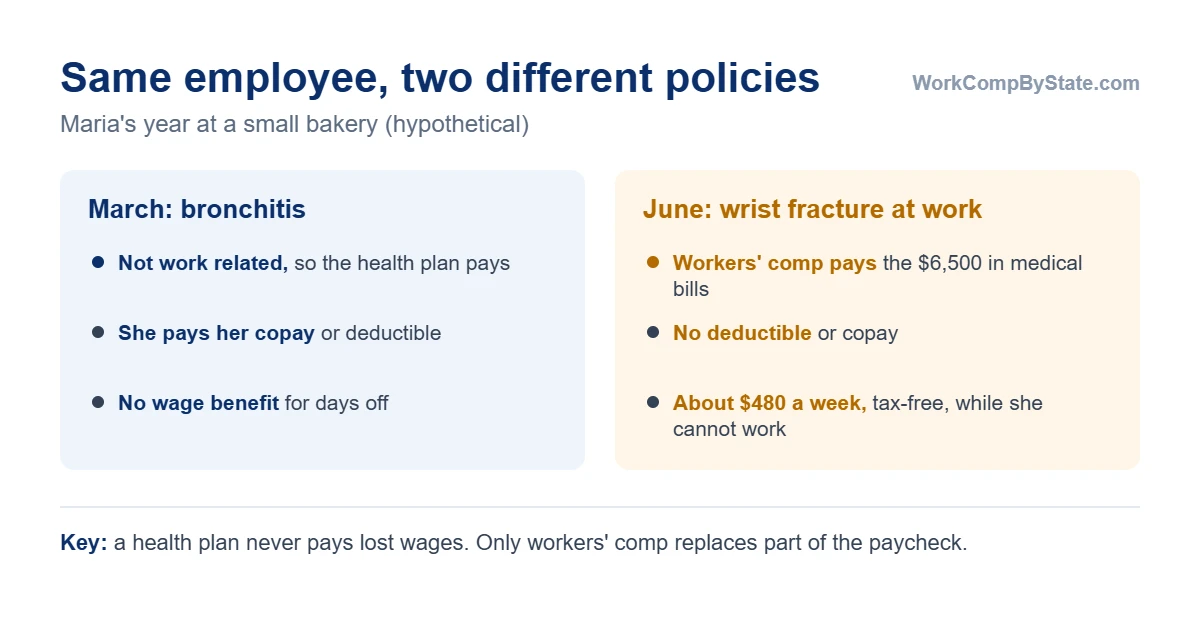
If the bakery had a health plan but no workers’ comp, the health plan might refuse the wrist bills, Maria would receive no wage benefit at all, and the bakery would face state penalties plus a possible lawsuit.
Should a small employer offer health insurance anyway?
That is a business decision, not a legal one, for most small employers. It helps with hiring and keeping good staff. There is also a federal incentive. The IRS small business health care tax credit is aimed at employers with fewer than 25 full-time equivalent employees that pay average wages under an inflation-adjusted limit, offer a qualified plan through the SHOP Marketplace (or meet a limited exception) and pay at least 50 percent of employee-only premiums. The maximum credit is 50 percent of premiums paid (35 percent for tax-exempt employers), it is available for two consecutive tax years, and it shrinks on a sliding scale as the business gets bigger. Ask your tax preparer whether you qualify.
A simple checklist for a new employer
- Before your first hire, confirm your state’s workers’ comp threshold and buy a policy if you meet it.
- Decide separately whether to offer health insurance, and check the tax credit if you are under 25 full-time equivalents.
- Write a one-page injury procedure: who to tell, where to get care, and that work injuries go through workers’ comp.
- Track your full-time headcount each year so you know if you approach 50 full-time employees including equivalents.
Related guides
- Is workers’ comp legally required for small businesses?
- What workers’ comp actually covers
- Workers’ comp vs. general liability
- Workers’ comp for part-time employees
Sources
- IRS, employer shared responsibility provisions
- IRS, small business health care tax credit and the SHOP Marketplace
- IRS Publication 525, taxable and nontaxable income
- California Labor Code 4653, temporary total disability rate
- RCW 51.16.140, Washington premium deductions
Last checked against the sources above on October 2, 2026.