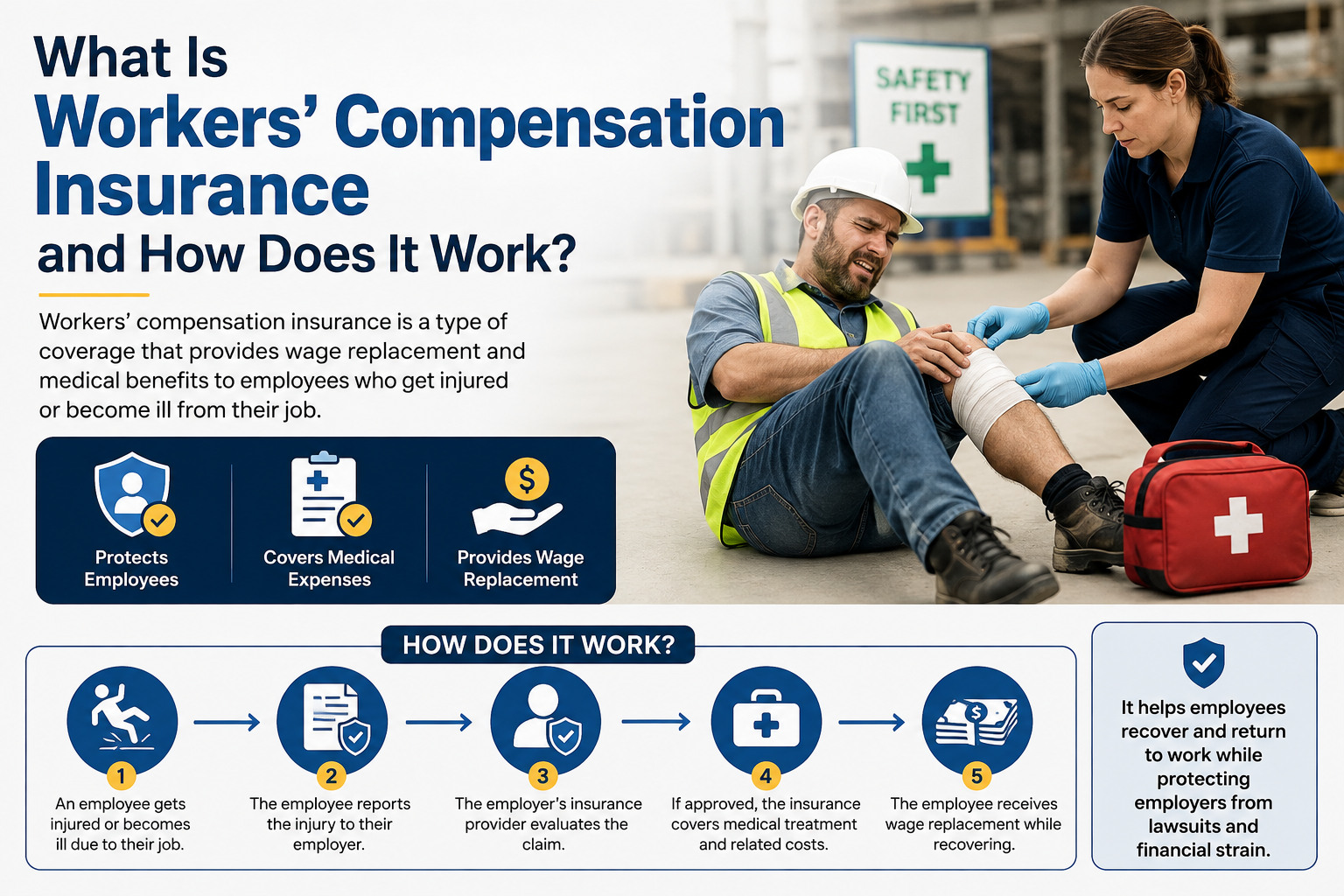
What Is Workers’ Compensation Insurance and How Does It Work?
If you’re a small business owner hiring your first employee, you’ve probably run into the term «workers’ comp» and wondered whether it’s just another box to check — or something that actually matters. It’s both. Workers’ compensation insurance is one of the few types of coverage that’s legally required in most states, and it’s also the policy most likely to save your business from a lawsuit that could otherwise put you out of business.
This guide breaks down what workers’ compensation insurance actually is, how it works from the moment an employee gets hurt to the moment a claim is paid, and where to go next depending on your situation.
Quick answer: Workers’ compensation insurance is a policy that pays for an employee’s medical care and a portion of their lost wages if they get injured or become ill because of their job — regardless of who was at fault. In exchange, the employee generally gives up the right to sue their employer over the injury. It’s required in nearly every state for businesses with employees, funded entirely by the employer (never deducted from an employee’s paycheck), and priced based on your payroll, industry, and safety record.
What Is Workers’ Compensation Insurance?
Workers’ compensation insurance is a type of business insurance that covers medical expenses and partial lost wages for employees who are injured or become ill as a direct result of their job. It’s sometimes called «workers’ comp,» «workman’s comp,» or «workmen’s compensation» — all three refer to the same coverage.
The defining feature of workers’ comp is that it’s a no-fault system. That means an injured employee doesn’t need to prove their employer did something wrong to receive benefits, and it doesn’t matter if the employee themselves made a mistake that contributed to the accident (as long as it wasn’t intentional or the result of intoxication, which most states carve out as exceptions). A warehouse worker who strains their back lifting a box gets the same access to benefits whether the accident was «nobody’s fault» or a genuine oversight.
In return for that no-fault guarantee, most states apply what’s known as the exclusive remedy doctrine: an employee covered by workers’ comp generally cannot also sue their employer in civil court for the same injury. This trade-off is the entire logic behind the system — employees get guaranteed, fast access to benefits without having to prove negligence, and employers get protection from unpredictable lawsuits and jury verdicts. (There are exceptions — for example, if an employer intentionally caused harm — which we cover in a dedicated article on exclusive remedy and when employees can still sue).
Who Pays for Workers’ Comp Insurance?
The employer pays 100% of the premium. It is illegal in every state to deduct workers’ compensation premiums from an employee’s paycheck, unlike health insurance or retirement contributions, which are often split between employer and employee. If you’re a small business owner, the cost of this policy is entirely yours to budget for — we break down realistic pricing in our guide to how much workers’ comp insurance costs.
How Does Workers’ Comp Insurance Actually Work?
It helps to walk through the process in order, from the day you buy the policy to the day a claim gets paid.
1. You buy a policy based on your payroll and industry risk. Insurers assign your business one or more «class codes» that describe what your employees actually do (an office administrator and a roofer have very different risk profiles, even at the same company). Your premium is calculated using your estimated annual payroll, your class code’s base rate, and a modifier based on your company’s claims history — a system we explain in detail in how workers’ comp premiums are calculated.
2. An employee is injured or becomes ill because of their job. This can be a sudden accident (a fall, a cut, a vehicle collision while on duty) or a condition that develops over time (repetitive strain injuries, hearing loss from prolonged noise exposure, certain occupational illnesses).
3. The employee reports the injury, and you report it to your insurer. Most states set a short window for the employee to notify the employer (often 30 days, though this varies by state) and a separate window for the employer to file the claim with the insurance carrier or state agency. Missing these deadlines can complicate or even jeopardize the claim.
4. The insurer reviews and approves (or disputes) the claim. In straightforward cases — a documented workplace accident with clear medical treatment — approval is usually routine. Claims can be disputed if the insurer questions whether the injury actually happened at work, or whether it’s connected to a pre-existing condition.
5. Benefits are paid directly related to the injury. This typically includes medical treatment, a portion of lost wages while the employee can’t work, and, in more serious cases, disability or death benefits. We cover each of these in the next section.
6. The employee returns to work, or the claim moves toward settlement. Many claims resolve once the employee recovers and returns to their job. More serious injuries may involve ongoing disability payments or a negotiated settlement, particularly if there’s a permanent impairment.
If you want the practical, step-by-step version of this process written for employers handling a real claim, see how to file a workers’ comp claim.
What Does Workers’ Compensation Insurance Cover?
Workers’ comp benefits generally fall into four categories. The exact rules, calculations, and maximum durations vary significantly by state, but the categories themselves are consistent nationwide:
- Medical expenses. Doctor visits, hospital stays, surgery, physical therapy, prescriptions, and any other treatment reasonably related to the workplace injury or illness, usually with no deductible or copay for the employee.
- Disability / lost wage benefits. A percentage of the employee’s average weekly wage (commonly around two-thirds, though this varies by state and is often subject to a state maximum) paid while they’re unable to work, whether temporarily or permanently.
- Vocational rehabilitation. Retraining or job placement assistance for employees who can’t return to their previous role due to a lasting impairment.
- Death and survivor benefits. A funeral expense allowance plus ongoing payments to a deceased employee’s dependents, in the case of a fatal workplace accident or occupational illness.
What workers’ comp does not typically cover: injuries that happen during an employee’s normal commute (with some exceptions), injuries caused by an employee’s intoxication or intentional misconduct, and injuries to independent contractors who are correctly classified as such (a distinction we unpack in do independent contractors need their own workers’ comp insurance).
Is Workers’ Comp Insurance Required for Small Businesses?
In most states, yes — but the specific threshold (how many employees trigger the requirement) and the enforcement mechanism vary considerably by state, so this is genuinely one of those «it depends on where you operate» answers.
A few structural points worth knowing before you check your own state’s rules:
- Most states require coverage as soon as you have one or more employees, though several states set a higher threshold (commonly 3, 4, or 5 employees) before it becomes mandatory for non-hazardous industries.
- Texas is a notable exception. It’s the only state where private employers can generally choose not to carry workers’ comp coverage at all (a status referred to as being a «non-subscriber»), though doing so removes the exclusive remedy protection and exposes the employer to direct lawsuits. We cover the details, and why «optional» doesn’t necessarily mean «advisable,» in does Texas really not require workers’ comp insurance.
- Four states are «monopolistic,» meaning you can’t buy workers’ comp from a private insurance company at all — coverage must be purchased through a state-run fund. As of this writing, those states are North Dakota, Ohio, Washington, and Wyoming. We explain what that means in practice in monopolistic states vs. private workers’ comp insurance.
- Sole proprietors, partners, and some LLC members are often exempt from covering themselves, even in states that require coverage for employees — though many choose to carry it voluntarily. This is covered in workers’ comp for a one-person LLC.
Because these rules genuinely differ by state, the right next step is to check the requirements where your business actually operates rather than rely on a national rule of thumb. Our state-by-state workers’ comp requirements guide breaks down all 50 states individually.
How to Get Workers’ Compensation Insurance
Small businesses typically get coverage one of three ways:
- Through a private insurance company or independent agent — the standard route in most states, and the one most small businesses use. Pricing and underwriting vary by carrier, which is why comparing quotes matters; see our roundup of the best workers’ comp insurance companies for small businesses.
- Through a state-run fund — mandatory in the four monopolistic states, and available as an «insurer of last resort» option in many other states for businesses that can’t find private coverage (often because of a high-risk industry or a claims history).
- Through self-insurance — an option for larger, financially stable employers who meet state requirements to cover claims out of pocket instead of paying premiums. This is rarely practical for small businesses; we cover when it starts to make sense in self-insured workers’ compensation.
Frequently Asked Questions
Does workers’ comp cover injuries that happen outside of work? No. Coverage is limited to injuries and illnesses that arise «in the course and scope of employment.» An injury at home or during off-duty personal time isn’t covered, even if the employee is otherwise a covered worker.
Can an employee still sue me if they’re covered by workers’ comp? In most cases, no — this is the exclusive remedy doctrine described above. There are narrow exceptions, such as intentional harm by the employer or, in non-subscriber states like Texas, if the employer opted out of coverage entirely.
Do part-time or seasonal employees need to be covered? In most states, yes — workers’ comp requirements are generally based on the number of employees and payroll, not on full-time status. See our guide on workers’ comp for part-time employees for state-specific nuances.
What happens if I don’t carry workers’ comp insurance when it’s required? Penalties vary by state but commonly include fines, stop-work orders, personal liability for the business owner, and loss of the exclusive remedy protection — meaning an injured employee could sue you directly. Details by state are in what happens if you don’t have workers’ comp insurance.
How much does workers’ comp insurance cost? It depends heavily on your state, industry, and payroll — a low-risk office-based business pays a fraction of what a roofing or trucking company pays for the same payroll amount. We break down realistic pricing in how much does workers’ comp insurance cost for a small business.