
What Is Workers’ Compensation Insurance and How Does It Work?
Workers’ compensation is insurance that pays for an employee’s medical care and part of their lost wages when they are hurt or get sick because of their job. In exchange, the employee generally cannot sue the employer over that injury. That trade, guaranteed benefits for the worker and protection from lawsuits for the employer, is the whole system in one sentence. The rest of this guide explains how it works in practice for a small business.
The basic bargain
Workers’ comp is “no-fault.” The worker does not have to prove the employer did anything wrong, and the employer cannot avoid paying by showing the worker was careless. If the injury happened in the course of the job, it is generally covered.
In return, workers’ comp is usually the employee’s only remedy against the employer. Lawyers call this the exclusive remedy rule. It is why states punish employers who skip coverage so hard: an uninsured employer has broken the bargain. In several states, including Arizona, Ohio and Missouri, an injured worker of an uninsured employer can sue in court, and the employer loses defenses such as the worker’s own negligence.
What it pays for
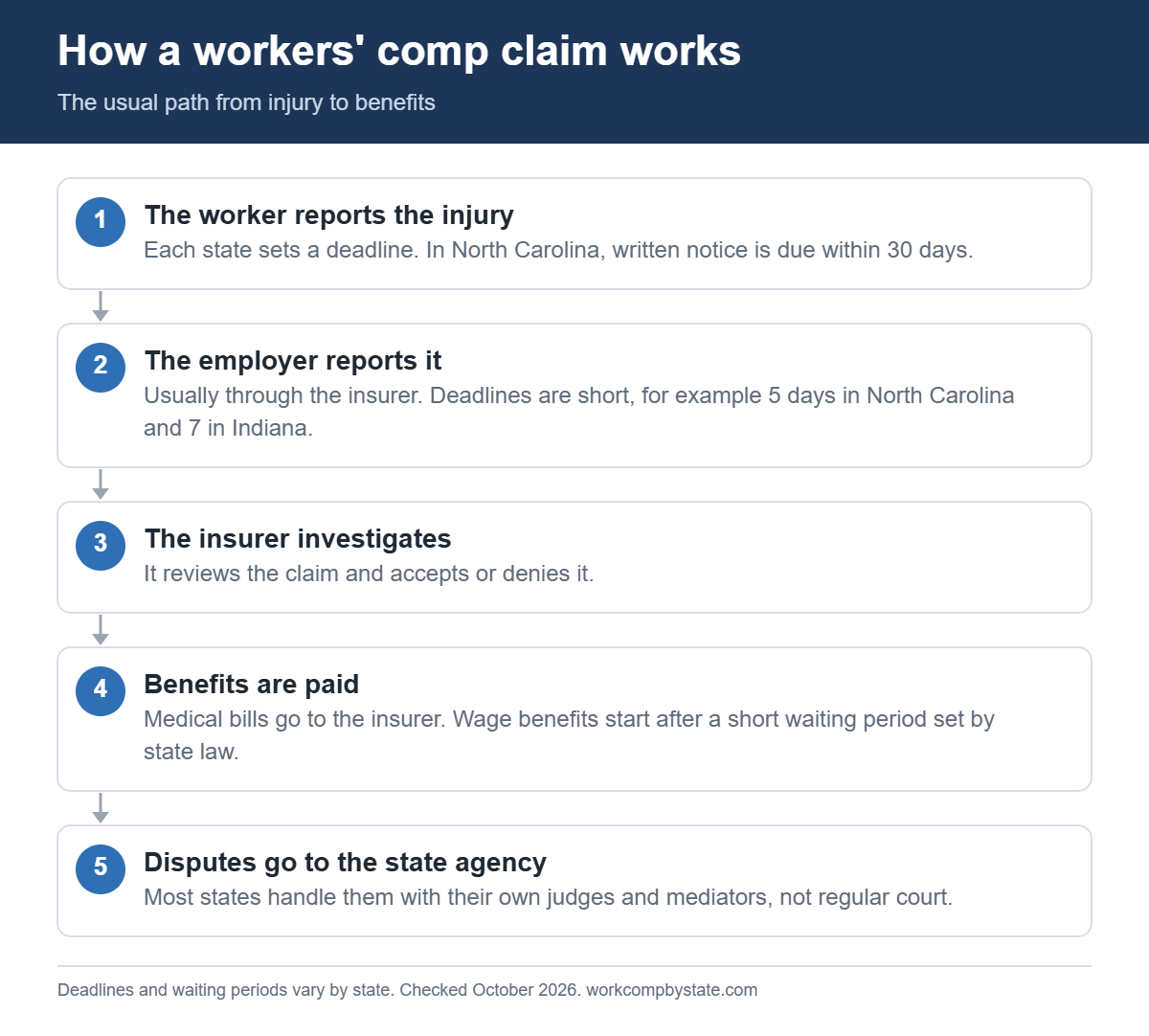
- The injury happens and the worker reports it. States set deadlines. In North Carolina, the employee must give written notice within 30 days.
- The employer reports it. Deadlines are short. North Carolina requires Form 19 within five days for qualifying injuries, Indiana requires a report to the carrier within seven days, and Virginia requires a report to its Commission within ten. In practice, you call your insurer and it files the official report.
- The insurer investigates and accepts or denies the claim.
- Benefits are paid. Medical bills go to the insurer. Wage benefits start after a short waiting period set by state law.
- Disputes go to the state agency, not regular court, in most cases. Workers’ comp agencies have their own judges and mediators.
- Private insurance carriers. The normal route in most states, through an agent or directly.
- State funds. Some states run or charter a fund that competes with private carriers. Four states, North Dakota, Ohio, Washington and Wyoming, sell coverage only through the state.
- Assigned risk pools. If no carrier will write you, every competitive state has a market of last resort. Michigan’s is the Workers’ Compensation Placement Facility, and Wisconsin’s is run by the Wisconsin Compensation Rating Bureau.
- Self-insurance. Larger employers can pay claims themselves with state approval and financial security.
- Is workers’ comp legally required for small businesses?
- How workers’ comp premiums are calculated
- Workers’ comp exemptions
- How to file a workers’ comp claim
- RCW 51.16.140, Washington premium deductions
- Tennessee Bureau of Workers’ Compensation, how rates are set
- N.C. Gen. Stat. 97-22, employee notice
- Va. Code § 65.2-900, employer reports
- Worker’s Compensation Board of Indiana, compliance
- RSMo 287.280, Missouri duty to insure
| Benefit | What it covers |
|---|---|
| Medical care | Treatment for the work injury or illness, usually with no deductible or copay |
| Wage replacement | A percentage of average wages while the worker cannot work, up to a state maximum |
| Permanent disability | Lasting damage, such as loss of use of a hand |
| Death benefits | Payments to dependents, plus burial expenses |
| Return-to-work help | Vocational rehabilitation in some states |
Most policies also include employer’s liability coverage, which protects the business in the cases where an injured worker or a third party can still sue. Monopolistic state funds generally do not include it, which is why employers there often buy separate “stop-gap” coverage.
Who pays
The employer pays the premium. In almost every state it is illegal to take any part of it out of employees’ wages. Washington is the notable exception: under RCW 51.16.140, employers must withhold half of the medical aid portion of the premium from each worker’s pay, and nothing more.
Premiums are usually set per $100 of payroll, based on a class code for the type of work. Riskier jobs cost more. Tennessee’s Bureau of Workers’ Compensation describes it this way: each class code has a set rate per $100 of payroll, and dangerous work like roofing has higher rates. Your claims history then adjusts that price up or down through an experience modification. Our premium calculation guide walks through the math.
How a claim works, step by step
Is it required?
In 48 states, yes, once a business reaches the state’s trigger. In many states that is the first employee. Others start at three, four or five employees, or use payroll, hours or industry instead. Texas and South Dakota do not require it. Our guide to whether workers’ comp is legally required explains how to work out your own obligation, and the 50-state table lists every state’s rule.
Where coverage comes from
Example
A delivery driver for a small Georgia bakery slips on ice while carrying trays and breaks a wrist. She reports it that afternoon. The owner calls the carrier, which files the state report. The carrier pays the urgent care visit, the orthopedic follow-up and the cast, and starts weekly wage benefits after the state’s waiting period while she cannot drive. Because the bakery is insured, the driver cannot sue the bakery over the fall, and the bakery pays nothing beyond its premium. If the bakery had three employees and no policy, it would owe all of that directly and face state penalties.
Frequently asked questions
Does workers’ comp cover injuries that are the worker’s fault?
Generally yes. It is a no-fault system. States do have limits, such as injuries caused by intoxication or intentional self-injury.
Does it cover owners?
Usually only if they choose to be covered. Most states let sole proprietors, partners and LLC members stay off the policy. Rules for corporate officers vary.
Does it cover independent contractors?
Not a real independent contractor. But states apply their own tests, and a worker paid on a 1099 can still be your employee for workers’ comp. See workers’ comp and 1099 workers.
Related guides
Sources
Last checked against the sources above and the linked state guides on October 2, 2026.