
Self-Insured Workers’ Compensation: Is It Right for Your Business?
Self-insurance sounds like a way to stop paying an insurance company and keep the money. For a large, cash-rich employer it can work. For most small businesses it is out of reach, and the effort is better spent elsewhere. This page answers the questions owners actually ask, then gives you a checklist to see where you stand.
What does “self-insured” mean for workers’ comp?
With a normal policy, you pay a premium and the insurer pays the claims. With self-insurance, your business pays injured workers’ benefits directly, out of its own money, under the state’s supervision. Most self-insurers also buy excess coverage that kicks in above a set amount per claim, so one catastrophic injury does not sink the company.
The injured worker’s benefits do not change. Medical care and wage replacement are set by state law either way. Only the payer changes.
Can I just decide to self-insure?
No. Self-insurance is a status the state grants, not a choice you make on your own. Every state that allows it requires an application and proof that you can pay claims. A few real examples:
- Tied-up cash. A required deposit or bond is money you cannot use to run the business. In Arizona the floor alone is $100,000.
- Lumpy costs. With 12 employees, one serious back injury can cost more than several years of premium. A large employer has enough workers for costs to average out. A small one does not.
- Paperwork that never stops. Someone has to handle claims, file state reports, set reserves and renew the approval. Most self-insurers pay a third-party administrator for this.
- Long tails. Some claims stay open for years. The state wants to know you will still be around to pay them, which is why it looks at financial history and security.
- Shop the policy. Rates for the same class code can differ between carriers. See how to get the cheapest quote.
- Fix your class codes and payroll figures before the audit. See workers’ comp audits.
- Bring down your experience mod with safety work and prompt claim reporting. See the experience modification rate.
- Use pay-as-you-go billing to smooth cash flow.
- Ask about a deductible plan, which shifts part of each claim back to you in exchange for a lower premium, without formal self-insurance approval.
- Several years of solid financial statements you can hand to a regulator.
- Enough spare capital to post a deposit, bond or letter of credit without straining operations.
- A workforce large enough that yearly claim costs are reasonably predictable.
- A safety program that already keeps injuries low.
- A plan for claims handling, either staff or a third-party administrator.
- Budget for excess coverage, state fees and any self-insurer tax.
- Willingness to renew approval and file reports every year.
- State fund vs. private insurer
- Monopolistic states and their state funds
- How workers’ comp premiums are calculated
- Ways to lower your workers’ comp premium
- IC 22-3-5-1, Indiana self-insurance requirements
- M.G.L. c. 152, section 25A, Massachusetts methods of coverage
- RSMo 287.280, Missouri insurance and self-insurance
- A.R.S. 23-961, Arizona methods of securing compensation
- RCW 51.14.010, Washington state fund or self-insurance
| State | What self-insurance requires |
|---|---|
| Indiana | Satisfactory proof to the Worker’s Compensation Board of financial ability to pay claims; the Board can require a bond. Application fee $500, renewal $250, late filing $250 more (IC 22-3-5-1). |
| Massachusetts | A license from the Department of Industrial Accidents every year; employers can also join a self-insurance group (M.G.L. c. 152, § 25A). |
| Missouri | Satisfying the Division of Workers’ Compensation of the ability to carry the risk, alone or as a group; the right can be suspended or revoked (RSMo 287.280). |
| Arizona | Proof of financial ability; a deposit or security of at least $100,000 may be required, plus an annual tax of up to 3% of the premiums it would have paid (A.R.S. 23-961). |
| Washington | Monopolistic state: self-insurance is the only alternative to the state fund (RCW 51.14.010). |
The common thread is financial proof plus ongoing oversight. That is why self-insurance is used mostly by large employers with steady cash flow.
Why does it rarely fit a small business?
Four reasons, and any one of them can rule it out.
What would the numbers look like?
These figures are illustrative only, to show the trade-off. They are not real quotes or averages.
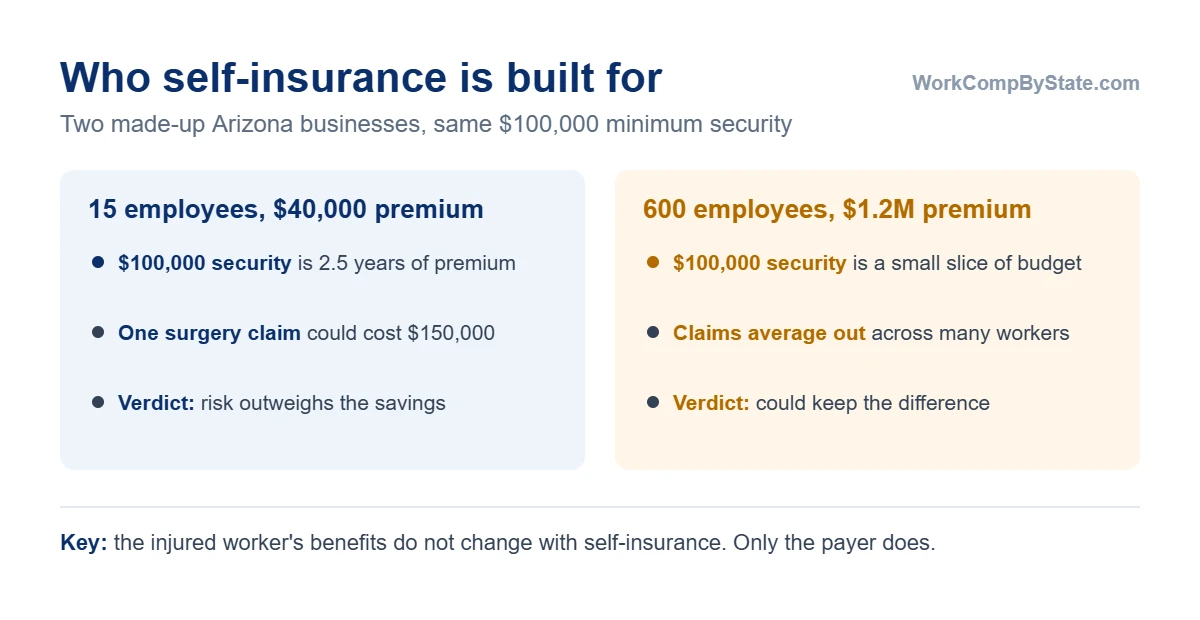
Picture two Arizona businesses thinking about self-insurance.
Business A has 15 employees and pays $40,000 a year in premium. To self-insure, it would need at least $100,000 posted as security, plus administrator fees, excess coverage and the annual tax. If one worker has a surgery claim that runs $150,000 over three years, the company carries that cost up to its excess coverage limit. The savings it might gain in a good year are small next to the risk of a bad one.
Business B has 600 employees and pays $1.2 million a year in premium. Its claims history over many years is steady. The same $100,000 minimum is a small slice of its budget, and with that many workers its yearly claims are fairly predictable. If its claims plus admin and excess costs run, say, $950,000, it keeps the difference. This is the kind of employer self-insurance is built for.
Is there a version that works for smaller employers?
Sometimes. Some states allow group self-insurance, where several businesses (often in one industry or trade association) pool their risk and apply together. Massachusetts and Missouri both mention groups in the laws above, and Arizona allows approved pools. Each member benefits from the group’s size, but each member’s costs also depend on how safely the other members work. Availability and rules vary by state, and not every state permits groups. If this interests you, ask your trade association whether a group exists in your state and industry.
What should I try first if my real goal is lower costs?
Readiness checklist
Individual self-insurance is worth a call to your state agency only if you can tick every box:
If you miss two or more, look at a self-insurance group or stick with a standard policy and work on the cost levers above.
This article is general information, not legal or insurance advice. Self-insurance rules differ by state and change over time, so confirm details with your state’s workers’ comp agency before you apply.
Related guides
Sources
Last checked against the sources above on October 2, 2026.