
Workers’ Comp Glossary: Plain-English Terms With Examples
Workers’ comp paperwork is full of terms nobody explains: mods, class codes, MMI, stop gap. This glossary gives each one a short definition in plain English and, where it helps, a quick example of how it shows up for a small business. The examples are hypothetical and the numbers are illustrative.
Terms are grouped by letter. Where we have a full guide on a topic, the entry links to it.
| Abbreviation | Stands for |
|---|---|
| AWW | Average weekly wage |
| COI | Certificate of insurance |
| EMR | Experience modification rate (the “mod”) |
| IME | Independent medical examination |
| MMI | Maximum medical improvement |
| PPD | Permanent partial disability |
| PTD | Permanent total disability |
| TPD | Temporary partial disability |
| TTD | Temporary total disability |
| TPA | Third-party administrator |
A to C
- Additional insured
- A person or company added to your insurance so it is also protected for claims arising from your work. Most common on general liability policies. Example: A general contractor asks to be named as an additional insured on your liability policy before you start a remodel.
- Assigned risk (residual market)
- The coverage source of last resort for employers that no carrier will insure voluntarily. Usually costs more. Some states use a pool; Michigan, for example, uses the Michigan Workers’ Compensation Placement Facility. Example: A new roofing company with no track record is turned down by three carriers and gets its policy through the state’s assigned risk plan.
- Average weekly wage (AWW)
- The pay figure used to calculate an injured worker’s wage benefits. Each state sets how it is figured. Example: A worker who earned $36,400 over the prior year has an AWW of about $700.
- Certificate of insurance (COI)
- A one-page document from your insurer proving you have active coverage. Clients and contractors ask for it before work starts. See certificate of insurance.
- Class code
- A code that describes a type of work and carries its own rate per $100 of payroll. Riskier work carries higher rates. See how premiums are calculated. Example: Office staff and roofers at the same company are rated under different class codes.
- Coming and going rule
- The general rule that a normal commute to and from work is not covered. Exceptions often include work errands and travel between job sites. Example: A cashier hurt in a car crash on the way to her shift is usually not covered; a plumber hurt driving between two customers’ homes usually is.
- Credibility
- How much weight a rating formula gives to your own claims history compared with the average for your industry. Bigger expected losses mean more credibility.
E to I
- Employer’s liability
- The second part of a standard workers’ comp policy. It defends you when someone sues over a work injury instead of, or on top of, a workers’ comp claim. Not included with state fund coverage in Ohio, and generally missing in the other monopolistic states too. Example: An injured worker’s spouse sues for loss of companionship; employer’s liability responds.
- Exclusive remedy
- The rule that a covered employee generally cannot sue the employer over a work injury, because workers’ comp is the remedy. See can an employee sue you.
- Experience modification rate (EMR, mod)
- A factor that raises or lowers your premium based on your claims compared with expected claims for businesses like yours. 1.00 is average. See our EMR guide. Example: At a 0.90 mod, a $10,000 premium becomes $9,000; at 1.20 it becomes $12,000.
- Experience period
- The years of claims used to calculate a mod. Washington, for example, uses three years ending 18 months before the rating year.
- Extraterritorial coverage
- Coverage for an employee who is temporarily working in another state. Rules depend on both states, and some states sign reciprocal agreements.
- Independent contractor
- A worker running their own business who is usually not covered by your policy. Each state has its own test, and a 1099 form alone does not decide it. See 1099 workers.
- Independent medical examination (IME)
- An exam by a doctor chosen by the insurer to give a second opinion on an injury or treatment.
L to N
- Light duty (modified duty)
- Temporary, easier work offered to an injured employee while they recover. Gets people back sooner and keeps claim costs down. Example: A warehouse worker with a sprained wrist answers phones for three weeks.
- Loss run
- A report from your insurer listing your claims, what was paid and what is still reserved. Carriers ask for it when you shop for a new policy.
- Manual premium
- Your payroll in each class times that class’s rate, before your mod and discounts. Example: $300,000 of payroll at $2.00 per $100 gives a manual premium of $6,000.
- Maximum medical improvement (MMI)
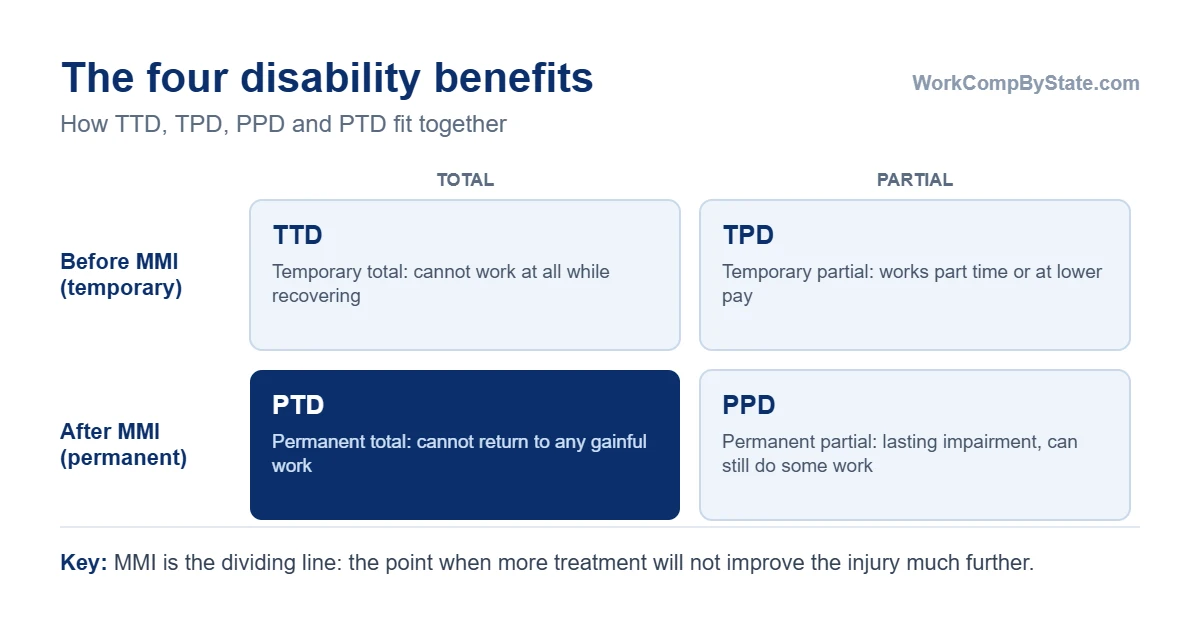
- The point when a doctor says more treatment will not improve the injury much further. Temporary benefits usually end here and any permanent rating begins.
- Monopolistic state
- A state where workers’ comp is sold only by a state fund: North Dakota, Ohio, Washington and Wyoming. See monopolistic states.
- Nonsubscriber
- A Texas employer that chooses not to carry workers’ comp. Nonsubscribers lose key defenses if an employee sues. See the Texas nonsubscriber decision.
P to R
- Pay-as-you-go
- Paying premium each payroll period based on actual wages, instead of a large deposit up front. See pay-as-you-go.
- Permanent partial disability (PPD)
- A benefit for a lasting impairment when the worker can still do some work. Example: A carpenter who loses part of a finger returns to work but receives a PPD award.
- Permanent total disability (PTD)
- A benefit for a worker who cannot return to any gainful work.
- Premium audit
- A review after the policy year comparing estimated payroll with actual payroll. You get a refund or a bill for the difference. See audits. Example: You estimated $200,000 of payroll but paid $240,000; the audit bills you for the premium on the extra $40,000.
- Rating bureau
- The organization that sets class codes and loss costs for a state. NCCI fills that role in most states (Tennessee, for example); some states have their own bureau.
- Reserve
- Money an insurer sets aside for what an open claim is expected to cost. Reserves count in your mod until the claim closes.
S
- Schedule rating
- A credit or debit an underwriter applies for things like safety programs or workplace conditions, separate from your mod.
- Second injury fund
- A state fund that shares costs when a new work injury combines with an earlier condition. Not every state still has one. See second injury funds.
- Self-insurance
- Paying your own claims with state approval instead of buying a policy. New York, for example, lets employers secure coverage through the state fund, a private insurer or approved self-insurance (Workers’ Compensation Law 50). See self-insurance.
- State fund
- A state-created insurer. In monopolistic states it is the only option; in others it competes with private carriers. See state fund vs. private.
- Stop gap coverage
- Employer’s liability coverage bought from a private insurer, usually added to general liability, for employees in monopolistic states.
- Subrogation
- The insurer’s right to recover what it paid from a third party who caused the injury. Example: A delivery driver is hit by a careless motorist; your carrier pays the claim and then pursues the motorist’s auto insurer.
T to W
- Temporary partial disability (TPD)
- A wage benefit for a worker who can work part time or at lower pay while recovering.
- Temporary total disability (TTD)
- A wage benefit while a worker cannot work at all. California pays two-thirds of average weekly earnings (Labor Code 4653), subject to state limits.
- Third-party administrator (TPA)
- A company hired to handle claims, often for self-insured employers.
- Vocational rehabilitation
- Retraining or job help for a worker who cannot return to the old job.
- Waiting period
- Days at the start of a disability that are not paid unless it lasts long enough. In California it is three days, paid back if the disability lasts more than 14 days or the worker is hospitalized as an inpatient (Labor Code 4652).
- Waiver of subrogation
- A contract term where your insurer gives up the right to recover from another party, often a general contractor. Carriers may charge for it.
A word on taxes, since it comes up often: IRS Publication 525 says workers’ comp benefits paid under a workers’ compensation act for an occupational injury or sickness are fully exempt from federal income tax.
Related guides
- What is workers’ comp and how does it work?
- What workers’ comp actually covers
- How premiums are calculated
- Is workers’ comp legally required?
Sources
- Washington L&I, experience rating
- Tennessee Bureau of Workers’ Compensation, how rates are set
- New York Workers’ Compensation Law 50, security for compensation
- California Labor Code 4652, waiting period
- Michigan Workers’ Disability Compensation Agency, insurance requirements
- IRS Publication 525
Last checked against the sources above on October 2, 2026.