
Monopolistic States vs. Private Workers’ Comp Insurance: What Changes for Your Business
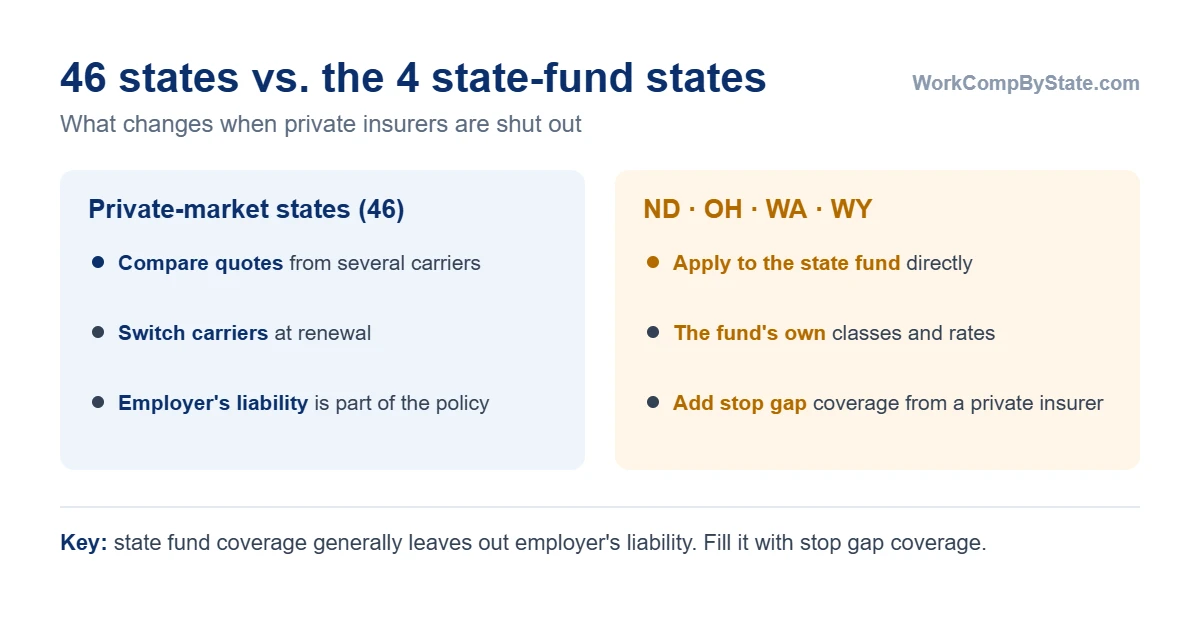
In 46 states you can shop workers’ comp like most other insurance: get quotes from several carriers, pick one, switch at renewal. In four states you cannot. North Dakota, Ohio, Washington and Wyoming sell workers’ comp only through a state-run fund. Private insurers are shut out of that market, and the usual playbook of comparing quotes does not apply.
This is a decision guide. It covers how each of the four funds works, what that means if you are based there, and what to do if you are based elsewhere but sending people in.
The four funds at a glance
| State | Who sells coverage | Who must have it | Detail to know |
|---|---|---|---|
| North Dakota | Workforce Safety & Insurance (WSI) | With limited exceptions, all employers, for all employees, including part-time, seasonal and occasional workers | Coverage must be in place before employees start; employers may not deduct any premium from wages |
| Ohio | Ohio Bureau of Workers’ Compensation (BWC) | Employers with one or more employees | Large, financially strong employers can apply to self-insure |
| Washington | Department of Labor & Industries (L&I) | Employers hiring employees, unless excluded by RCW 51.12.020 | Premiums are charged per hour worked, and employers deduct half the medical benefits premium from workers’ pay |
| Wyoming | Department of Workforce Services (DWS) | Businesses in extra-hazardous industries, before work begins | Other businesses may choose coverage; classification uses NAICS industry codes |
If your business is based in one of the four states
1. Sign up with the fund, not an agent
You open an account with the state. In Washington, L&I says you get a workers’ comp account by applying for or updating your state business license. In Wyoming, you create an employer account through the state’s WYUI system, and DWS confirms what coverage you need. In Ohio and North Dakota you apply directly to BWC or WSI. You can still hire an agent or consultant for advice, but the policy comes from the state.
2. Expect the state’s own classes and rates
Rates are set by the fund, using its own classification system. Wyoming uses NAICS industry codes. Washington charges by hours worked in each risk class instead of by payroll dollars. Your claims history still matters: Washington applies an experience factor every year, explained in our EMR guide.
3. Fill the employer’s liability gap
A standard private workers’ comp policy has two parts: the workers’ comp benefits and employer’s liability, which defends you if someone sues over a work injury (for example, a spouse’s claim, or a third party who was sued and turns around and sues you). Ohio’s state fund coverage does not include that second part, and the same gap is the general pattern in the monopolistic states. Most employers fill it with stop gap coverage, usually an endorsement on a general liability policy bought from a private insurer. Ask your liability agent to confirm it is on your policy and what limits apply.
4. Check who is excluded before you assume
Each state draws its own lines. Washington’s RCW 51.12.020, for example, excludes sole proprietors and partners, qualifying corporate officers and LLC members, booth renters and certain for-hire drivers who own or lease their vehicles, among others. In Wyoming, a business outside the extra-hazardous list may not need coverage at all. North Dakota’s default is the opposite: almost every worker must be covered.
5. Take the penalties seriously
Running without coverage is treated harshly. In Washington, operating without a certificate of coverage is a gross misdemeanor, and doing it after a revocation is a class C felony (RCW 51.48.103). In Ohio, an employer that fails to secure coverage loses the system’s protection and is liable to injured employees for damages (Ohio Revised Code 4123.77). See penalties by state.
If you are based elsewhere and send workers in
This is where multi-state businesses get caught. Your private policy from another state usually cannot cover the work, because private carriers cannot write monopolistic-state coverage. Some practical rules:
- Ask the fund before the job starts. North Dakota’s WSI publishes rules for out-of-state employers working there, and Wyoming has extraterritorial agreements with some neighboring states, including Montana, North Dakota, Nevada and Washington. Whether a short job is covered by your home policy depends on these specific rules.
- Do not rely on “other states coverage” on your private policy for these four states unless your agent confirms in writing how it applies.
- Add stop gap coverage on your liability policy for any work there.
- Budget for two systems. You will report to the state fund for that state and to your private carrier for the rest.
A short scenario (hypothetical)
A Boise, Idaho, drywall contractor with eight employees wins a six-week job in Spokane, Washington. Its private Idaho policy will not cover Washington work the way it covers Idaho work. Before the crew crosses the state line, the owner contacts L&I about a Washington account, sets aside money for hourly premiums (part of the medical premium will be withheld from the crew’s pay under Washington law), and asks the liability agent to add stop gap coverage. Skipping these steps would leave the company exposed to Washington’s penalties and to an injured worker’s claim with no coverage behind it.
Is a state fund cheaper or more expensive?
There is no single answer. A monopolistic fund has no competitors and no profit target like a stock insurer, but it also has no reason to undercut anyone. What changes for certain is the process: you cannot shop the base coverage. Your levers are the ones inside the system, such as correct classification, accurate hour or payroll reports, safety programs and the fund’s own discount programs. Ohio and Wyoming both promote discount and safety programs for employers.
For how state funds compare where they compete with private carriers, see state fund vs. private insurer. For large employers, self-insurance is the other route in Ohio and Washington; see self-insured workers’ comp.
Related guides
- Ohio workers’ comp requirements
- Washington workers’ comp requirements
- 50-state comparison table
- Workers’ comp vs. general liability
Sources
- North Dakota WSI, coverage requirements
- Wyoming Department of Workforce Services, workers’ compensation for employers
- Ohio Bureau of Workers’ Compensation
- Washington L&I, how to get a workers’ comp account
- RCW 51.48.103, Washington penalties
- Ohio BWC, Ohio Revised Code workers’ compensation statutes
Last checked against the sources above on October 2, 2026.