
Workers’ Compensation Insurance Requirements in Ohio
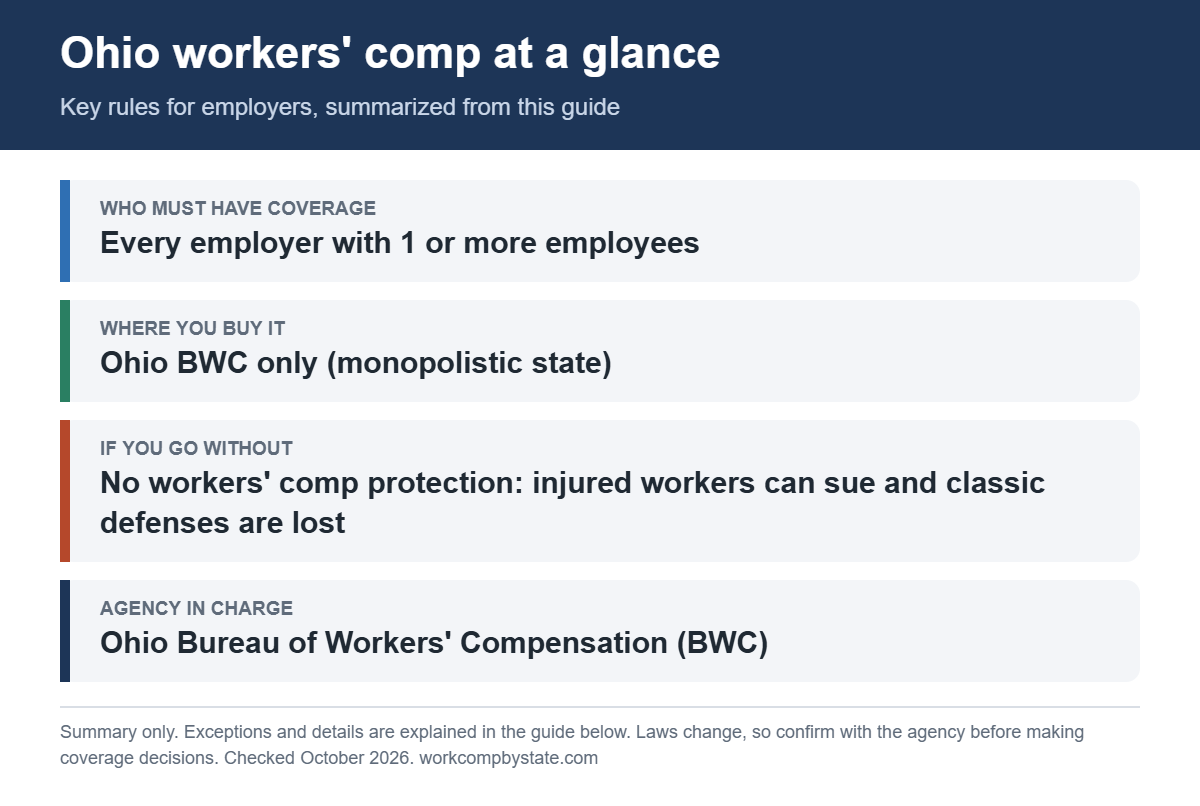
In most states, buying workers’ comp means calling an agent and comparing quotes from several insurance companies. Ohio doesn’t work that way. It is one of the few monopolistic states: private insurers are not allowed to sell workers’ comp in Ohio, and nearly every employer buys coverage directly from the state, through the Ohio Bureau of Workers’ Compensation (BWC). This changes how you shop, what you pay and what you need to buy separately.
Do you need coverage?
Almost certainly, if you have anyone working for you. Ohio Revised Code § 4123.01 defines an employer as every person or company that “has in service one or more employees… regularly in the same business,” under any contract of hire, whether written, oral or implied. One regular employee is enough, and part-time work in your usual business counts.
Owners are treated differently. Sole proprietors and partners are not automatically covered, but the law lets them opt in by notifying BWC in writing and including their own pay in the payroll they report. BWC handles this through its elective coverage application.
How coverage works in a state-fund system
There are two ways to meet the requirement in Ohio:
- The State Insurance Fund, through BWC. This is the route for almost all small and mid-sized businesses. You apply directly to BWC, report payroll, and pay premiums based on your industry classification and claims history.
- Self-insurance. Large, financially strong employers can apply to BWC to self-insure and pay their own claims. It is not realistic for a small business.
What you won’t find is a private workers’ comp policy. If someone offers you one for your Ohio employees, be cautious. You can still use an independent agent or a third-party administrator to help you manage your BWC account and enroll in discount programs, but the coverage itself comes from the state.
The gap many Ohio employers miss: employer’s liability
A standard workers’ comp policy in most states includes a second part called employer’s liability, which defends you if an employee sues you over a work injury instead of (or in addition to) filing a claim. In Ohio, coverage from the state fund does not include that protection, so many employers buy it separately from a private insurer, usually called “stop gap” coverage. It is often available as an endorsement to a general liability policy. If you have employees in Ohio, ask your agent whether you have it. Our guide to monopolistic states vs. private insurance explains why this gap exists in all four monopolistic states.
What happens if you don’t comply
Ohio’s statute is direct about the main consequence. Under § 4123.77, a private employer that fails to secure coverage is not entitled to the protection of the workers’ comp system during the period of noncompliance and is liable to injured employees for damages. In that lawsuit, the employer cannot use three classic defenses:
- that a co-worker caused the accident (the “fellow servant” rule);
- that the employee assumed the risk;
- that the employee was partly at fault.
The injured worker also has a second route. Under § 4123.75, they can apply to BWC or the Industrial Commission for benefits as if the employer had been covered. The state then goes after the employer to recover whatever it pays. If the employer doesn’t pay within ten days after being notified, the award becomes a liquidated claim against the business, and the Ohio Attorney General is directed to collect it through a civil action.
A short example
A two-person landscaping company in Columbus has a BWC policy but lets it lapse for unpaid premium over the winter, assuming nothing will happen in the slow season. In February an employee slips on ice while loading a trailer and breaks a wrist. The employee files with BWC, which pays the medical bills and lost wages and then bills the company for the full amount. Had the employee sued instead, the company could not have argued that he should have been more careful on the ice.
Practical checklist for a new Ohio employer
- Apply for coverage with BWC before your first employee starts, using its online application.
- Decide whether you, as a sole proprietor or partner, want elective coverage for yourself.
- Buy stop-gap (employer’s liability) coverage from a private insurer.
- Set calendar reminders for payroll reports and premium installments, since a lapse removes your protection.
- If you also have employees in other states, make sure those states are covered separately; BWC coverage is for Ohio.
Related guides
- Monopolistic States vs. Private Workers’ Comp Insurance
- Workers’ Compensation Requirements in Washington State
- Workers’ Comp Insurance for Landscaping Businesses
- Workers’ Comp Requirements by State: 50-State Comparison Table
Sources
- Ohio Bureau of Workers’ Compensation
- Ohio BWC, applying for coverage (who must have coverage)
- Ohio BWC, Ohio Revised Code workers’ compensation statutes (including 4123.01, 4123.75 and 4123.77)
Last checked against the sources above on October 2, 2026. General information only, not legal or insurance advice. Contact BWC or a licensed agent for your situation.