
Workers’ Comp Requirements by State: 50-State Comparison
Every state except Texas and South Dakota requires private employers to carry workers’ compensation once they reach a certain point. Where that point sits is the part that changes. In some states it is the first employee. In others it is three, four or five. A few use payroll dollars, hours worked or the type of industry instead of a headcount. This page puts all 50 states side by side so you can see where your business stands and where the exceptions are.
How to read the table
- Who must have coverage is the general trigger for private employers. Most states have exceptions for farm labor, domestic workers, casual labor and some owners. Those exceptions are not repeated in every row.
- Market tells you where coverage comes from. “Competitive” means you buy from private carriers (sometimes alongside a state-chartered fund). “Monopolistic” means coverage comes only from the state fund, or through self-insurance where allowed. “Optional” means the state does not require coverage.
- Worth knowing flags the detail most likely to catch an owner off guard. Where we have a full state guide, it is linked here.
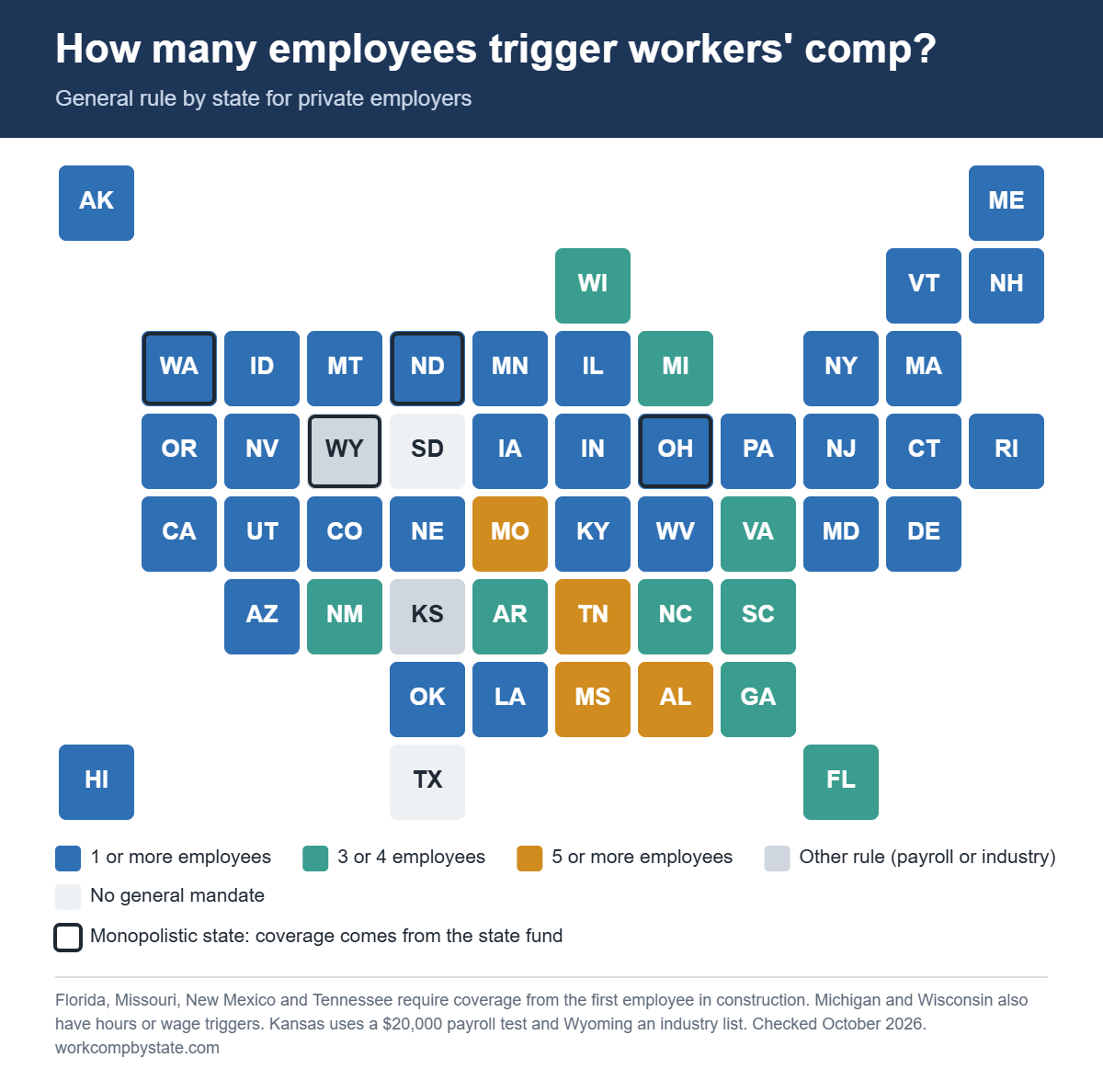
The 50-state table
| State | Who must have coverage | Market | Worth knowing |
|---|---|---|---|
| Alabama | 5 or more employees | Competitive | |
| Alaska | 1 or more employees | Competitive | |
| Arizona | 1 or more employees | Competitive | Former state fund became CopperPoint Mutual in 2013. Arizona guide |
| Arkansas | 3 or more employees | Competitive | Construction rules differ; confirm with the state commission |
| California | 1 or more employees | Competitive | Stop orders and misdemeanor charges. California guide |
| Colorado | 1 or more employees | Competitive | 10% owners can reject coverage by form. Colorado guide |
| Connecticut | 1 or more employees | Competitive | |
| Delaware | 1 or more employees | Competitive | |
| Florida | 4 or more employees; 1 in construction | Competitive | Stop-work orders within 72 hours. Florida guide |
| Georgia | 3 or more employees | Competitive | Officers and LLC members count. Georgia guide |
| Hawaii | 1 or more employees | Competitive | |
| Idaho | 1 or more employees | Competitive | |
| Illinois | 1 or more employees | Competitive | $500 a day penalty, $10,000 minimum. Illinois guide |
| Indiana | 1 or more employees | Competitive | Officers covered unless they opt out; LLC members only if they opt in. Indiana guide |
| Iowa | 1 or more employees | Competitive | |
| Kansas | Gross annual payroll over $20,000 | Competitive | Payroll trigger, not headcount |
| Kentucky | 1 or more employees | Competitive | |
| Louisiana | 1 or more employees | Competitive | |
| Maine | 1 or more employees | Competitive | Limited farm exceptions |
| Maryland | 1 or more employees | Competitive | |
| Massachusetts | 1 or more employees | Competitive | Domestic workers covered at 16 hours a week. Massachusetts guide |
| Michigan | 3 or more, or 1 working 35+ hours a week for 13 weeks | Competitive | Second trigger catches one-employee businesses. Michigan guide |
| Minnesota | 1 or more employees | Competitive | |
| Mississippi | 5 or more employees | Competitive | |
| Missouri | 5 or more employees; 1 in construction | Competitive | Family members count. Missouri guide |
| Montana | 1 or more employees | Competitive | |
| Nebraska | 1 or more employees | Competitive | Separate rules for farm employers |
| Nevada | 1 or more employees | Competitive | Formerly monopolistic, now competitive |
| New Hampshire | 1 or more employees | Competitive | |
| New Jersey | 1 or more non-owner workers | Competitive | $5,000 per 10-day period penalties. New Jersey guide |
| New Mexico | 3 or more employees; 1 in construction | Competitive | |
| New York | 1 or more employees | Competitive | Disability and paid family leave too. New York guide |
| North Carolina | 3 or more employees | Competitive | Officers count; subcontractor certificates. North Carolina guide |
| North Dakota | 1 or more employees | Monopolistic | Monopolistic |
| Ohio | 1 or more employees | Monopolistic | Monopolistic. Ohio guide |
| Oklahoma | 1 or more employees | Competitive | |
| Oregon | 1 or more subject workers | Competitive | |
| Pennsylvania | 1 or more employees | Competitive | Per-day misdemeanor and felony charges. Pennsylvania guide |
| Rhode Island | 1 or more employees | Competitive | |
| South Carolina | 4 or more employees | Competitive | Employers under $3,000 in annual payroll exempt |
| South Dakota | No mandate | Optional | Uninsured employers can be sued in civil court |
| Tennessee | 5 or more employees; 1 in construction | Competitive | Construction owners must cover themselves or get an exemption. Tennessee guide |
| Texas | No mandate | Optional | Nonsubscribers lose key lawsuit defenses. Texas guide |
| Utah | 1 or more employees | Competitive | |
| Vermont | 1 or more employees | Competitive | |
| Virginia | 3 or more employees | Competitive | Farms: more than 3 full-time. Virginia guide |
| Washington | 1 or more employees | Monopolistic | Monopolistic; premiums per hour worked. Washington guide |
| West Virginia | 1 or more employees | Competitive | Formerly monopolistic, privatized in 2006 |
| Wisconsin | 3 or more, or $500 in wages in a quarter | Competitive | Strict nine-part contractor test. Wisconsin guide |
| Wyoming | Set by industry (extrahazardous list) | Monopolistic | Monopolistic; coverage depends on industry, not headcount |
The four monopolistic states
North Dakota, Ohio, Washington and Wyoming sell workers’ comp only through the state. Private carriers cannot write standard policies there. Washington, for example, gives employers exactly two options under RCW 51.14.010: insure with the state fund or qualify as a self-insurer. Washington also prices by the hour worked, not by payroll. If you operate in one of these states, a multistate policy from a private carrier will not cover your employees there. Our comparison of state funds and private insurers explains the differences.
Nevada and West Virginia used to be monopolistic and are now competitive. Older lists sometimes still include them.
The two states without a mandate
Texas and South Dakota do not require private employers to carry workers’ comp. South Dakota’s Department of Labor and Regulation says plainly that no law requires any employer to carry it, while recommending it and warning that an uninsured employer may be sued in civil court. Texas has a formal system for employers who opt out, called nonsubscribers, with its own filing and notice duties. Our Texas nonsubscriber guide covers how that works and what it costs employers who choose it.
States that do not count heads
Most rows in the table reduce to a number of employees. Four do not:
- Kansas uses payroll. The requirement applies once gross annual payroll passes $20,000, which two moderately paid employees can reach.
- Michigan adds an hours test. A business with fewer than three employees is still covered once one employee has worked 35 or more hours a week for 13 weeks in the past year.
- Wisconsin adds a wage test. Paying $500 or more in wages in any quarter brings a business under the law on the 10th day of the next quarter, even with one employee.
- Wyoming uses industry. Coverage is mandatory for employers in occupations the law lists as extrahazardous, regardless of headcount.
Construction usually means employee number one
Several states with a higher general threshold drop it to one employee for construction. Florida (4 generally), Missouri (5), Tennessee (5) and New Mexico (3) all follow that pattern. Tennessee goes further and expects construction business owners to cover themselves unless they obtain an exemption. If you run a trades business, check your state’s construction rule before relying on the general number. Our guide to workers’ comp for construction companies covers the industry-wide issues, including subcontractor liability.
What the table cannot tell you
Thresholds are only the first question. Three others decide most real cases:
- Who counts. Georgia and North Carolina count corporate officers. Missouri counts family members. Tennessee counts part-timers and minors. Two businesses with the same payroll can land on different sides of the line.
- Who is a contractor. Wisconsin requires a worker to meet nine conditions to be a contractor. Colorado presumes an employee unless two tests are met. Tennessee weighs seven factors. A 1099 settles nothing.
- Who is liable for your subs. Many states make a general contractor responsible for an uninsured subcontractor’s injured workers. North Carolina applies this even when the sub has fewer than three employees.
How this table was checked
The 20 states with full guides on this site were each checked against the state’s statutes and agency pages; those guides list their sources. For the other 30 states, the table reflects each state’s general rule as published by its workers’ compensation agency. Thresholds and exceptions change, so treat this page as a starting point and confirm your own state’s current rule with its agency or a licensed agent, especially if you are close to a threshold.
Frequently asked questions
Which states require coverage with one employee?
Most of them. Of the 48 states with a mandate, the majority apply it at the first employee. The exceptions in the table are the states with a higher headcount, Kansas with its payroll test, and Wyoming with its industry test.
If my state does not require coverage, should I skip it?
Not without thinking it through. An uninsured employer generally loses the protection that workers’ comp gives against injury lawsuits. In South Dakota, the state itself warns that an uninsured employer may be sued in civil court.
I have employees in two states. Which rule applies?
Usually the rules of each state where employees work. Your policy must list each state where you have employees, and monopolistic states need their own state fund coverage.
Related guides
- Is workers’ comp legally required for small businesses?
- Penalties for not carrying workers’ comp by state
- Workers’ comp exemptions: who doesn’t need coverage
- State fund vs private insurer
Sources
- South Dakota Department of Labor and Regulation, workers’ compensation
- RCW 51.14.010, Washington state fund requirement
- Wisconsin DWD, insurance requirements
- MCL 418.115, Michigan employers subject to the Act
- Tennessee Bureau of Workers’ Compensation, who must carry insurance
- RSMo 287.030, Missouri employer definition
Last checked against the sources above and the linked state guides on October 2, 2026.