
North Carolina Workers’ Compensation Requirements for Employers
North Carolina sets its line at three employees. That sounds simple, and for a lot of small businesses it is. The trouble starts with the details: who counts as an employee, what happens when you hire a subcontractor, and how quickly the daily penalty adds up if you guess wrong. This guide answers the questions owners in North Carolina actually ask, with the statute behind each answer.
Do I need workers’ comp in North Carolina?
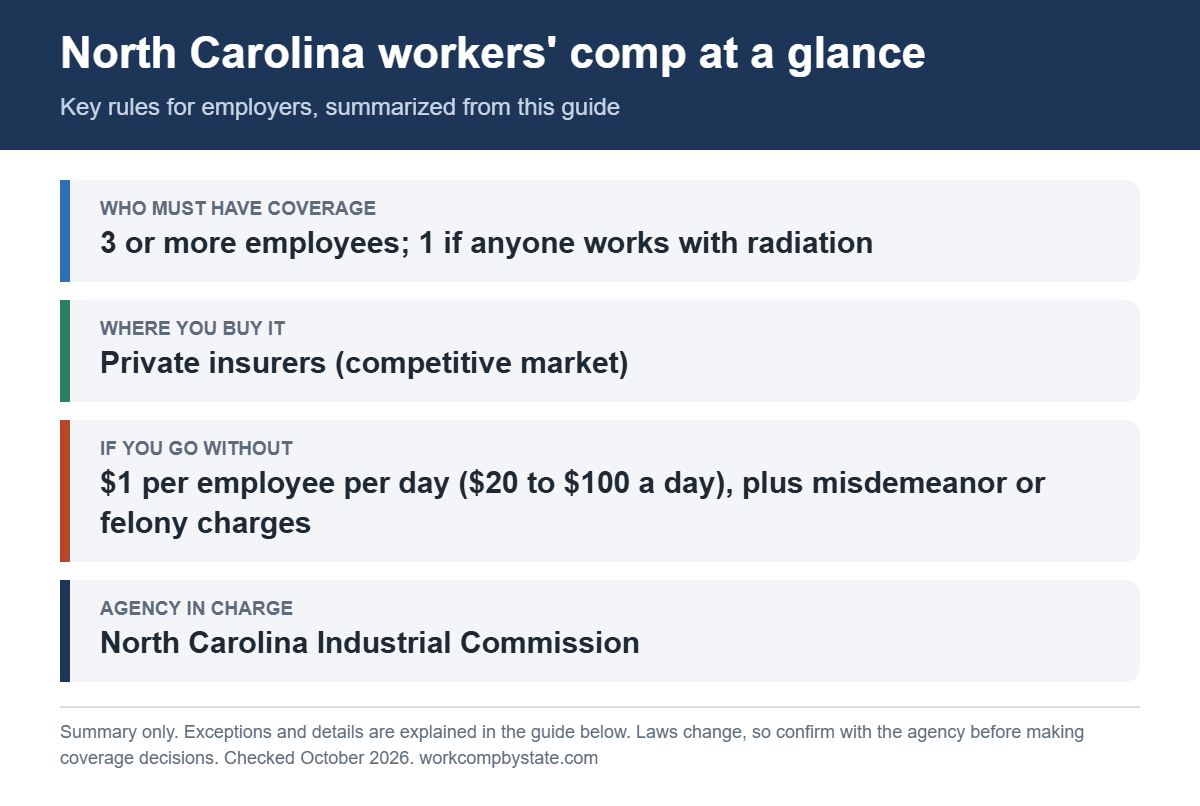
You do if three or more employees are “regularly employed” in your business. That phrase comes from the definition of employment in G.S. 97-2(1). The Industrial Commission puts it plainly on its employer page: all businesses employing three or more employees on a regular basis are covered by the Act.
“Regularly” matters. A business that keeps three people on the schedule week after week is covered, even if one of them works only part time. A business that hires a third person for a single afternoon to help move inventory is in a grayer spot. If your headcount routinely touches three, treat yourself as covered.
There is one exception that runs the other way. If even one employee works with radiation or in its presence, coverage is required with one employee. That mostly affects dental offices, imaging centers and some labs.
Do corporate officers count toward the three?
Yes. The Commission says corporate officers are counted when deciding whether a corporation has three or more employees. So a small corporation with two officers and one hourly worker has three employees for this purpose.
Officers can be excluded from the policy itself. G.S. 97-2(1) allows executive officers to be left out of coverage through the insurance contract. Being excluded from the policy and being excluded from the headcount are two different things. The officer still counts. The policy just doesn’t pay that officer’s claims.
What about sole proprietors, partners and LLC members?
A sole proprietor, a partner, or a member of a limited liability company is not automatically covered. The statute lets each of them elect coverage for themselves if they are actively engaged in the business and the insurer is notified. That election is optional. It does not change your obligation to cover your employees once you have three.
Many one-person contractors buy a policy anyway because general contractors ask for a certificate before they will hire them. That brings us to the biggest trap in the state.
I hire subcontractors. What is my exposure?
G.S. 97-19 makes a contractor who sublets work liable for injuries to the subcontractor’s employees unless the contractor got a certificate of insurance from the sub. The certificate must come from a workers’ compensation carrier (or from the Department of Insurance) and show that the sub complied with G.S. 97-93 for a specified term.
The key line in the statute is that the contractor becomes liable “irrespective of whether such subcontractor has regularly in service fewer than three employees.” In other words, the three-employee rule does not protect you here. A two-person framing crew with no policy can put its injury claims on your policy.
There is a partial safety valve. If the sub actually had an active policy on the date of injury, you are not liable even if you never collected the certificate. You should not rely on that. Collect the certificate before work starts, check the dates, and keep it with the job file. If you do end up paying, the statute lets you recover what you paid from whoever was liable in the first place.
Trucking has its own rule. The Commission notes that coverage must be in place for certain trucking arrangements regardless of whether any of the contractors in the chain regularly employs three or more people.
Are farms and household employers covered?
Agricultural work and domestic service are excluded from the definition of employment, with one major exception for farms. A farm that regularly employs 10 or more full-time, non-seasonal agricultural workers must carry coverage. Seasonal pickers do not count toward that 10.
Casual employment that is not part of your usual trade or business is also excluded. A dentist who pays someone once to paint the office fence is not suddenly an employer under the Act for that job.
How do I comply?
G.S. 97-93 gives you two routes:
- Buy a policy from a carrier authorized in North Carolina. Most small employers do this. If no carrier will write you, the residual market (the assigned risk plan) is the fallback.
- Self-insure, either alone or through a group, with approval from the Commissioner of Insurance. This is realistic only for larger, financially stable employers.
Once you are covered, post the Commission’s workplace notice (Form 17) where employees can see it. The statute also requires you to take the notice down within five working days if your coverage ends.
What happens if I don’t have coverage?
The penalties are in G.S. 97-94 and they stack.
- Daily civil penalty. $1 per employee per day, with a minimum of $20 and a maximum of $100 for each day you go without coverage. The Commission’s Compliance Division investigates referrals and assesses this penalty for the whole period you were out of compliance.
- Alternative calculation. A first-time violator who gets insured and hands over payroll records can ask the Commission to replace the daily penalty with the cost of the policy you should have had for the average number of employees, plus 10%.
- Criminal charges. Neglecting to get coverage is a Class 1 misdemeanor. Willfully failing to get it is a Class H felony.
- Personal liability. Any person with the ability and authority to bring the business into compliance who willfully fails to do so can also be charged with a Class H felony. That reaches owners and officers personally.
On top of all that, an injured employee still gets benefits, and you can be ordered to pay them yourself.
A quick example
A landscaping company in Raleigh has an owner, two full-time crew members and one part-timer who works every Saturday. That is three regular employees, not counting the owner as a sole proprietor. The owner lets the policy lapse for 120 days during the slow season. The daily penalty alone is $20 a day (three employees at $1 each is below the $20 floor), so $2,400. If a crew member is hurt during that window, the owner also faces the medical bills and wage benefits directly, plus possible misdemeanor charges.
When an employee gets hurt
Under G.S. 97-92, you must report an injury to the Commission on Form 19 within five days of learning about it if the worker misses more than one day or medical charges pass the amount the Commission sets. The penalty for skipping the report is $5 to $25 per failure. Small, but it signals a sloppy file to the Commission.
Your employee has a deadline too. G.S. 97-22 requires written notice of the accident within 30 days. Encourage prompt reports. Late notice causes disputes that help nobody.
Checking someone else’s coverage
Before you sign with a sub, or if you want to confirm your own policy shows up correctly, use the Commission’s online coverage search. It lists policies reported by carriers. If a sub’s name is not there, ask questions before work starts.
Related guides
- Penalties for not having workers’ comp, state by state
- How to read a certificate of insurance
- Workers’ comp for construction companies
- Workers’ comp for landscaping businesses
- Georgia workers’ comp requirements
Sources
- N.C. Gen. Stat. 97-2, definitions
- N.C. Gen. Stat. 97-19, subcontractor liability
- N.C. Gen. Stat. 97-94, penalties
- NC Industrial Commission, information for employers
- NC Industrial Commission, Compliance Division
Last checked against the sources above on October 2, 2026. Laws change, so confirm with the Industrial Commission or a licensed agent before making coverage decisions.