
Workers’ Comp for Construction Companies: Thresholds and Subcontractor Liability
Construction gets its own rules in workers’ comp. States that let a shop or office wait until it has three, four or five employees often require a construction business to be covered from its first employee. And construction has a risk most other industries don’t: if you hire a subcontractor who has no coverage, the law in many states makes you responsible for that sub’s injured workers.
This guide covers both problems, the threshold and the sub, then explains how premiums and bidding fit in.
Part 1: The construction threshold is usually lower
Here is how a few states treat construction compared with other businesses. All figures come from the statute or state agency linked in the Sources.
| State | Construction | Most other businesses |
|---|---|---|
| Florida | 1 or more employees | 4 or more |
| Missouri | 1 or more (work that erects, demolishes, alters or repairs improvements) | 5 or more |
| Tennessee | 1 or more, counting part-time, seasonal, family and “as needed” workers | 5 or more |
| North Carolina | 3 or more regularly employed, but a contractor can be liable for a smaller sub’s workers (see Part 2) | 3 or more |
Tennessee goes further than most. Owners of construction businesses there must cover themselves unless they apply for and receive an exemption, and the exemption covers only the named person. Out-of-state construction companies working in Tennessee need a Tennessee policy from the first day of work.
Florida’s statute is blunt about it: section 440.10 says any contractor or subcontractor engaged in public or private construction in the state shall secure and maintain compensation for its employees. Florida’s definitions in construction are also broad enough to pull in many people other states would call independent contractors; see our Florida guide.
If your state is not listed, check the 50-state comparison table and your state guide. Don’t assume the general threshold applies to construction.
Part 2: How you become liable for a subcontractor’s workers
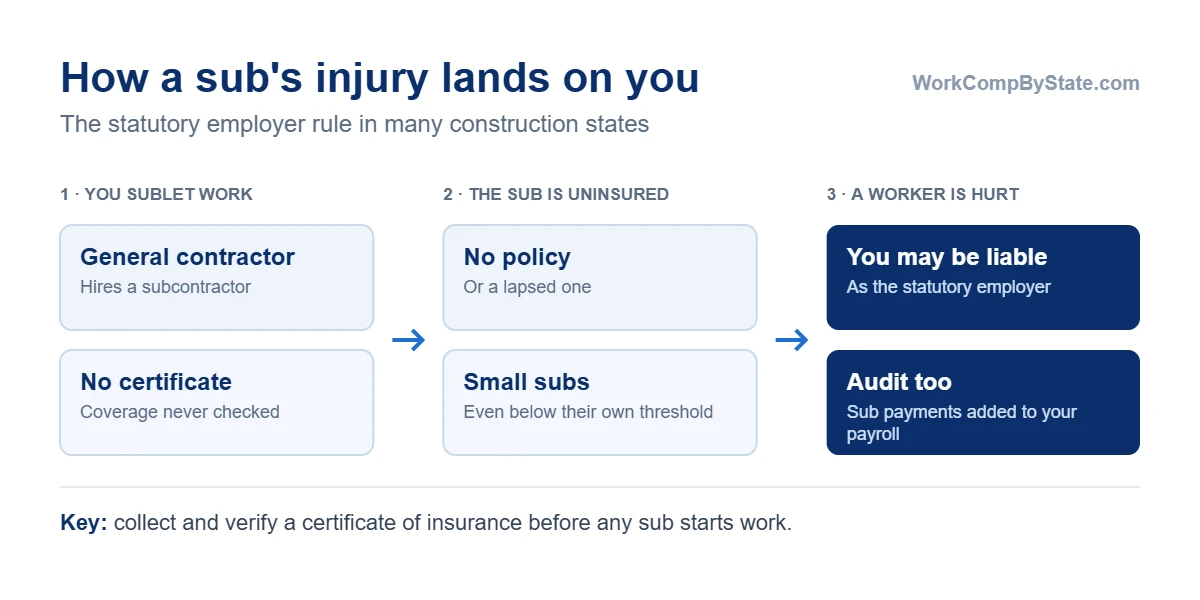
Many states treat a general contractor as the “statutory employer” of an uninsured sub’s employees. The logic: the injured worker has to be covered by somebody, and the contractor up the chain was in the best position to check. Here is how the rule reads in four states.
Florida
Under section 440.10, when a contractor sublets part of its contract work, all employees of the contractor and its subs on that work are treated as employed in one business, and the contractor is liable for compensation to all of them, except employees of a sub who has secured coverage. The statute also says a contractor shall require subcontractors to provide evidence of workers’ comp insurance. If the contractor ends up paying for an uninsured sub’s worker, it can try to recover the cost from the sub, unless they agreed in writing that the contractor would provide coverage.
North Carolina
G.S. 97-19 applies when a contractor sublets work without obtaining a certificate showing the sub has coverage. The contractor becomes liable for the sub’s injured employees, and this applies even if the sub has fewer than three employees and would not otherwise need a policy. The certificate is the contractor’s protection.
Indiana
Indiana sets a dollar trigger. Under IC 22-3-2-14, if you contract out work worth more than $1,000 and do not get a certificate from the Workers’ Compensation Board showing that the contractor has complied, you are liable for compensation to that contractor’s injured employees. Indiana independent contractors can obtain a certificate of exemption from the Board, so ask for that document when a sub says it has no employees.
Missouri
RSMo 287.040 makes a business the statutory employer of workers doing work under contract on or about its premises in the usual course of its business. The same section says the rule does not apply to owners of premises who are having improvements built by an independent contractor. In practice, a homeowner hiring a remodeler is usually outside the rule, while a builder subcontracting framing on its own project is inside it.
A worked example: one uninsured sub
The numbers here are hypothetical and only show how the pieces connect.
A small general contractor in North Carolina hires a two-person drywall crew for a $40,000 job. The drywall owner says he is “covered” but never sends a certificate. One of his workers falls from a scaffold and breaks a leg.
- Because the crew has only two employees, the drywall company itself may not have been required to carry coverage.
- Because the GC sublet the work without obtaining a certificate, G.S. 97-19 makes the GC liable for the injured worker’s benefits.
- The claim lands on the GC’s policy (or on the GC directly if its own coverage is missing). It can raise the GC’s experience mod for years.
- At the GC’s year-end audit, the carrier may also charge premium on the uninsured sub’s labor as if it were the GC’s own payroll. If $25,000 of the $40,000 job was labor and the drywall rate were $6.00 per $100 of payroll (an illustrative rate), that is an extra $1,500 of premium ($25,000 / 100 x $6.00), on top of the claim.
The fix would have cost five minutes: get the certificate before the crew started and verify it with the carrier or state database.
Your subcontractor checklist
- Get a current certificate of insurance before any sub starts work. See certificates of insurance.
- Verify it independently. Florida’s Division of Workers’ Compensation has an online coverage and exemption lookup; many states have one.
- Check that the policy dates cover the whole job and that the state where you are working is listed.
- If the sub claims an exemption, get a copy of the actual exemption certificate. In Tennessee, an owner’s exemption does not cover any helper they bring.
- Calendar expiration dates and ask for renewals before they lapse.
- Keep certificates with your audit records. Auditors ask for them.
- Put an insurance clause in every subcontract requiring continuous coverage.
Part 3: Premiums, class codes and the bid
Construction premiums are higher because the work is riskier. Rates are set per $100 of payroll for each class code, and riskier work such as roofing carries higher rates. Tennessee’s Bureau notes that the governing class is the one with the most payroll. Many construction businesses have more than one class code, and putting all payroll in the cheapest one is a common audit problem. See how premiums are calculated.
Your experience modification rate also matters more in construction than almost anywhere else, because many general contractors and project owners check it when they prequalify subs. A mod above 1.0 means your losses have been worse than expected for a business your size, and it can cost you bids, not just premium. More in the EMR guide.
On large projects, the owner or general contractor may run a wrap-up program (OCIP or CCIP) that covers workers on that site. You still need your own policy for work outside the wrap-up, so read the enrollment terms closely.
Penalties in construction states
Skipping coverage in construction is expensive. Penalties in these states range from daily fines to multiples of the premium you should have paid, criminal charges and stop-work orders that shut down every job site at once. Each of our state guides (Florida, Missouri, Tennessee, North Carolina, Indiana) lists the exact penalties with sources, and penalties by state compares them.
Related guides
- Workers’ comp for roofing contractors
- Workers’ comp for electricians and plumbers
- Independent contractors and their own coverage
- Certificates of insurance explained
- Experience modification rate (EMR)
Sources
- Florida Statutes 440.10, liability for compensation (contractors and subcontractors)
- North Carolina G.S. 97-19, subcontractor liability
- Indiana Code 22-3-2-14, contractor certificates
- RSMo 287.040, Missouri statutory employer
- RSMo 287.030, Missouri employer definition
- Tennessee BWC, construction requirements
Last checked against the sources above on October 2, 2026.