
Penalties for Not Carrying Workers’ Comp Insurance, by State
Going without required workers’ comp is one of the more expensive mistakes a small business can make, and the cost does not come from one place. States combine fines, orders that shut the business down, criminal charges, and personal liability for owners. Then there is the injury itself, which the business pays for directly. This page compares the penalties in the 20 states we cover in depth, explains the patterns, and shows what a real gap in coverage can cost.
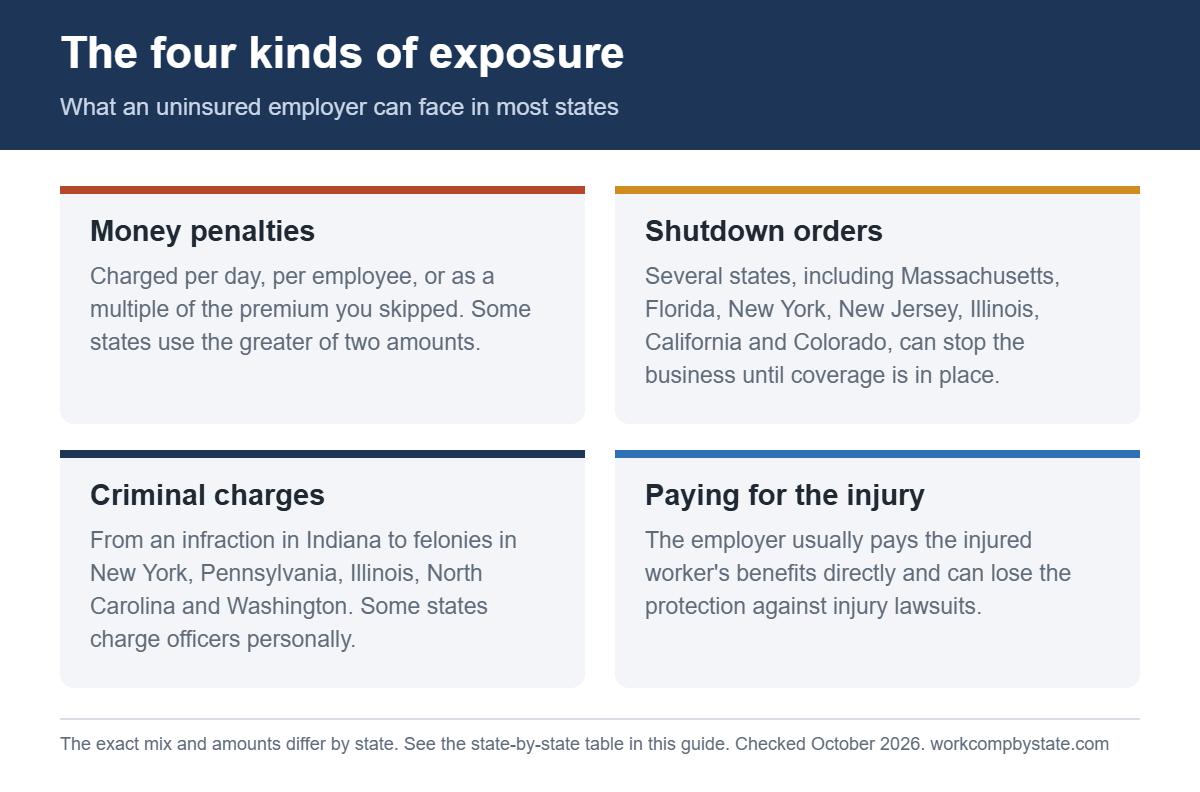
The four kinds of exposure
Almost every state uses some mix of the same tools:
- Money penalties. Some states charge per day, some per employee, some a multiple of the premium you skipped. A few use the greater of two numbers so that small businesses cannot get off cheaply.
- Shutdown orders. Massachusetts, Florida, New York, New Jersey, Illinois, California and Colorado can stop a business from operating until it gets coverage. In Massachusetts the order takes effect immediately.
- Criminal charges. These range from an infraction in Indiana to felonies in New York, Pennsylvania, Illinois, North Carolina and Washington. Several states charge officers personally.
- Liability for the injury. An uninsured employer typically pays the worker’s benefits directly and often loses the protection workers’ comp gives against injury lawsuits.
Penalties in 20 states
Each row is based on the statutes and agency guidance cited in that state’s full guide, linked in the first column. Amounts are the general rule for a business with no required coverage. Each guide explains exceptions and repeat-offense rules.
| State | Money penalty | Shutdown power | Criminal and other exposure |
|---|---|---|---|
| Arizona | $1,000 first violation, $5,000 second, $10,000 third; plus 10% of the claim (at least $1,000) to the Special Fund | Court injunction available | Injured worker can sue without the usual defenses |
| California | Greater of $1,500 per employee or twice the avoided premium | Stop order; workers get up to 10 days of pay | Misdemeanor, minimum $10,000 fine, up to 1 year |
| Colorado | Up to $250 a day; $250 to $500 a day for repeat violations | Cease and desist order | 25% of benefits owed paid to the Uninsured Employer Fund |
| Florida | Twice the premium you should have paid for the prior 12 months, or $1,000 | Stop-work order within 72 hours | Conditional release with $1,000 down |
| Georgia | $500 to $5,000 per occurrence | Not in statute | Misdemeanor, $1,000 to $10,000 and up to 12 months; 10% increase in benefits owed |
| Illinois | $500 a day, $10,000 minimum; repeat $1,000 a day, $20,000 minimum | Work-stop order | Class A misdemeanor; Class 4 felony if knowing |
| Indiana | Up to $10,000 (Class A infraction); $100 a day if proof of coverage is not provided | Order to cease business until insured | Board can refer to a county prosecutor |
| Massachusetts | At least $100 a day; $250 a day if you appeal | Stop work order effective immediately | Up to $1,500 and 1 year; 3-year public contract debarment |
| Michigan | Fine up to $1,000 | Not in statute | Misdemeanor, up to 6 months; officers and directors personally liable |
| Missouri | Up to 3 times the annual premium or up to $50,000, whichever is greater | Not in statute | Class A misdemeanor; class E felony on repeat |
| New Jersey | Up to $5,000 per 10-day period | Stop-work order; $1,000 to $5,000 a day for violating it | Disorderly persons offense; fourth-degree crime if knowing |
| New York | Up to $2,000 per 10 days, or twice the cost of coverage | Stop-work order | Misdemeanor (5 or fewer employees) or class E felony (more than 5) |
| North Carolina | $1 per employee per day, minimum $20, maximum $100 a day | Not in statute | Class 1 misdemeanor; Class H felony if willful, including for responsible individuals |
| Ohio | State fund pays the injured worker and recovers from the employer | Not in statute | Injured worker can sue without the usual defenses |
| Pennsylvania | Up to $2,500 a day (misdemeanor) or $15,000 a day (felony) | Not in statute | Each day can be a separate offense, up to 1 or 7 years per day |
| Tennessee | Up to 1.5 times the estimated annual premium | Not in statute | Uninsured Employers Fund pays workers at most $40,000 |
| Texas | No coverage mandate | None | Nonsubscribers lose key defenses in injury lawsuits |
| Virginia | Up to $250 a day, maximum $50,000 | Cease and desist after 15 days’ notice | Penalty split with the Uninsured Employer’s Fund |
| Washington | Billed for unreported coverage | Not in statute | Gross misdemeanor; class C felony after revocation; public works bidding ban |
| Wisconsin | Twice the premium owed or $750, plus $100 a day for up to 7 days | Business can be ordered closed | Owner can be personally liable for benefits |
Patterns worth noticing
Penalties that scale with your size
Several states tie the penalty to what you avoided paying. Missouri can charge up to three times the annual premium, Florida twice the premium for the prior year, Wisconsin twice the premium owed, and Tennessee up to one and a half times the estimated annual premium. Each sets a floor, such as $50,000 in Missouri or $1,000 in Florida, so a very small business still faces a real number.
Penalties that grow every day
Other states make time the enemy. Illinois charges $500 a day with a $10,000 minimum. Virginia charges up to $250 a day up to $50,000. Pennsylvania treats each day without coverage as a separate offense, which is why its numbers look extreme on paper. New Jersey counts in ten-day blocks of up to $5,000 each.
Penalties aimed at people, not companies
Michigan makes officers and directors of a noncompliant corporation personally liable. North Carolina can charge any person who had the authority to get coverage and willfully did not. Washington charges officers who allow the company to operate without coverage. Massachusetts names the president and treasurer. Forming a corporation does not keep the owner out of it.
The cost of the injury itself
Fines are usually the smaller number. When an employee is hurt and there is no policy, the employer owes the benefits the insurer would have paid: medical bills, wage replacement and, in serious cases, permanent disability.
The lawsuit risk is worse. In states like Arizona, Ohio and Missouri, an injured worker of an uninsured employer can sue in court, and the employer cannot rely on defenses like the worker’s own negligence or a co-worker’s fault. Texas applies the same rule to employers who choose not to carry coverage. A single serious injury can produce a verdict well beyond any fine.
State uninsured employer funds do not protect the business. They exist to help the worker, and they come after the employer for what they pay. Tennessee’s fund, for example, caps payments to a worker at $40,000 in total, and the employer stays liable for the claim.
Example: a 90-day gap in two states
A small roofing company with six employees lets its policy lapse for 90 days while changing agents.
- In Illinois, the daily penalty alone is $500 a day, so $45,000, which is above the $10,000 minimum. The state can also issue a work-stop order, and a knowing failure can be charged as a felony.
- In Massachusetts, an investigator who finds the gap issues a stop work order on the spot. The company is closed until it binds coverage and pays at least $100 for each day. It is also barred from state and municipal contracts for three years.
If a roofer falls during the gap, either company pays the medical and wage benefits directly on top of the penalties.
If you discover a gap
- Bind coverage immediately. Every state on this page counts penalties by day or period, so the fastest fix is the cheapest one.
- Ask your agent whether the new policy can start on the date the old one ended. That is not always possible, but when it is, it closes the gap.
- If anyone was hurt during the gap, talk to a workers’ comp attorney before responding to the claim.
- Keep proof of the new policy where you work. In states with on-site investigators, showing it quickly matters.
States not in the table
The other 30 states also penalize employers who skip required coverage, with their own mix of fines, injunctions and criminal charges. Because we have not yet published a full, source-checked guide for them, we do not list their penalties here. Check your state’s workers’ compensation agency directly. South Dakota, like Texas, does not require coverage at all, though its labor department warns that uninsured employers can be sued in civil court.
Frequently asked questions
Can I be charged with a crime for not having workers’ comp?
In many states, yes. Among the states above, New York, Pennsylvania, Illinois, North Carolina and Washington can treat it as a felony in some circumstances, and most of the others as a misdemeanor.
Does a lapse count the same as never having a policy?
Yes. A day without coverage is a day without coverage. Massachusetts, New Jersey and Wisconsin all treat lapses the same as never insuring.
What if I misclassified workers as contractors?
Several states treat that as failing to insure. New Jersey can issue a stop-work order specifically for misrepresenting employees as contractors, and Tennessee applies its 1.5 times premium penalty to misclassification too.
Related guides
- What happens if you don’t have workers’ comp?
- Workers’ comp requirements in all 50 states
- Workers’ comp and 1099 workers
- Is workers’ comp legally required for small businesses?
Sources
Each state’s penalties are sourced in its linked guide. Additional sources for this page:
- Massachusetts DIA, stop work orders and fines
- RSMo 287.128, Missouri penalties
- Tennessee Uninsured Employers Fund
- Wisconsin DWD, insurance requirements and penalties
- South Dakota Department of Labor and Regulation
Last checked against the sources above and the linked state guides on October 2, 2026. Penalties change, so confirm with your state agency or an attorney before acting.