
Massachusetts Workers’ Comp Requirements: What Employers Owe, and What a Stop Work Order Looks Like
Massachusetts makes the coverage question easy and the enforcement hard. Every employer with an employee needs workers’ compensation. There is no small-business threshold. Where owners get into trouble is the enforcement side, because the state can shut a business down the same day an investigator finds no policy. This guide covers who must be insured, who is exempt, and then walks through a stop work order step by step.
Who needs coverage
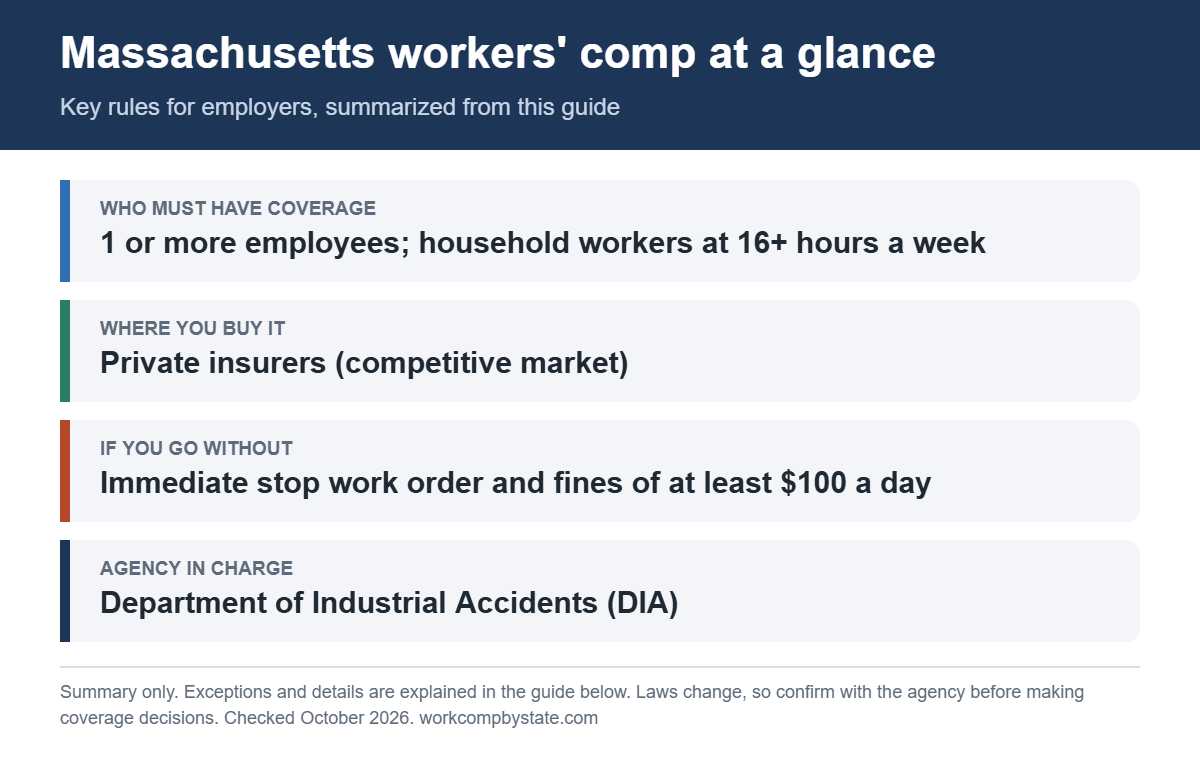
The Department of Industrial Accidents (DIA) says it plainly: all employers operating in Massachusetts are required to carry workers’ compensation insurance for their employees, and for themselves if they are employees of their own company. One part-time employee is enough. So is a single seasonal worker.
The one exception the DIA lists is for domestic employees in a private home. They are covered only if they work at least 16 hours a week. A housekeeper who comes in for four hours on Fridays is outside the requirement. A nanny who works 30 hours a week is inside it, and the family that employs her needs a policy.
Owners: who can leave themselves off
Owners are treated differently depending on how the business is set up:
- Sole proprietors of unincorporated businesses do not have to cover themselves.
- Partners in a limited liability partnership do not have to cover themselves.
- LLC members do not have to cover themselves.
- Corporate officers who own at least 25% of the corporation can request an exemption. An officer who owns less than that is an employee of the corporation and must be covered.
None of these exemptions extends to anyone else. The DIA is explicit that workers who are not members of the LLC or LLP, or who are not exempt officers, must still be covered. An LLC with two members and one employee needs a policy for the employee.
How you can comply
Chapter 152, section 25A gives employers three options. You can buy insurance from a carrier, join a workers’ compensation self-insurance group, or obtain an annual self-insurer license from the DIA. Most small businesses buy a policy. If carriers decline you, an agent can place you in the state’s assigned risk pool.
Anatomy of a stop work order
Massachusetts uses stop work orders more aggressively than most states. Here is how one unfolds under Chapter 152, section 25C, and the DIA’s guidance.
Day 1: The order is served
A DIA investigator finds that your business has employees and no coverage. A stop work order is served on the employer, requiring all business operations to stop. It takes effect immediately. That means the job site closes, the restaurant locks its doors, or the shop sends everyone home.
The fine starts running
The fine is at least $100 per day, including weekends and holidays, starting the day the order was issued. Waiting until Monday to call an agent costs you for Saturday and Sunday too.
Your employees still get paid
Section 25C says any employee affected by a stop work order must be paid for the first ten days lost. Your workers are not the ones who carry the cost of your missing policy.
Getting back to work
If you do not appeal, the business stays closed until you give the DIA proof of coverage and pay the fines, which keep accruing until both are done. If you appeal, the business can stay open, but the fine rises to $250 per day, and the commissioner or a designee must hold a hearing within fourteen days of receiving the appeal. Appeal only if you have a real argument, such as proof that you had coverage all along.
The longer tail
The order is only the start. Section 25C also provides:
- Debarment. An employer issued a stop work order is immediately barred from bidding on or participating in any state or municipally funded contract for three years.
- Criminal penalties. Failing to provide coverage can be punished by a fine of up to $1,500, up to one year in prison, or both.
- Personal liability. If the employer is a corporation, the president, the treasurer or both can be held liable for that punishment.
On top of all of that, an employee hurt while you were uninsured is still entitled to benefits, and you can be required to pay them.
Example: a two-person landscaping company
Two friends form an LLC to do landscaping in Worcester County. Both are members, so neither must cover himself. In April they hire a helper for the season. From his first day they need a policy. They forget, and in June an investigator visits a job site. The stop work order closes them that afternoon. If they find a carrier and bind coverage in four days, they owe at least $400 in fines, must pay the helper for the days lost, and are barred from municipal contracts for three years. The town parks contract they had planned to bid on in the fall is gone.
Practical tips
- Bind coverage before the first employee’s first shift. Not after the first paycheck.
- If you are a corporate officer who owns 25% or more and wants to be excluded, request the exemption through the proper process. Do not just leave yourself off the payroll report.
- Household employers: track weekly hours for nannies, caregivers and housekeepers. At 16 hours a week, coverage is required.
- Calendar your renewal date. A lapse is treated the same as never having insurance.
- Keep a copy of your policy declarations page where you work. If an investigator visits, you can show it on the spot.
Related guides
- Workers’ comp for a one-person LLC
- Family members and workers’ comp
- Workers’ comp for landscaping businesses
- Penalties for not having workers’ comp by state
- New York workers’ comp requirements
Sources
- Massachusetts DIA, workers’ compensation insurance requirements
- M.G.L. c. 152, § 25A, methods of providing coverage
- M.G.L. c. 152, § 25C, penalties and stop work orders
Last checked against the sources above on October 2, 2026. Laws change, so confirm with the Department of Industrial Accidents or a licensed agent before making coverage decisions.