
Colorado Workers’ Comp Requirements for Employers
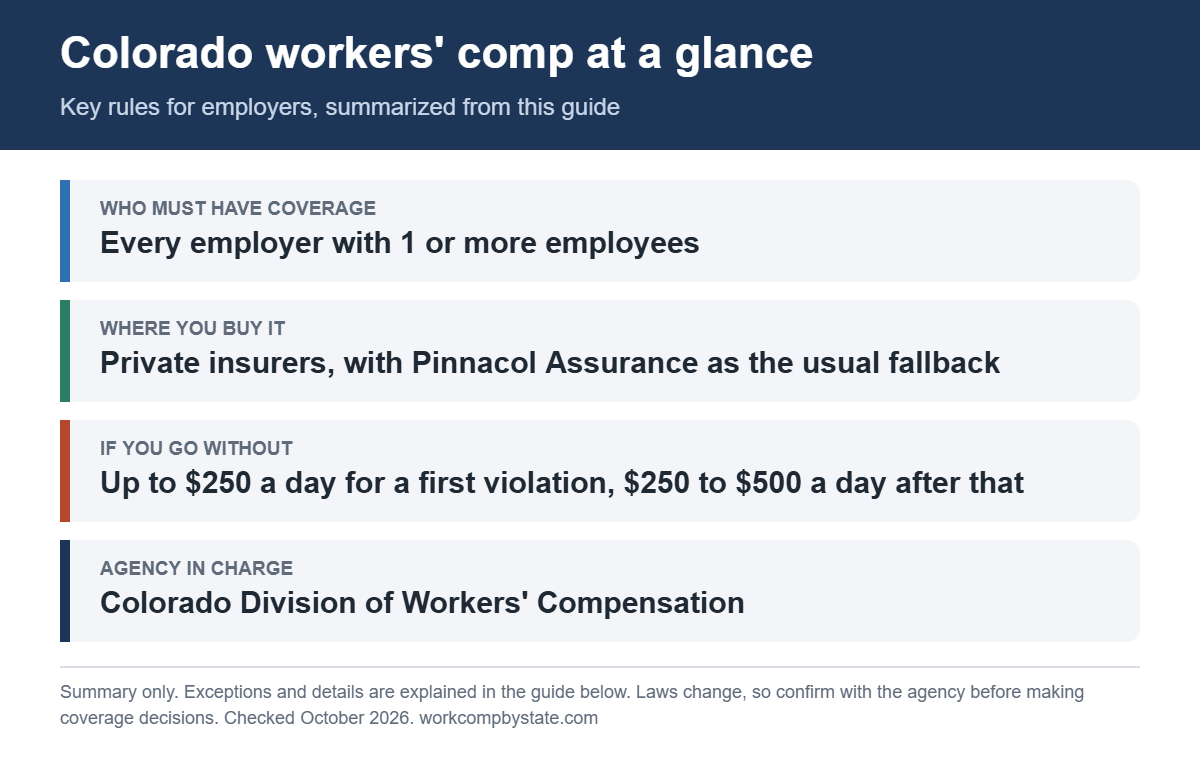
Colorado’s rule is short. If you have an employee, you need workers’ compensation. The Division of Insurance states that Colorado law requires all employers to carry it. The harder questions are about who counts as an employee, which owners can opt out, and what the state does when it finds a business without a policy. Colorado is unusually specific on all three, so this guide spends most of its time there.
The basic rule
There is no minimum headcount. One part-time employee triggers the requirement. The exceptions the Division of Insurance lists are for owners, not workers: a sole proprietor or general working partner, a corporate officer, or a member of a limited liability company. Even those exceptions have conditions, covered below.
Owners who can reject coverage
Sole proprietors and working partners are not required to cover themselves. Their employees must be covered.
Corporate officers and LLC members are a different case. Under C.R.S. 8-41-202, an officer who owns at least 10% of the corporation’s stock, or an LLC member who owns at least 10% of the membership interest, can reject coverage. Rejection is not automatic. The owner must send written notice on a form approved by the Division of Workers’ Compensation to the insurer by certified mail. If the business has no insurer, the notice goes to the Division, also by certified mail.
Two practical points follow. First, an officer who owns less than 10% cannot reject coverage. Second, an owner who qualifies but never files the form is still covered and still counted for premium. Keep a copy of the signed form and the certified mail receipt.
The independent contractor test
Colorado presumes that anyone who performs services for pay is an employee. C.R.S. 8-40-202(2)(a) overcomes that presumption only if the worker is both:
- free from control and direction in the performance of the service, both under the contract and in fact; and
- customarily engaged in an independent trade, occupation, profession or business related to the service.
The statute then lists factors that point toward independence. To show a real contractor relationship, the hiring business generally should not:
- Daily fines. Up to $250 per day for an initial violation. For a second or later violation, $250 to $500 per day. Fines can be imposed for periods going back up to three years before the Division notified the employer of a possible violation.
- Cease and desist order. The Division can order the employer to stop business operations immediately for as long as the default continues.
- Have one employee? Get a policy before the first shift.
- Officer or LLC member with 10% or more who wants out? File the rejection form by certified mail and keep proof.
- Using contractors? Check each one against the statute’s factors and use a compliant, notarized written agreement.
- Pay contractors’ businesses, not the individuals.
- Calendar the policy renewal date so coverage never lapses.
- Do 1099 contractors need workers’ comp?
- Workers’ comp for a one-person LLC
- Workers’ comp exemptions explained
- Penalties for not having workers’ comp by state
- Arizona workers’ comp requirements
- Colorado Division of Insurance, workers’ compensation insurance
- C.R.S. 8-40-202, employee and independent contractor
- C.R.S. 8-41-202, rejection by officers and LLC members
- C.R.S. 8-43-408, uninsured employers
- C.R.S. 8-43-409, fines and cease and desist orders
| Factor in C.R.S. 8-40-202 | Points toward an employee | Points toward a contractor |
|---|---|---|
| Exclusivity | Business requires them to work only for it | They may choose exclusivity themselves for a set period |
| Quality | Business oversees the work | Business provides specifications only |
| Pay | Salary or hourly rate | Fixed or contract rate |
| Ending the work | Business can end it at will during the contract | Only for breach or failing specifications |
| Training | More than minimal | Minimal or none |
| Tools and benefits | Business provides them | Business provides only materials and equipment |
| Schedule | Business dictates the time of performance | Completion schedule and mutually agreed hours |
| Payment | Paid personally | Paid to a business name |
| Operations | Combined with the hiring business | Kept separate |
There is a useful tool here. Under 8-40-202(2)(b)(IV), a written agreement signed by both parties creates a rebuttable presumption of an independent contractor relationship if it includes a disclosure, in larger type than the rest of the document or in bold or underlined type, that the contractor is not entitled to workers’ compensation benefits and must pay federal and state income tax on the money earned. All signatures must be notarized. The agreement does not make the relationship bulletproof. If the reality looks like employment, the presumption can be rebutted.
Example
A Denver kitchen remodeler uses a tile setter on most jobs. The tile setter has an LLC, his own tools, other clients and a fixed price per job. He is paid by check to his LLC. That relationship lines up well with the statute, and a signed, notarized agreement with the required disclosure strengthens it. Compare a “contractor” who shows up at 7 a.m. when told to, is paid $28 an hour, uses the remodeler’s tools and works for nobody else. Colorado will treat that person as an employee, and an uninsured injury will land on the remodeler.
Penalties for not having coverage
Colorado’s enforcement law, C.R.S. 8-43-409, gives the Division two tools that can be used separately or together.
The cost of an injury is a separate problem. Under C.R.S. 8-43-408, the injured worker of an uninsured employer can still claim full benefits. The employer must pay a trustee chosen by the Division or the judge the present value of the unpaid benefits or, within ten days of the order, file a bond guaranteeing payment. An employer that ignores that order owes the worker an extra 50% of the award or $1,000, whichever is greater, plus attorney fees. And every uninsured employer must pay an additional amount equal to 25% of the benefits into the Colorado Uninsured Employer Fund.
Put those together and the math is not close. A small business that skips a $2,000 annual premium for 18 months can face more than $100,000 in daily fines at the first-offense maximum, before any injury.
Getting coverage
Most employers buy a policy from a private carrier through an agent. If you have trouble finding one, Pinnacol Assurance, the state-chartered workers’ comp carrier, is the usual option for businesses that cannot find coverage elsewhere. Large employers can apply to the Division to self-insure.
Checklist
Related guides
Sources
Last checked against the sources above on October 2, 2026. Laws change, so confirm with the Colorado Division of Workers’ Compensation or a licensed agent before making coverage decisions.