
Workers’ Comp for a One-Person LLC: Do You Need It?
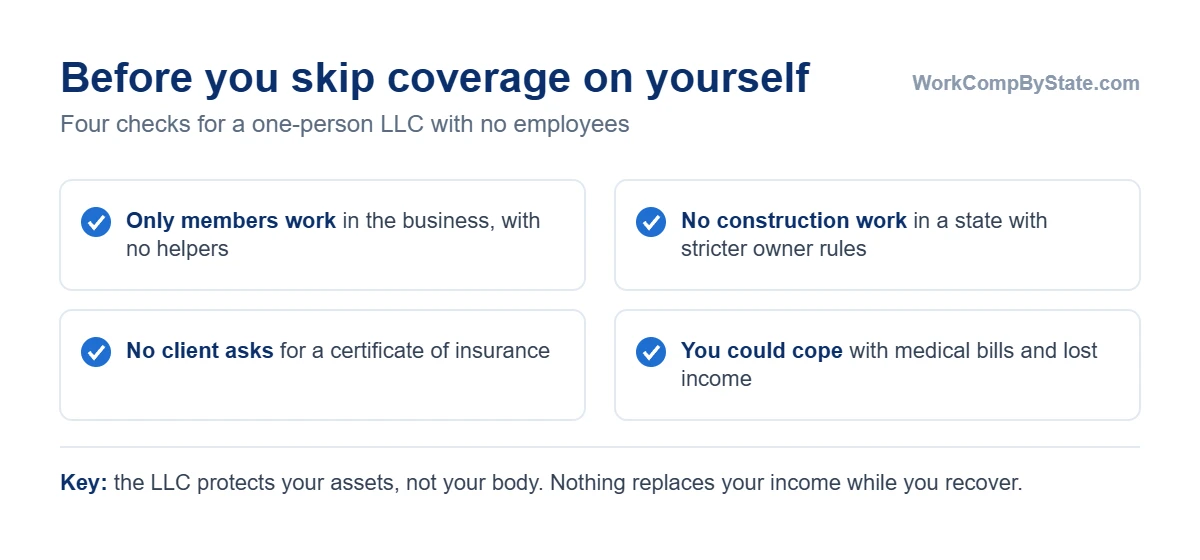
In most states, a single-member LLC with no employees does not have to buy workers’ comp for its owner. The LLC protects your personal assets from business debts, but it does nothing for your body. If you get hurt on the job, the LLC will not pay your medical bills or replace your income. So the real question is not only “is it required?” but “which of the three paths fits my business?”
The three paths at a glance
| Path | What it means | Who it suits |
|---|---|---|
| Stay uncovered | No policy; you rely on your own health insurance and savings if you are hurt | Desk-based solo owners in states that don’t require owner coverage, with no clients demanding a certificate |
| Elect coverage on yourself | Buy a policy that includes you as the owner, where the state allows | Trades and physical work, or anyone who would struggle financially after an injury |
| Carry a policy because a client or state requires it | Coverage driven by contracts, licensing or construction rules | Contractors and subs working for general contractors or in strict states |
Path 1: Staying uncovered, and what it really means
Most states build their requirement around employees, and an LLC member who owns the company is usually not counted as one. Some state examples, straight from their agencies and statutes:
- Massachusetts: LLC members are not required to carry coverage for themselves. Any worker who is not a member must be covered from day one.
- Wisconsin: LLC members are not considered employees under the Act, but they can buy coverage voluntarily.
- Indiana: an LLC member or manager is not covered unless they elect coverage by written notice to their insurer and the state board. Nothing changes until the notice is received.
- Colorado: an LLC member who owns at least 10% can reject coverage, but only by sending the approved form by certified mail.
Two things end this path immediately. The first is hiring anyone who is not a member, even part-time, in a state where your headcount now meets the threshold. In Massachusetts that is one worker. The second is construction work in a state with stricter owner rules (Path 3).
The cost of staying uncovered is the risk you carry yourself. Many health plans limit or exclude work-related injuries, and nothing replaces your income while you recover. For a one-person business that depends on your hands, that can be a bigger threat than any fine.
Path 2: Electing coverage on yourself
If you decide you want protection, most states give owners a way in. In Indiana, you elect in by written notice. In Wisconsin, members can buy coverage voluntarily. Your insurance agent will tell you how your state handles it and which payroll figure the carrier uses for an owner, since owner payroll rules differ by state and carrier.
Price depends on your class code, your state and the payroll amount used. Carriers also charge a minimum premium, so a very small policy may cost more than the payroll math alone suggests. Get a quote before deciding; for budgeting ideas see what workers’ comp costs a small business and pay-as-you-go options.
Path 3: When the choice is made for you
Construction rules
Tennessee is the clearest example. Owners of construction businesses are required to cover themselves unless they apply for and receive an exemption, and that exemption covers only the named person, not any helper they bring to a job. Other states have their own construction rules, and some limit how many owners can opt out. If you are a one-person LLC in construction, check your state’s construction rules specifically. They are often stricter than the general rule.
Clients who want proof
General contractors, property managers and larger customers often require a certificate of insurance from every vendor, as a matter of their own policy. Being legally exempt does not change their requirement. This is the most common reason solo LLC owners end up buying a policy. See certificates of insurance.
New York’s exemption certificate has narrow uses
New York shows why “exempt” paperwork does not always satisfy a client. A business with no employees can get a Certificate of Attestation of Exemption (Form CE-200), but the Workers’ Compensation Board says it can only be used with a government entity issuing a license, permit or contract. It cannot be used to show another business, or that business’s insurance carrier, that coverage is not required. Certificates for building permits are job-specific, so each permit needs its own.
An illustrative scenario. A solo electrician in New York, set up as a single-member LLC, pulls building permits for three jobs over a few months and gets a CE-200 for each one. A general contractor then asks him for proof of coverage before letting him on a commercial site. The CE-200 does not answer that request, so he either buys a policy or loses the job. Many solo trades owners in this position decide a small policy is simpler than turning down work.
How to choose in ten minutes
- Check whether your state requires coverage for LLC members at all (most do not), using the 50-state table and your state agency.
- If you do construction, read your state’s construction rules first.
- List the clients who ask for a certificate of insurance. If any of them matter to your revenue, price a policy.
- Ask your health insurer, in writing, how it handles injuries that happen while you are working.
- Decide whether you could cover a few months without income. If not, get a quote for Path 2.
Revisit the choice the day you hire your first helper. See sole proprietors and workers’ comp for how the same rules apply when there is no LLC at all.
Related guides
- Sole proprietors and workers’ comp
- Workers’ comp exemptions
- Workers’ comp vs. health insurance
- Workers’ comp for construction companies
- Independent contractors and their own coverage
Sources
- Massachusetts DIA, insurance requirements
- Wisconsin DWD, insurance requirements
- IC 22-3-6-1, Indiana owner elections
- C.R.S. 8-41-202, Colorado rejection by LLC members
- Tennessee Bureau of Workers’ Compensation, construction requirements
- New York WCB, Certificate of Attestation of Exemption (CE-200)
Last checked against the sources above on October 2, 2026.