
Workers’ Compensation Insurance Requirements in Arizona
If you have even one person working for you in Arizona, you almost certainly need workers’ comp. The law doesn’t care whether that person works 40 hours a week or 10, or only during your busy season. What surprises many small business owners is everything around that basic rule: who the law treats as your employee, how a written contract can (or can’t) protect you when you hire independent contractors, and what happens to a contractor’s license when coverage lapses.
This guide walks through those rules using the Arizona statutes themselves, so you can check every point.
The rule in one paragraph
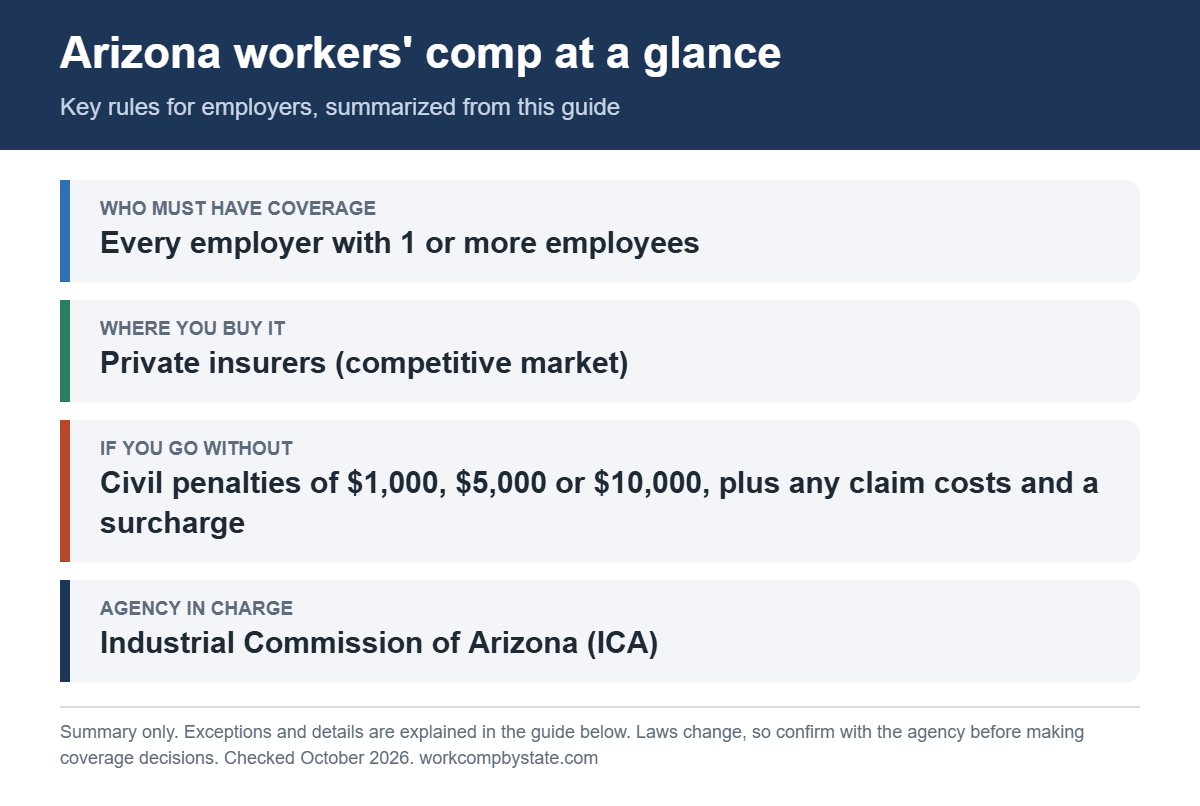
Under A.R.S. § 23-902(A), the law covers “every person who employs any workers or operatives regularly employed in the same business or establishment.” “Regularly employed” includes seasonal and part-year work in your usual line of business. There is no minimum headcount. The only group the statute names as exempt is domestic servants, and even their employers may choose to come under the law voluntarily.
Ways to meet the requirement
A.R.S. § 23-961 gives employers two routes:
- Buy a policy from an insurance carrier licensed in Arizona. This is what nearly every small business does.
- Self-insure, either individually or through a self-insurance pool approved by the Industrial Commission of Arizona (ICA). You must prove to the Commission that you can pay claims, and it may require a deposit or other security. In practice this is for large employers.
Arizona has no monopolistic state fund. You may have read about “SCF Arizona”, the old State Compensation Fund. It was converted into a private mutual insurer and renamed CopperPoint Mutual in 2013, so today it is one carrier among many in a competitive market. If you want to understand how state funds work elsewhere, see monopolistic states vs. private insurance.
Who counts as your employee
Arizona gives the question two sides, and both matter for small businesses.
The statutory employer rule
Section 23-902(B) says that when you hire a contractor, keep supervision or control over the work, and the work is “a part or process” of your own business, that contractor and its workers are treated as your employees for workers’ comp purposes. The statute defines “part or process” as work that is regular, ordinary or routine in your business, or that your own employees routinely do.
Example: a remodeling company that hires a drywall crew and directs how and when they work can end up responsible if a crew member is hurt and the drywall company has no coverage. That is why general contractors in Arizona ask every subcontractor for a certificate of insurance before work starts.
The written independent contractor agreement
Arizona is unusual because it lets businesses create a legal presumption that someone is an independent contractor. Under § 23-902(D), a signed and dated written agreement creates a rebuttable presumption of an independent contractor relationship if it includes a statement that the contractor is not entitled to workers’ comp benefits from your business, and states that your business:
- does not require the contractor to work only for you;
- does not provide the business registrations or licenses the contractor needs;
- does not pay a salary or hourly rate instead of a fixed contract amount;
- will not end the contract early unless the contractor breaches it or breaks the law;
- does not provide tools;
- does not dictate the time of performance;
- pays the contractor in the name on the agreement;
- will not combine business operations with the contractor.
Two cautions. First, “rebuttable” means the presumption can be overturned if the real working relationship looks like employment. Second, under § 23-902(F) the agreement is void if either side’s consent came through misrepresentation, fraud, intimidation, coercion or duress. A form signed by a worker you actually manage like an employee will not hold up. Our guide to 1099 workers and workers’ comp explains how classification is usually tested.
Sole proprietors who work for you
A sole proprietor with no employees can waive coverage for jobs they do for your business. Under § 23-961(N), the waiver must be signed and dated by the sole proprietor and by your insurance carrier, using wording close to the form printed in the statute. Once that waiver exists, § 23-902(E) says your business is not liable for coverage or premium for that person. Ask your carrier for its version of the form before the work starts, not after an audit.
If you are a licensed contractor
The Arizona Registrar of Contractors (ROC) ties licensing to workers’ comp. Its license applications state that applicants must comply with the workers’ comp statutes under A.R.S. § 32-1122(B)(1)(i), and ask you to choose one of three positions: you carry workers’ comp insurance, you are an approved self-insured employer, or you are a sole proprietorship with no employees. If you hire your first employee after you get your license, your answer on file is no longer true, so arrange the policy before that person’s first day.
What happens if you don’t have coverage
Section 23-907 sets out the consequences. They stack up quickly:
- You can be sued directly. An uninsured employer loses the protection of the workers’ comp system. In a lawsuit you cannot argue that the employee assumed the risk or was partly at fault, and proof of the injury counts as initial evidence that you were negligent.
- Or the employee claims from the Special Fund. The injured worker can instead file with the ICA, and benefits are paid from the state’s Special Fund. You are then billed for everything paid, plus a penalty of 10% of that amount or $1,000, whichever is greater, plus interest. The bill acts as a court judgment and becomes a lien on your property for eight years.
- Your business can be shut down. The Commission can ask a court for an injunction that stops you from operating until you comply.
On top of that, the ICA can issue civil penalties just for being uninsured, even if nobody has been hurt:
| Violation within five years | Maximum civil penalty |
|---|---|
| First | $1,000 |
| Second | $5,000 |
| Third or later | $10,000 |
The Commission can reduce or waive a penalty. The statute lists factors it may consider, including a clean history and a lapse that was “inadvertent”, which it defines as a gap of no more than 30 days caused by a change of insurance carrier, a change of ownership or a change in the form of the business. It can also take into account an employer who was defrauded by an agent or broker.
A short example
Maria runs a two-person cleaning business in Tucson as a sole proprietor. In March she hires a part-timer for four mornings a week. From that day she is an employer under § 23-902, so she buys a policy before the first shift. In October she lets the policy lapse while switching carriers, and the new policy starts 12 days later. No one is hurt in those 12 days. If the ICA ever flagged the gap, the change of carrier and the short length of the lapse are exactly the factors the statute allows it to weigh when deciding whether to reduce a penalty. A gap of several months with an injury in the middle would be a very different story: Special Fund bills, the 10% or $1,000 penalty and a possible lawsuit.
Common questions
Does a part-time or seasonal worker count?
Yes. The statute’s definition of “regularly employed” covers work for only part of the year in your usual business.
Do I need coverage for a housekeeper or nanny?
Domestic servants are the one group the statute excludes. You may still choose to cover them.
Is there still a state fund I can fall back on?
Not in the old sense. SCF Arizona became CopperPoint Mutual in 2013. If you struggle to find coverage, an independent agent who works with several carriers is the usual next step. See how to get the cheapest workers’ comp quote for what affects the price.
Related guides
- Workers’ Comp Requirements by State: 50-State Comparison Table
- Penalties for Not Carrying Workers’ Comp Insurance by State
- Sole Proprietors and Workers’ Comp
- Workers’ Comp Insurance for Construction Companies
Sources
- A.R.S. § 23-902: Employers subject to chapter; exceptions
- A.R.S. § 23-907: Liability of employer failing to secure compensation; civil penalties
- A.R.S. § 23-961: Methods of securing compensation; sole proprietor waiver
- A.R.S. 32-1122, contractor license qualifications (workers’ comp attestation)
Last checked against the statutes above on October 2, 2026. This is general information, not legal or insurance advice. For a decision about your business, talk to a licensed agent or an Arizona attorney, or contact the Industrial Commission of Arizona.