
Do Rideshare and Delivery Drivers Get Workers’ Comp? What Four States Require
Most rideshare and delivery drivers are treated as independent contractors, and workers’ comp is built for employees. So the short answer to “does a gig driver get workers’ comp?” is usually no. A handful of states have changed that, each in its own way. Washington gives rideshare drivers real workers’ comp through the state. New York routes them through a special fund. California and Massachusetts require a different product, occupational accident insurance, paid for by the apps. This guide walks through all four, then covers what changes when your own business pays someone to drive or deliver for it.
The default: contractors are not covered
Workers’ comp pays for medical care and lost wages when an employee is hurt on the job. The big platforms classify drivers as contractors, so in most states a driver who is injured mid-trip has no workers’ comp claim against the app. What is left is the driver’s own health insurance, the auto policy that covers the trip, and whatever injury coverage the app chooses to offer.
That classification is not automatic, though. It depends on state law, and some states have written specific rules for app-based work. The four below are the clearest examples.
Washington: workers’ comp through L&I
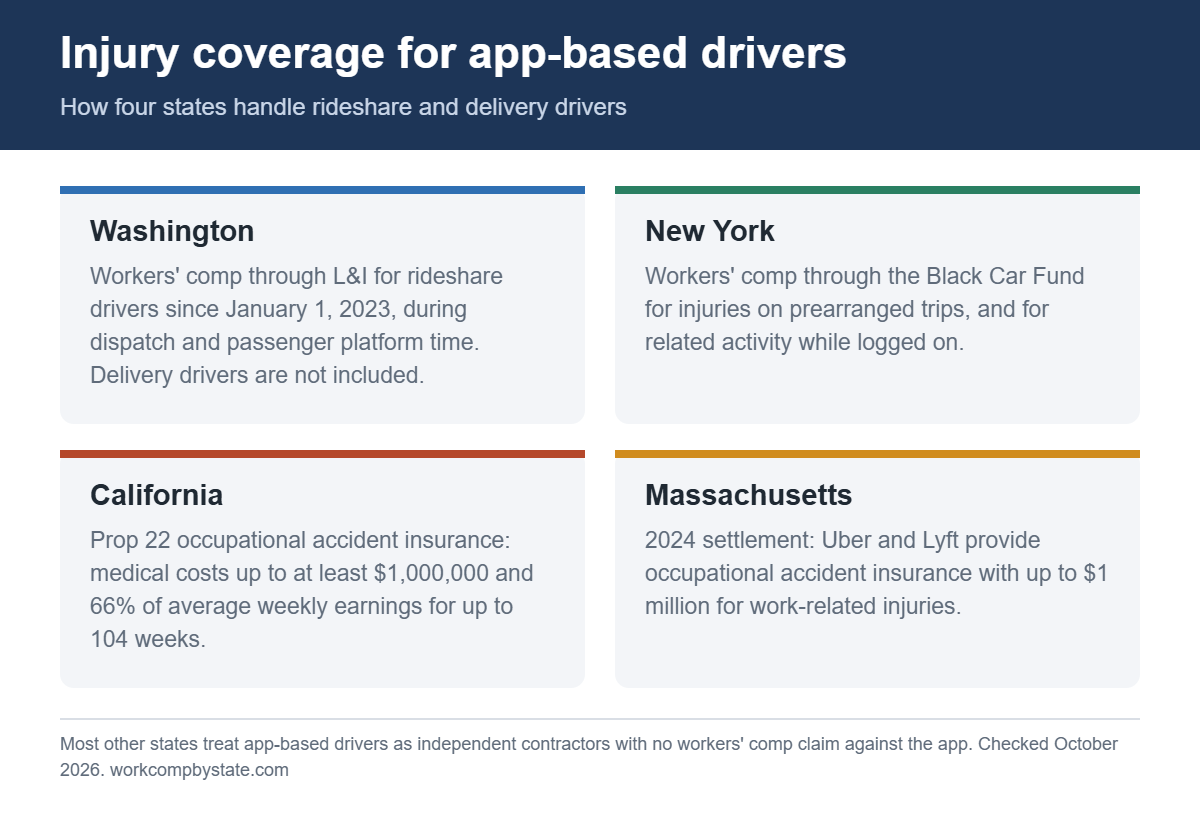
Since January 1, 2023, transportation network companies in Washington must pay for and provide workers’ compensation for their drivers through the Department of Labor & Industries. The coverage works like any other L&I claim: medical care for the injury, partial wage replacement while the driver cannot work, vocational programs, and disability or pension payments for severe injuries.
Three details matter:
- When it applies. L&I says drivers are covered only during dispatch platform time and passenger platform time, meaning while heading to a pickup or carrying a rider.
- Who it covers. The law protects drivers who transport passengers. Food and package delivery drivers are not part of it.
- What it does not pay for. Workers’ comp does not cover repairs to the car.
Since June 6, 2024, there is also a death benefit for a driver who dies while logged in and available but before a ride is assigned, as long as the driver was in or right next to the vehicle. Beneficiaries have one year from the date of death to file.
New York: the Black Car Fund
New York took a different route. According to the Department of Financial Services, a rideshare driver hurt during a prearranged trip is entitled to workers’ comp benefits through the New York Black Car Operators’ Injury Compensation Fund. A driver who is logged on but between trips can also qualify if the activity was reasonably related to driving, judged by its time, place and manner.
The fund itself is a nonprofit workers’ comp provider created by state law in 1999. For bases that belong to it, coverage is paid for by a small surcharge on passenger fares, and benefits include medical care and wage replacement for on-the-job injuries. It does not pay for vehicle damage or for injuries that happen off the job.
California: Prop 22 occupational accident insurance
California voters approved Proposition 22 in 2020. Under Business and Professions Code section 7451, an app-based rideshare or delivery driver is an independent contractor as long as the company does not set the driver’s hours, does not require the driver to accept a particular request, and does not stop the driver from working for other apps or other businesses.
In exchange, section 7455 requires the companies to provide occupational accident insurance, which is not the same thing as workers’ comp but covers similar ground:
- Medical expenses up to at least $1,000,000.
- Disability payments of 66% of the driver’s average weekly earnings from all apps, for up to the first 104 weeks after the injury. Average weekly earnings are the total from the 28 days before the accident, divided by four.
- Coverage while the driver is online (logged in and able to take requests) or in engaged time. It does not apply if the driver was online but doing personal errands, or was engaged on another app at the time.
Prop 22 only covers app-based drivers. Other freelancers in California are judged by the ABC test, which has applied to workers’ comp claims for injuries on or after July 1, 2020.
Massachusetts: a settlement, not a statute
In 2024 the Massachusetts Attorney General settled a lawsuit with Uber and Lyft. The result is not workers’ comp, but the settlement does require the two companies to provide occupational accident insurance with up to $1 million in coverage for work-related injuries, starting October 1, 2024. It also set a minimum pay rate for engaged time, which started at $32.50 an hour and is adjusted every year; the AG lists $34.48 from January 15, 2026.
Because it is a settlement with two companies, it does not automatically cover other apps.
The four states side by side
| State | What drivers get | Who pays | When it applies |
|---|---|---|---|
| Washington | Workers’ comp through L&I | The rideshare company | Dispatch and passenger platform time |
| New York | Workers’ comp through the Black Car Fund | Fare surcharge | Prearranged trips and related activity |
| California | Occupational accident insurance (Prop 22) | The app company | Online and engaged time |
| Massachusetts | Occupational accident insurance (settlement) | Uber and Lyft | Work-related injuries |
Which rule applies to you?
Pick a state and the kind of work. The answer summarizes the rules described in this guide.
General information only. Your exact coverage depends on the facts of the injury and current state law.
If your business pays people to drive or deliver
None of the rules above help a business that hires drivers directly. When you book a delivery through an app, the driver works with the platform. When you pay a person yourself, your state’s employee test decides whether you owe workers’ comp, and gig-style pay does not change that.
Take a catering company in Tacoma that pays a driver $25 an hour, in his own car, to deliver orders on a schedule the company sets. The company sets the hours and the work is part of its normal business. Washington’s test for independent contractors is strict, and L&I can bill a business for the hours of anyone it reclassifies as a covered worker. The same company paying an app to deliver those orders has no such exposure for the app’s drivers.
The safe habit is the same everywhere: if you control when, where and how someone works for you, treat them as an employee for workers’ comp purposes until your state’s test says otherwise.
If you are the driver
- Check which of the rules above, if any, applies in your state.
- After an injury, take screenshots showing you were online or on a trip. Every one of these programs depends on what you were doing at that moment.
- Report the injury in the app right away. In Washington, you can also file with L&I at 1-877-561-3453.
- Keep your own health insurance. Outside these states, it is often the only coverage you have.
Related guides
- Workers’ comp for 1099 workers: what businesses should know
- Washington workers’ comp requirements
- California workers’ comp requirements
- New York workers’ comp requirements
- Massachusetts workers’ comp requirements
Sources
- Washington L&I, workers’ compensation for rideshare drivers
- Washington L&I, rideshare driver rights
- New York DFS, ride sharing FAQ
- The Black Car Fund, FAQs
- Cal. Bus. & Prof. Code 7451, app-based drivers
- Cal. Bus. & Prof. Code 7455, occupational accident insurance
- California Labor & Workforce Development Agency, employment status FAQ
- Massachusetts AG, Uber and Lyft settlement FAQ
Last checked against the sources above on October 13, 2026. Laws change, so confirm with the state agency before relying on any of this.