
Do Independent Contractors Need Workers’ Comp? A Guide to 1099 Workers
Short version: a true independent contractor who works alone usually is not required to cover themselves. But that is rarely the end of the question. First, paying someone on a 1099 does not make them a contractor for workers’ comp. Second, a contractor with helpers is an employer. And third, the business that hired them can end up paying for their injuries anyway.
This guide works through the questions in the order you should ask them, first as the business hiring a contractor, then as the contractor.
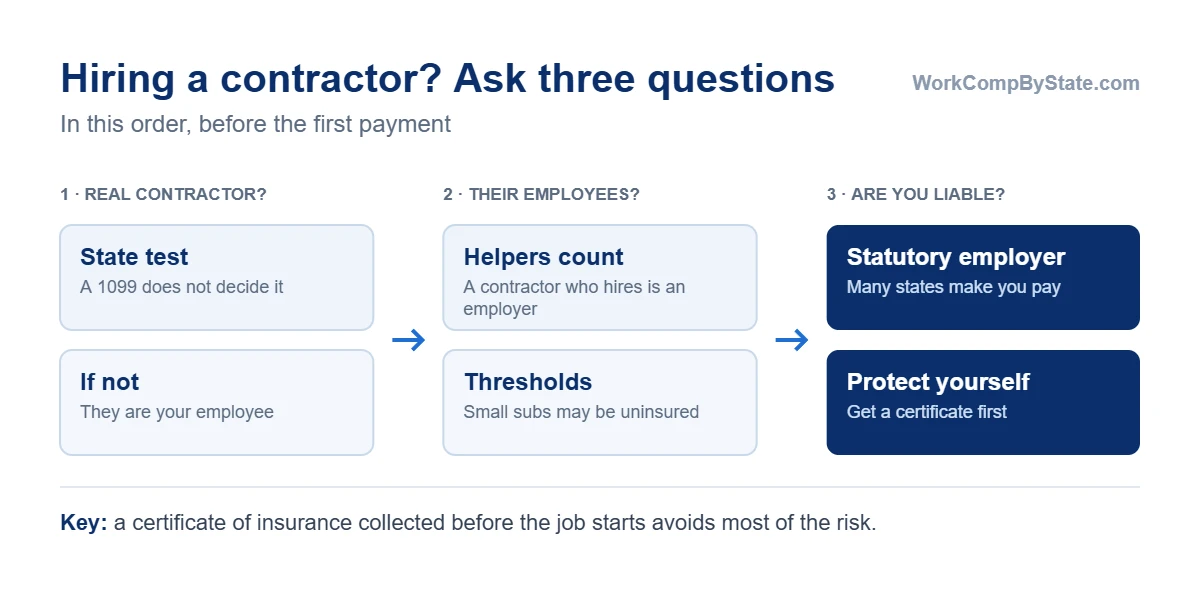
Question 1: Is this person really an independent contractor?
Everything else depends on this, and it is where most small businesses go wrong. Three beliefs cause most of the trouble.
“If I send a 1099, they are a contractor”
The form you file is a result of your classification decision, not proof that it was right. The IRS itself says you must first figure out the business relationship before deciding how to treat payments, and that all evidence of control and independence has to be weighed. Its guidance on contractors and employees groups the facts into three areas: behavioral control, financial control and the type of relationship. No single factor decides the answer.
State workers’ comp agencies say the same thing even more bluntly. Tennessee’s Bureau of Workers’ Compensation states that paying someone on a 1099 instead of a W-2 does not mean they are properly classified.
“If I pass the IRS test, I’m fine for workers’ comp too”
Workers’ comp classification is a separate legal question decided under state law, often by a different agency with a different test. Passing one does not guarantee passing the other. Wisconsin’s guidance says a person is not a contractor just because both sides say so, or even because the IRS says so.
How four states actually word the test
“Independent contractor” means something different in each state’s workers’ comp law. Here is how four of them put it:
- Wisconsin requires a person to meet, and keep meeting, all nine conditions in s. 102.07(8). They include holding a federal employer ID number (or having filed business tax returns for the work), working under specific contracts, being paid per job or by bid, and being able to make or lose money. See the Wisconsin DWD contractor page.
- Tennessee uses a seven-factor test, and the most weight goes to who controls the conduct of the work. See the Tennessee Bureau of Workers’ Compensation.
- Colorado presumes a worker is an employee unless they are free from control and direction and customarily engaged in an independent business. A signed, notarized agreement with a prominent disclosure creates a rebuttable presumption of contractor status under C.R.S. 8-40-202.
- Indiana follows the IRS guidelines, as its Worker’s Compensation Board explains, then adds paperwork. A contractor who does not elect coverage must obtain a certificate of exemption, and a business hiring someone not covered must get a copy of the stamped certificate. The insurer of the hiring business has to accept that stamped certificate the same way it accepts a certificate of insurance, under IC 22-3-2-14.5 as reproduced on the Board’s compliance page.
The common thread: none of these states treats a 1099 as proof of anything for workers’ comp.
“A signed contractor agreement protects me”
A written agreement helps show what both sides intended, and in Colorado a properly done one creates a presumption. But a presumption can be overcome, and in most states the label in the contract matters less than how the work is actually done. If you set the hours, supply the tools, train the person and they work only for you, the agreement will not carry much weight.
A quick self-check before you pay someone on a 1099
- Do they decide how and when the work gets done?
- Do they have other clients, or could they?
- Do they use their own tools and cover their own expenses?
- Can they make or lose money on a job?
- Do they have a business identity: name, ID number, insurance, licenses where required?
- Is the work something outside what your business normally does?
The more “no” answers, the more the person looks like an employee. When the answers are mixed, treat it as a warning sign and read your state’s actual test, or ask your state agency.
If the person fails your state’s test, they are your employee for workers’ comp purposes, and your policy has to cover them.
Question 2: Does the contractor have employees?
A contractor who hires helpers is an employer. Their workers need coverage under the same state rules as anyone else’s. Thresholds vary: some states require coverage from the first employee, while others start at three, four or five, and construction often has a lower threshold. Our state requirement guide and 50-state comparison list the numbers.
This is where most problems happen. A small subcontractor with two helpers may sit below its own state’s threshold, or may simply be uninsured. Their helpers can still get hurt on your job.
Question 3: Would you be on the hook if they are uninsured?
In many states, yes. These are often called statutory employer rules. They make a business liable for injuries to a contractor’s workers when the contractor does not carry coverage. Some examples:
- Decide the classification before the first payment. Use the self-check above and your state’s actual test, not the tax form.
- Get a certificate of insurance before work starts. Check the policy dates, the insured name and that it is workers’ comp, not just general liability. See our certificate of insurance guide.
- Calendar the expiration date. A certificate proves coverage on the day it was issued. Ask for a new one when the policy renews.
- For a contractor with no employees, ask for state paperwork if your state has it. Indiana, for example, issues a certificate of exemption for independent contractors who do not elect coverage, with a $15 fee, according to the Worker’s Compensation Board of Indiana.
- Write coverage into your contracts. A written agreement should describe the job, the price and who supplies what, and require subs to carry workers’ comp and send updated certificates.
- Keep a file for every contractor. Their invoices (not timesheets you created), the certificate or exemption, and proof they run a business, such as a business license, an EIN or a website. Your auditor will ask for them.
- Clients may require it. Many general contractors will not hire an uninsured sub, or will deduct the audit charge from your pay.
- Construction can be different. Some states have stricter rules for construction. In a few states, construction business owners must cover themselves unless they get an exemption, so check before assuming you are exempt.
- Your own injuries. Without a policy, a serious injury means relying on health insurance, which may not replace lost income.
- The day you hire. Once you have a helper, you need to check your state’s threshold right away.
- Certificates of insurance
- Workers’ comp audits
- Workers’ comp for construction
- Workers’ comp for cleaning businesses
- Workers’ comp for sole proprietors
- Penalties for not having coverage, by state
- Va. Code 65.2-302, statutory employer
- N.C. G.S. 97-19, subcontractor certificates
- Indiana Code 22-3-2-14
- Worker’s Compensation Board of Indiana, compliance
- RSMo 287.040, Missouri statutory employer
- Wisconsin DWD, independent contractors
- Tennessee Bureau of Workers’ Compensation, who is considered an employee
- C.R.S. 8-40-202, Colorado employee and contractor definitions
- Worker’s Compensation Board of Indiana, independent contractors
- IRS, independent contractor or employee
| State | When the hiring business can be liable | Law |
|---|---|---|
| Virginia | An owner that contracts out work that is part of its own trade or business, or a general contractor that subcontracts work, is liable as if it employed the sub’s workers directly. | Va. Code 65.2-302 |
| North Carolina | A contractor that sublets work without getting a certificate showing the sub has coverage is liable for the sub’s employees, even if the sub has fewer than three employees. | G.S. 97-19 |
| Indiana | Contracting out work worth more than $1,000 without getting a certificate from the contractor can make you liable for its workers. | IC 22-3-2-14 |
| Missouri | A business can be the statutory employer of a contractor’s workers doing its usual business on its premises. Not an owner simply having improvements built by an independent contractor. | RSMo 287.040 |
Notice the pattern. The risk is highest when the contractor does work that is part of your normal business, such as a roofing company hiring a roofing sub. Hiring an electrician to rewire your own bakery is usually a different situation.
Misclassification usually shows up at your audit
Many businesses assume a contractor label only matters if someone gets hurt. In practice it usually shows up earlier, at your annual premium audit. Auditors review payments to 1099 workers. If a worker looks like an employee, or if a contractor cannot show their own coverage or exemption, the auditor may add those payments to your payroll and bill you premium for them. If someone does get hurt, the stakes are higher: the worker may be found to be your employee, and if you had no coverage for them, your state’s penalties for uninsured employers can apply. Our audit guide explains the process.
Two worked examples (illustrative numbers)
An uninsured subcontractor in North Carolina
A remodeling company in North Carolina hires a drywall subcontractor for a kitchen job. The sub has two helpers and no workers’ comp policy. The remodeler never asks for a certificate.
One helper falls off a ladder and breaks a wrist. Because the remodeler sublet the work without getting a certificate, it can be liable for the helper’s benefits. The claim goes to the remodeler’s own policy, and it shows up in the remodeler’s claims history.
The cost does not stop there. Insurers commonly add payments to uninsured subcontractors to your payroll at the year-end audit. Say the remodeler paid the drywall sub $40,000 during the year, and the class rate for that work was a made-up $8 per $100 of payroll. The audit could add $3,200 in premium (400 x $8), on top of the claim’s effect on future rates. Collecting a certificate before the job starts would have avoided both.
Cleaners paid on 1099s
A residential cleaning company pays five cleaners on 1099s. The company sets their schedules, assigns the houses, supplies the products and equipment, sets the prices clients pay, and does not let the cleaners work for competing services.
At the policy audit, the auditor asks for the 1099 payments and how the work is arranged. On those facts the cleaners look much more like employees than independent businesses: the company controls the work, the cleaners have no chance of profit or loss, and they do not run their own operations. The auditor adds their pay to the company’s payroll.
Say, for illustration, the five cleaners were paid $120,000 in total and the class rate is a made-up $3 per $100 of payroll. The audit bill would be about $3,600 (1,200 x $3). That is the cheap outcome. If one of them had been badly hurt and the company had treated them as uncovered, the cost could be far higher.
What the hiring business should do
When it is safer to treat the worker as an employee
If the relationship looks like a job (regular hours, close supervision, one client), covering the person as an employee is often cheaper over time than defending a contractor label later. Adding a worker to your policy costs premium based on their pay and job class, which is predictable. A misclassification finding is not.
What the contractor should consider
If you work alone, you are usually not required to cover yourself. Many states exclude sole proprietors and partners from mandatory coverage unless they choose to buy it. But there are reasons to consider a policy anyway:
Our guide for one-person LLCs and the one for sole proprietors go through the options, including low-cost owner-only policies.
This article is general information, not legal, tax or insurance advice. Contractor tests and statutory employer rules vary by state and change over time. For your situation, talk to a licensed agent, an employment attorney or your state’s workers’ comp agency.
Related guides
Sources
Sources last checked on October 2, 2026. Updated October 20, 2026: our separate guide to 1099 workers was merged into this page.