
How to File a Workers’ Comp Claim: A Step-by-Step Guide for Employers
An employee just got hurt. You have a policy. Now what? Filing a workers’ comp claim is mostly a matter of doing a few simple things in the right order and on time. The order matters because some deadlines are measured in hours, and others in days. Miss one and you can owe a late fee or make the claim harder to resolve, even when nobody disputes the injury.
This guide walks through the sequence an employer follows, from the moment of injury to the point where the insurer takes over. It also shows where the rules change from state to state, so you know which details to confirm for your own business.
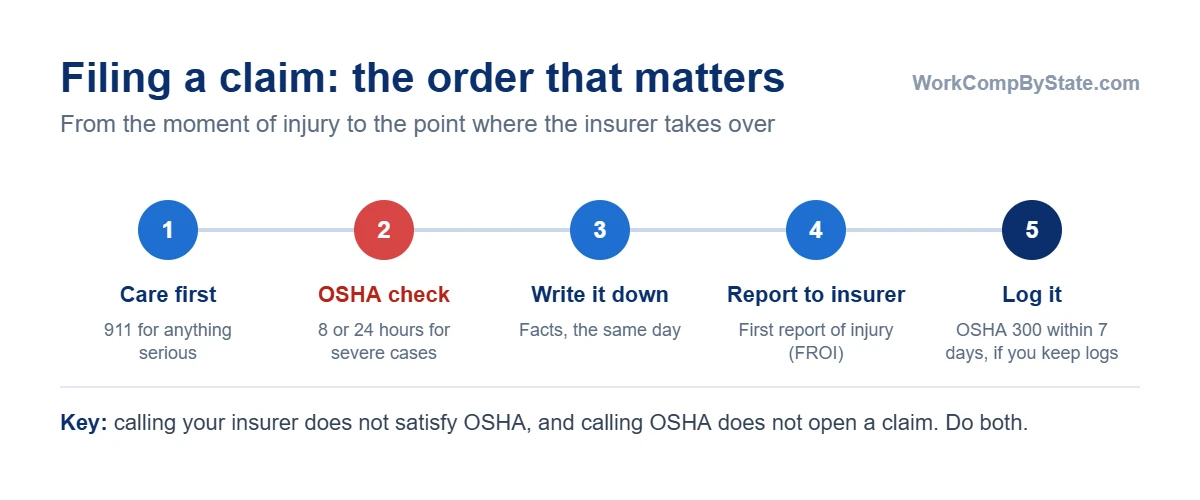
Before anything else: care first, paperwork second
Get the worker medical help. Call 911 for anything serious. For minor injuries, follow your state’s rules on where the employee can be treated (some states let the employer or insurer steer the first visit, others let the worker choose). Then make the area safe so the same thing does not happen to someone else. If you need a detailed playbook for that first hour, see our guide on what to do when an employee gets injured at work.
Step 1: Check the clock that runs in hours (OSHA)
This is a federal rule, separate from workers’ comp, and it is the one with the shortest fuse. According to OSHA’s reporting page, every employer under OSHA jurisdiction must notify OSHA:
- within 8 hours of a work-related death, and
- within 24 hours of a work-related in-patient hospitalization, amputation or loss of an eye.
A few details trip people up. Treatment in an emergency room only, without a formal admission, is not reportable. A death that happens within 30 days of the incident still has to be reported. And small employers who are exempt from keeping OSHA logs still have to make these reports. You can call your nearest OSHA office, use the OSHA 24-hour hotline, or report online.
Calling your insurer does not satisfy OSHA, and calling OSHA does not open a claim. You do both.
Step 2: Write down the facts the same day
Take ten minutes while memories are fresh. Record:
- date, time and exact location of the incident
- what the employee was doing and how the injury happened, in plain words
- body part injured and the treatment given
- names and phone numbers of witnesses
- photos of the scene, tools or equipment involved
- the employee’s job title, hire date and usual pay
Stick to what you saw or were told. Do not add guesses about fault. The adjuster will ask for this information anyway, and a report written the same day is far more useful than one pieced together a week later.
Step 3: Report the injury to your insurer (and your state, if required)
Every carrier has a first report of injury form, often called a FROI. Most accept it online or by phone. Send it as soon as you know about the injury, even if the injury looks minor or you suspect it is not work related. The insurer decides whether the claim is covered, not you.
Some states also put a hard deadline on the employer, or require a state form. A few examples, all from official sources:
| State | Employer duty | Deadline |
|---|---|---|
| Indiana | Report injuries needing more than first aid to the insurance carrier | Within 7 days; late report penalties of $50, $150 and $300 |
| North Carolina | File Form 19 (employer’s report of injury) | Within 5 days of learning of the injury |
| Virginia | Report the injury to the Workers’ Compensation Commission | Within 10 days |
| Michigan | File Form WC-100 for a death, specific loss or 7 or more days of disability | Required for those injuries |
Sources: Indiana Workers’ Compensation Board, North Carolina Industrial Commission, Va. Code 65.2-900 and the Michigan employer FAQs. Other states set their own rules, so check your state agency’s employer page or ask your carrier which forms it files for you.
Step 4: Know the employee’s side of the deadline
Employees also have a notice window. In North Carolina, for example, the employee should give the employer written notice within 30 days. Windows differ a lot between states. The safest habit is simple: once a worker tells you about an injury, treat that as notice and start Step 3. Do not wait for a formal letter.
Give the employee the claim information your state or carrier requires, such as the carrier’s name, the claim number once you have it, and who to call with questions. Never suggest they skip reporting or use their personal health insurance for a work injury. That can create legal trouble of its own, covered in can an employee sue you if they’re covered by workers’ comp.
Step 5: Log it if you keep OSHA records
If your company had more than 10 employees at any time last year and you are not in a partially exempt industry, you keep OSHA injury records. A recordable case goes on the OSHA 300 Log and the 301 Incident Report within 7 calendar days of learning about it, per 29 CFR 1904.29. That same rule notes that many employers use their insurance form in place of the 301, adding any information OSHA requires. So the FROI you already filled out can do double duty. More on that in our OSHA and workers’ comp guide.
Step 6: Work with the adjuster
Once the carrier has the report, it assigns an adjuster. Expect calls asking for your account of the incident, wage records and any witness details. Answer promptly and stick to facts. If something about the claim looks off to you, say so to the adjuster privately. Do not confront the employee. Our guide on workers’ comp fraud explains how to raise a concern the right way.
Step 7: Plan the return to work
When the doctor releases the worker, with or without restrictions, have a plan ready. Light or modified duty, if you can offer it, often gets people back sooner and can shorten the time wage benefits are paid. Keep the doctor’s restrictions in writing and match the job to them. See how long a workers’ comp claim takes to settle for what happens after that.
A sample timeline (hypothetical)
Here is how the steps line up for an imaginary 14-person bakery in Virginia. The business, people and dates are illustrative.
- Monday, 2:10 p.m. A baker burns her forearm on a tray. The shift lead applies first aid and drives her to urgent care. She is treated and sent home, not admitted, so there is no OSHA 24-hour report.
- Monday, 4:00 p.m. The owner writes a short incident note and photographs the oven area.
- Tuesday morning. The owner submits the FROI to the carrier online and gives the baker the carrier’s contact details.
- By Thursday. Because the baker received prescription treatment, the owner checks the OSHA definition of a recordable case and enters it on the 300 Log, well within 7 days.
- Within 10 days. The owner confirms the carrier has made the Virginia Commission report and keeps the confirmation.
- Week 2. The baker returns on light duty (packing orders, no oven work) until cleared.
Nothing here was complicated. It just happened in order, and quickly.
Four habits that keep claims clean
- Report small injuries too. A sprain can become surgery. A late report can cost you a fee and slows the claim.
- Keep one folder per claim. Incident notes, photos, the FROI, adjuster emails and doctor notes in one place.
- Train supervisors on the first call. They should know who to phone and where the form lives.
- Stay polite and neutral with the employee. Most claims are legitimate, and a calm process tends to resolve faster.
Related guides
- What to do when an employee gets injured at work
- Workers’ comp and OSHA compliance
- How long a workers’ comp claim takes to settle
- How to lower your workers’ comp premium
Sources
- OSHA, Report a Fatality or Severe Injury
- OSHA, 29 CFR 1904.29 Forms
- Indiana Workers’ Compensation Board, Compliance
- North Carolina Industrial Commission, Employers
- Va. Code 65.2-900
- Michigan WDCA, Employer FAQs
Last checked against the sources above on October 2, 2026.