
Missouri Workers’ Comp Requirements: Five Employees, One in Construction
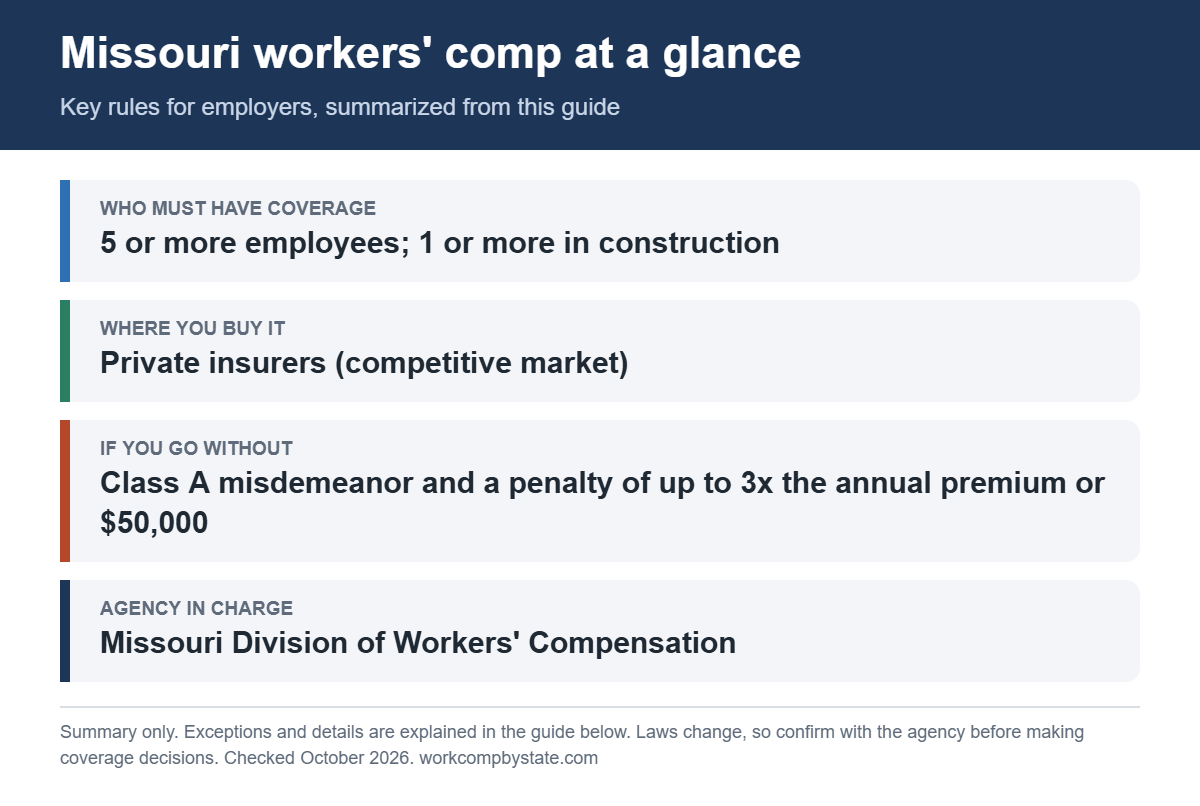
Missouri’s workers’ compensation law does not treat a business as an “employer” until it has five or more employees, unless it works in construction, where one employee is enough. That single sentence in the statute decides whether most small Missouri businesses need a policy. The rest of this guide covers how to count, which jobs are outside the law, the contractor rule that surprises property owners, and the penalties for knowingly going without coverage.
The rule, in the statute’s words
RSMo 287.030 defines “employer” broadly: every person, partnership, corporation, LLC and other entity using the service of another for pay. Then it adds the threshold. An employer must have five or more employees to be covered by the chapter, except that construction industry employers who erect, demolish, alter or repair improvements are covered with one or more employees.
Once covered, RSMo 287.280 requires the employer to insure its entire liability with a carrier authorized in Missouri, or to satisfy the Division of Workers’ Compensation that it can carry the risk itself, alone or as part of an approved group of employers.
Counting to five
The statute adds one specific instruction about counting: family members of the employer within the third degree of relationship by blood or marriage are counted. A spouse, a son and a nephew on the payroll all count toward five.
The statute does not say “full time,” so part-time employees are generally counted as well. If you regularly hover around five, talk to your agent about how your workforce is counted before you decide you are under the line.
| Business | Workers | Coverage required? |
|---|---|---|
| Retail shop | Owner plus 3 part-time clerks | No, fewer than five employees |
| Restaurant | Owner’s spouse, daughter and 3 servers | Yes, family members count, so there are five |
| Drywall contractor | Owner plus 1 helper | Yes, construction is covered at one employee |
| Family farm | Owner plus 6 farm workers | No, farm labor is exempt |
Jobs the law does not cover
RSMo 287.090 lists employment the chapter does not apply to. For private employers the important ones are:
- farm labor;
- domestic servants in a private home, including family chauffeurs, and occasional labor for a private household;
- qualified real estate agents and direct sellers as defined by federal tax law;
- unpaid volunteers of 501(c)(3) and 501(c)(19) organizations; and
- referees, officials and contest workers for school and amateur youth programs who are not otherwise employed by the sponsor.
Employers below the threshold, or with only exempt workers, can opt in. Under 287.090, the election takes effect when you buy a workers’ compensation policy or endorsement, and you can withdraw by canceling or not renewing it.
The two-owner corporation
One more option is easy to miss. A corporation whose only employees are no more than two owners can withdraw from the chapter by filing a notice of election with the Division. The withdrawal takes effect on filing. If the corporation later hires, it can reverse the election, and the reversal takes effect 30 days after filing or later if the notice says so.
The premises rule for contractors
RSMo 287.040 is where Missouri businesses that hire contractors get caught. If you have work done under contract on or about your premises, and the work is part of the usual business you carry on there, you are treated as the employer of the contractor, its subcontractors and their employees if they are injured on or about your premises doing that work.
The liability has an order. The worker’s immediate employer is primarily liable, and the businesses above it are secondarily liable. Anyone who pays as a secondary employer can recover from the one primarily liable, including attorney fees. And none of this applies if the injured worker was insured by the immediate employer or any contractor in between.
There is an important carve-out for property owners. The section does not apply to the owner of premises where improvements are being built, demolished, altered or repaired by an independent contractor. In that case, the independent contractor is treated as the employer of its subcontractors’ employees on the job.
Example
A St. Louis warehouse company hires an outside loading company to load its trucks, which is the work the warehouse does every day. A loader hurt on the dock has a claim against the contractor first. If the contractor has no policy, the warehouse can be liable as the statutory employer and must then chase the contractor for repayment. Asking for a certificate of insurance at signing, and checking it at each renewal, closes that gap. If the same warehouse hires a roofer to replace its roof, the premises rule does not reach the warehouse, because that is an improvement done by an independent contractor.
Penalties for going uninsured
RSMo 287.128 sets out the penalties. An employer that knowingly fails to insure its liability is guilty of a class A misdemeanor. It is also liable to the State of Missouri for a penalty of up to three times the annual premium it would have paid, or up to $50,000, whichever is greater. A repeat violation is a class E felony.
The injured worker also gets a choice. Under 287.280, when an employer fails to insure, the worker can sue the employer for damages, and the employer loses the defenses that the injury was caused by a co-worker’s negligence, by the worker’s own negligence, or that the worker assumed the risk. The worker can instead claim benefits under the workers’ comp law, with the payments made due immediately in a lump sum.
The Division runs a fraud and noncompliance unit. Anyone can file a complaint, and the Division can refer cases to the Attorney General for prosecution. Handing out a fake certificate of insurance is a separate felony.
Quick checklist
- Construction? One employee means you need coverage.
- Everyone else: count to five, family members included.
- Two-owner corporation with no other employees? Decide whether to file the withdrawal notice.
- Bringing contractors onto your premises for your usual work? Collect certificates first.
- Keep your policy active with no gaps at renewal.
Related guides
- Workers’ comp for construction companies
- Family members and workers’ comp
- How to read a certificate of insurance
- Penalties for not having workers’ comp by state
- Illinois workers’ comp requirements
Sources
- RSMo 287.030, employer defined
- RSMo 287.040, liability for contractors
- RSMo 287.090, exempt employers and occupations
- RSMo 287.128, penalties
- RSMo 287.280, duty to insure
Last checked against the sources above on October 2, 2026. Laws change, so confirm with the Missouri Division of Workers’ Compensation or a licensed agent before making coverage decisions.