
Indiana Workers’ Comp Requirements: Employers, Owners and the Contractor Certificate
Indiana has no small-business exemption. If you have an employee, you need workers’ compensation. What makes Indiana different is its paperwork for owners and independent contractors. Owners opt in or out by written notice, contractors in construction need a state certificate of exemption, and anyone who hires a contractor for more than $1,000 can end up paying that contractor’s injury claims if the right certificate is not on file. This guide covers each piece.
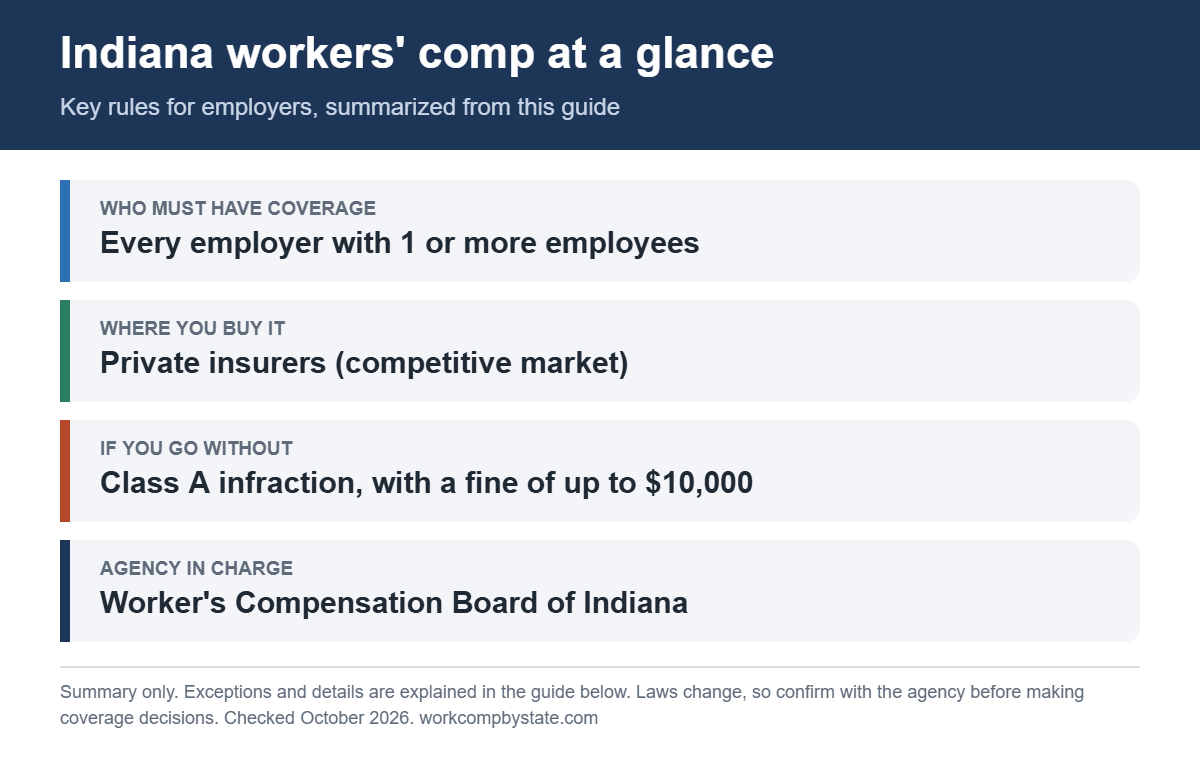
The short version
- Every Indiana employer with employees must carry insurance or be approved to self-insure.
- Farm workers, household employees and casual laborers are outside the Act.
- Corporate officers are employees unless they file a written election to be excluded.
- Sole proprietors, partners and LLC members are not employees unless they file a written election to be included.
- Hiring a contractor for work over $1,000? Get a certificate from the contractor, or you share liability for its workers’ injuries.
- Going uninsured is a Class A infraction, with a fine of up to $10,000.
Who must carry coverage
IC 22-3-2-2 makes every employer and every employee subject to the Act, except where the Act says otherwise. IC 22-3-5-1 then requires every covered employer to either insure with a carrier authorized in Indiana or prove to the Worker’s Compensation Board that it has the financial ability to pay claims directly. Self-insurance comes with a $500 application fee and a $250 annual renewal, and the Board can require a bond or other security.
There is no minimum number of employees. One part-time cashier is enough.
Who is outside the Act
IC 22-3-2-9 lists four groups the Act does not apply to: casual laborers, farm or agricultural employees, household employees, and people who coach youth part time under an independent contractor agreement with a 501(c)(3) nonprofit. An employer of those workers can still choose to come under the Act by posting or serving a written notice and filing a copy with the Board.
Licensed real estate agents paid on sales volume under a written agreement with their broker are also not employees, and neither are owner-operators who lease a truck and driver to a motor carrier under a qualifying written contract.
Owners: who is in and who is out
Indiana handles owners through written elections filed with both the insurance carrier and the Board. Nothing changes until the notice is received.
Corporate officers start in. An executive officer of a for-profit corporation is an employee under IC 22-3-6-1. An officer can elect not to be an employee by serving written notice on the corporation’s carrier and on the Board.
Sole proprietors, partners and LLC members start out. Each of them may elect to be treated as an employee if actively engaged in the business, again by written notice to the carrier and the Board.
The practical difference is large. A two-person corporation that never files anything is paying premium on both officers. A two-member LLC that never files anything has no coverage for either member.
| Owner type | Default under Indiana law | How to change it |
|---|---|---|
| Corporate officer (for-profit) | Counted as an employee and covered | Written notice to the carrier and the Board to be excluded |
| Sole proprietor | Not an employee, not covered | Written election to the carrier and the Board to be included |
| Partner | Not an employee, not covered | Same written election |
| LLC member | Not an employee, not covered | Same written election |
Independent contractors and the certificate of exemption
Indiana uses the IRS guidelines to decide who is an independent contractor. If the IRS would treat the person as a contractor, so does the Act.
The state then adds a certificate. Under IC 22-3-2-14.5, an independent contractor who does not elect coverage files a statement with the Department of State Revenue, supports it with documentation each year, and receives a certificate of exemption. The certificate is filed with the Worker’s Compensation Board and takes effect at midnight seven business days after the Board stamps it. The fee is $15 to the Board.
For sole proprietors and partners who work as independent contractors in the construction trades, the certificate is mandatory if they do not elect coverage. For other independent contractors it is optional, but useful.
Here is why it matters to the business doing the hiring. The statute says a stamped certificate holds harmless both the hiring business and its carrier from claims by that contractor. It also says the hiring business must obtain a copy of the stamped certificate from any contractor not covered by the Act, and that its carrier must accept the certificate the same way it would accept a certificate of insurance.
The $1,000 rule for contracts
IC 22-3-2-14 is where many Indiana businesses get caught. If you contract for work worth more than $1,000 with a contractor who is subject to the Act, and you do not get a certificate from the Worker’s Compensation Board showing the contractor has complied with the insurance requirements, you are liable to the same extent as the contractor for its employees’ injuries. That covers compensation, medical bills and burial expenses. The same rule applies one level down, to a contractor who sublets work to a sub.
Homeowners are carved out. The rule does not apply to an owner who hires someone to work on the owner’s own occupied home.
Example
An Indianapolis property management company hires a painting crew to repaint a vacant rental for $4,200. The painter has two employees and no policy, and the manager never asked for a certificate. One painter falls from a ladder and breaks a wrist. Because the contract was over $1,000 and no certificate was obtained, the property company can be held liable for the painter’s medical bills and wage benefits, just as if the painter’s employee were its own. It can try to recover from the painter, who has no insurance. Five minutes spent collecting a certificate would have prevented the whole problem.
Penalties
According to the Indiana Compensation Rating Bureau, an employer that fails to insure or self-insure commits a Class A infraction under IC 22-3-4-13 and IC 22-3-5-1, with a fine of up to $10,000. The Bureau notes the Board can also order compensation up to double the normal amount, medical expenses, attorney fees, and an order to stop doing business in Indiana until proof of insurance is shown. The Board can refer the case to a county prosecutor.
The Board can also simply ask for proof. Under IC 22-3-5-2.5, an employer that does not provide current proof of compliance by the tenth day after the request can be fined $100 a day, counted from the day of the request. The fine is waived if proof arrives within 20 days of the Board’s violation notice.
Reporting injuries
Keep a record of every workplace injury. Within 7 days of learning about an injury that causes death or needs medical care beyond first aid, report it to your carrier, or to the Board if you are self-insured. The carrier then files the electronic first report with the Board. Late or missing reports can draw civil penalties of $50 for a first violation, $150 for a second and $300 for later ones.
Post the Board’s workers’ compensation notice where employees can see it. It is available in English and Spanish on the Board’s employer page.
Related guides
- Do 1099 contractors need workers’ comp?
- How to read a certificate of insurance
- Workers’ comp for sole proprietors
- Penalties for not having workers’ comp by state
- Illinois workers’ comp requirements
Sources
- Worker’s Compensation Board of Indiana, compliance and statutory fines
- Worker’s Compensation Board of Indiana, independent contractors
- IC 22-3-2-9, exempt employments
- IC 22-3-2-14, liability when hiring contractors
- IC 22-3-6-1, definitions and owner elections
- Indiana Compensation Rating Bureau, requirements and penalties
Last checked against the sources above on October 2, 2026. Laws change, so confirm with the Worker’s Compensation Board of Indiana or a licensed agent before making coverage decisions.