
Wisconsin Workers’ Comp Requirements: When Coverage Starts and When You Can Stop
Most states ask one question: how many employees do you have? Wisconsin asks two, and it also tells you the exact day coverage becomes required. A third employee triggers it immediately. So does a single employee once you pay $500 in wages in a quarter, with a short delay. And once you are in, getting out is harder than most owners expect. This guide follows that timeline from start to finish.
The three triggers
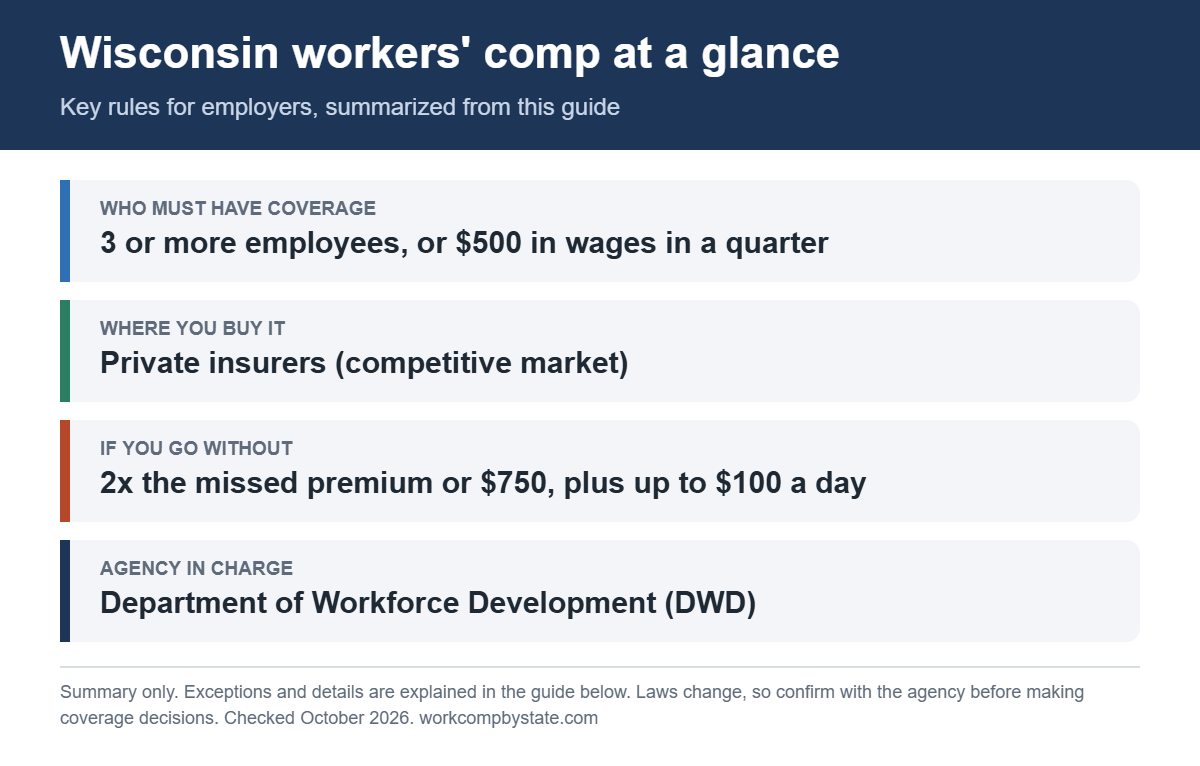
The Department of Workforce Development (DWD) lists three situations that require worker’s compensation insurance, each with its own start date.
| If you… | Coverage is required |
|---|---|
| Employ 3 or more full-time or part-time employees | The day you employ the third person |
| Pay gross wages of $500 or more in any quarter to 1 or more employees for work done in Wisconsin | The 10th day of the 1st month of the next quarter |
| Are a farmer employing 6 or more workers on the same day for any 20 days in a calendar year | 10 days after the 20th day of employment |
The $500 trigger is the one that catches small businesses. It is not hard to hit. A single part-time employee earning $15 an hour for 12 hours a week crosses $500 in about three weeks.
Example: a one-employee shop
A Madison bike shop owner hires her first part-time mechanic on February 3. By the end of March, the mechanic has earned well over $500. That quarter ends March 31, so the shop must have a policy in place by April 10. If she had hired two more people in March, coverage would have been required on the day the third person started.
Who counts as an employee
DWD says nearly all private and public employees in Wisconsin are covered, including part-time employees, family members, minors and corporate officers.
The groups not considered employees under the Act include:
- sole proprietors, partners and LLC members (they may buy coverage for themselves voluntarily);
- domestic servants;
- anyone whose work is not part of the employer’s trade, business, profession or occupation;
- certain relatives of a farmer: parents, spouse, children, siblings and in-laws;
- volunteers of nonprofits who receive no more than $10 a week in pay or in-kind compensation;
- employees of Native American tribal enterprises, including casinos;
- qualified members of certain religious sects; and
- real estate brokers and agents who meet the two conditions in s. 452.38.
Corporate officers
Every Wisconsin policy for a corporation includes its officers by default. A closely held corporation, meaning fewer than ten shareholders, can exclude up to two officers by endorsement on the policy. Everyone else must stay covered.
Two details matter. First, excluded officers still count when deciding whether the corporation has three employees. Second, a closely held corporation with no more than two officers and no other employees does not need insurance at all, but only if the officers file a Corporate Officer Option Notice with DWD.
Independent contractors: all nine, all the time
Wisconsin’s test is strict. Under s. 102.07(8), a person is an independent contractor only if they meet and maintain all nine conditions:
- maintain a separate business;
- hold a federal employer identification number, or have filed business or self-employment tax returns based on the work in the previous year;
- operate under specific contracts;
- be responsible for operating expenses under those contracts;
- be responsible for satisfactory performance of the work;
- be paid per contract, per job, by commission or by competitive bid;
- be subject to profit or loss on the work;
- have recurring business liabilities and obligations; and
- be in a position to succeed or fail if business expenses exceed income.
DWD is blunt about this. A person is not an independent contractor just because they say so, because you say so, or even because the IRS or another agency says so. Missing one condition makes the person an employee for worker’s comp.
Getting a policy
Buy from an insurance company licensed to write worker’s compensation in Wisconsin. The policy must list Wisconsin in section 3-A, and the insurer files it with the Wisconsin Compensation Rating Bureau. If you are turned down, you can get coverage through the Bureau’s Worker’s Compensation Insurance Pool. The State of Wisconsin does not sell policies.
Out-of-state employers with employees working in Wisconsin must carry Wisconsin coverage too.
When you can stop
This is where Wisconsin differs most from other states. Once you are subject to the Act, you stay subject to it until you formally qualify to withdraw.
- You must keep a policy as long as you have one or more employees, full time or part time.
- If you drop to a single part-timer earning less than $500 a quarter, you must still keep coverage for the rest of that year and the next calendar year before you can withdraw.
- If you lay off everyone, you can drop the policy while you have no employees, but you remain subject to the Act. When you hire again, the policy must be in place on the new employee’s first day.
- Farmers must wait a full calendar year without employing 6 or more workers on 20 or more days before withdrawing.
- Corporations cannot withdraw at all, except through the Corporate Officer Option Notice described above.
Penalties
An uninsured employer can be assessed double the premium it should have paid during the uninsured period, or $750, whichever is greater. There can also be a penalty of $100 a day for up to seven days. DWD can order the business closed. And if an employee of an uninsured business is hurt, the owner can be held personally liable for the benefits paid.
Checklist
- Track quarterly wages from your first hire. The $500 line comes fast.
- Bind coverage before the third employee starts.
- Closely held corporation? Decide on officer exclusions, and file the Corporate Officer Option Notice if it applies.
- Test every contractor against all nine conditions.
- Do not cancel a policy without confirming you are eligible to withdraw.
Related guides
- Do part-time employees count for workers’ comp?
- Do 1099 contractors need workers’ comp?
- Family members and workers’ comp
- Penalties for not having workers’ comp by state
- Michigan workers’ comp requirements
Sources
- Wisconsin DWD, worker’s compensation insurance requirements
- Wisconsin DWD, independent contractor nine-point test
- Wisconsin DWD, employer resources
Last checked against the sources above on October 2, 2026. Laws change, so confirm with the Wisconsin Worker’s Compensation Division or a licensed agent before making coverage decisions.