
Do Part-Time Employees Need Workers’ Comp Coverage?
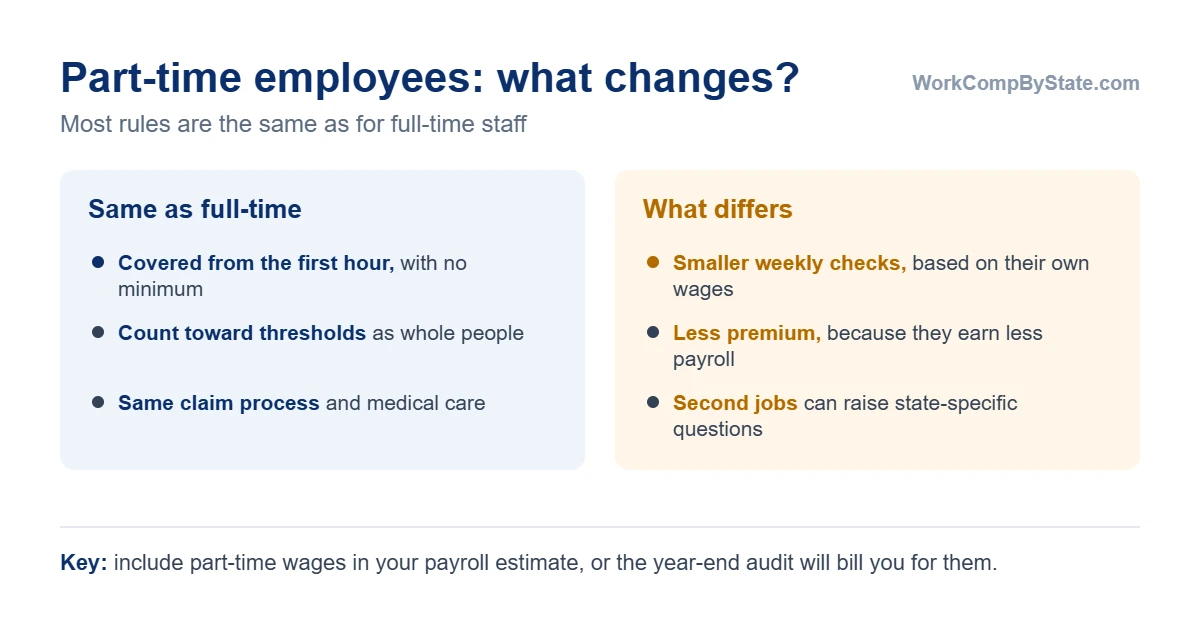
Yes, in almost every case where your state requires you to carry workers’ comp at all. State laws generally do not have a separate category for part-time workers. Someone who works 12 hours a week is an employee, and if they get hurt on the job, the same rules apply as for someone working 40.
Where part-time status does matter is in two narrower places: whether your business has enough employees to trigger the requirement in the first place, and how much the coverage costs. This guide answers the questions owners ask most about both.
Do part-timers count toward my state’s employee threshold?
Usually, yes. Many states require coverage only once you reach a certain number of employees, and part-timers generally count as full people, not as fractions. Some examples from official sources:
| State | When coverage is required | How part-timers are treated |
|---|---|---|
| Tennessee (non-construction) | 5 or more employees | Part-timers, minors and working family members all count |
| Tennessee (construction) | 1 or more employees | Part-time, seasonal and “as needed” workers all count |
| Wisconsin | 3 or more employees, or $500 or more in gross wages in any calendar quarter | Part-time employees are covered employees |
| Michigan | 3 or more employees at one time, or 1 employee working 35+ hours a week for 13+ weeks in the prior 52 | Part-timers count toward the three; the hours rule can catch a single full-time worker |
Sources: Tennessee BWC (non-construction), Tennessee BWC (construction), Wisconsin DWD employer guide and MCL 418.115.
Notice Wisconsin’s wage trigger. A business with only one or two part-time employees can still be required to carry coverage once it pays $500 or more in gross wages in a quarter. Under the DWD guide, coverage is then required by the 10th day of the next quarter.
Many other states require coverage from the first employee, part-time or not. Our is workers’ comp required guide and 50-state table list each state’s rule.
Is there a minimum number of hours before coverage applies?
For most employers, no. Coverage applies to the injured worker from their first hour on the job. A few exceptions are tied to specific kinds of work, not to part-time status in general. Household help is the usual one: several states cover domestic workers only above a set number of hours or workers. If you run an ordinary business, do not look for an hours cutoff. Assume your part-timers are covered.
Does a part-timer’s injury get handled any differently?
The claim process is the same: report it, send the worker for care, notify your insurer. Wage-loss benefits are generally calculated from the worker’s own average weekly wage, so a part-timer who earns less usually receives smaller weekly checks. Medical care is covered the same way.
One wrinkle: part-timers often hold a second job. Some states have rules for how wages from other employment are treated. New Jersey’s worker FAQ, for example, addresses a worker hurt at a part-time job who also cannot do a full-time job. Ask your insurer how your state handles it if it comes up.
Will adding part-timers raise my premium a lot?
Usually much less than adding a full-time worker. In most states premium is calculated on payroll: a rate for each job class, applied per $100 of wages. A part-timer earns less, so they add less premium.
Illustrative example. A small bakery has a class rate of $2.00 per $100 of payroll (a made-up figure; real rates depend on your state, class code and insurer). It hires two weekend counter workers who will earn about $14,000 each this year.
- Added payroll: $28,000
- Added premium: 280 x $2.00 = $560 for the year
The key is to include them in your payroll estimate. If you leave them out, the year-end audit will catch the difference and bill you for it at once. Our premium calculation guide walks through the math.
Washington works differently. It is one of the states where coverage comes only from the state fund, and premiums there are based on hours worked in each risk class. Employers also deduct part of the premium from workers’ pay: one-half of the medical benefits portion, and no other part, under RCW 51.16.140. For a part-timer, fewer hours means less premium.
A Michigan scenario (hypothetical)
A two-person print shop in Michigan has the owner, one full-time press operator working 40 hours a week, and one part-time designer working 15 hours a week.
- Three employees at one time? No. The owner is a sole proprietor, and Michigan’s employer FAQ says sole proprietors are not covered, so there are two employees.
- One employee working 35 or more hours a week for 13 or more weeks in the past 52? Yes, the press operator.
So the shop must carry coverage, and once it has a policy, the part-time designer is covered too. Owners often assume they are too small to need coverage because they only have “one real employee and a part-timer.” Michigan’s hours rule is exactly the case that catches them.
What about seasonal or on-call workers?
Treat them like other employees while they work for you. Tennessee’s construction rules spell this out by listing seasonal and “as needed” workers. Seasonal hiring also changes your payroll estimate, so tell your insurer ahead of a busy season. Our seasonal and temporary workers guide covers this in more detail.
Checklist for employers with part-time staff
- Count every employee, including part-timers, against your state’s threshold.
- Check whether your state also has a wage trigger (like Wisconsin) or an hours trigger (like Michigan).
- Include part-time wages in your payroll estimate when you buy or renew.
- Post the required workers’ comp notice where part-timers will see it too.
- Train part-timers on how to report an injury. They are often the ones who wait too long.
This article is general information, not legal advice. Thresholds and exclusions vary by state.
Related guides
- Is workers’ comp legally required?
- Seasonal and temporary workers
- Family members working in the business
- Tennessee workers’ comp requirements
- Michigan workers’ comp requirements
Sources
- Tennessee BWC, non-construction employers
- Tennessee BWC, construction employers
- Wisconsin DWD, employer’s guide to workers’ compensation
- MCL 418.115, Michigan
- Michigan WDCA, employer FAQs
- RCW 51.16.140, Washington
Last checked against the sources above on October 2, 2026.