
Workers’ Comp for Volunteers: Are They Covered?
Usually not. Workers’ comp is insurance for employees, and a true volunteer is not one. But the word “volunteer” carries less legal weight than most organizations think. Who you are, what you pay, and which state you are in all change the answer. A business that calls unpaid helpers “volunteers” can end up with uninsured employees, and a nonprofit that hands out small stipends can do the same thing without noticing.
This guide breaks the question into three tests, then walks through common situations.
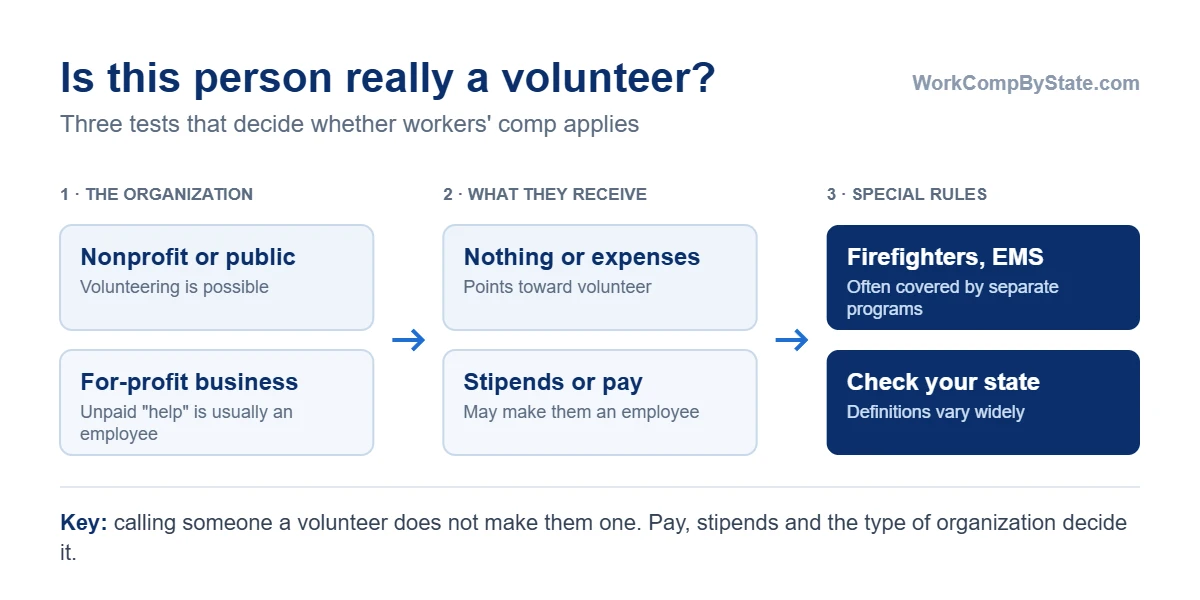
Test 1: Is the organization allowed to have volunteers at all?
For a for-profit business, the answer is generally no. The U.S. Department of Labor’s guidance under the Fair Labor Standards Act says employees may not volunteer services to for-profit private sector employers. People who donate their time for public service, religious or humanitarian purposes to nonprofit organizations, without expecting pay, are a different matter, and so is volunteering for public agencies.
That has a direct workers’ comp consequence. If a café owner lets a friend “help out for free” on busy weekends, the friend is very likely an unpaid employee in the eyes of wage law and, in many states, workers’ comp law. If that person is hurt, “they were volunteering” is a weak defense. Count them, pay them properly and cover them.
Test 2: Is the person getting anything of value?
Many state laws define a volunteer by what they do not receive. The details vary, which is why small amounts matter:
- A church member who mows the lawn for free once a month. Classic volunteer. Usually not an employee for workers’ comp.
- A nonprofit’s paid office manager who “volunteers” extra hours at the annual gala. Risky. Many organizations treat this as part of the job. Count it as work time and keep them covered.
- A retired contractor who builds a ramp for a charity and gets free lunches. Probably a volunteer in California, where meals are allowed, and in many other states.
- An intern at a for-profit marketing firm working unpaid for credit. Interns are a separate question under federal wage law and fall outside this guide; do not assume the volunteer rules apply. Talk to your agent before the start date.
- A board member who drives to a donor meeting. Unpaid board service for a nonprofit is usually volunteer service. Accident coverage may still be wise.
- A “volunteer” at a family-run shop helping stock shelves. Likely an employee. See family members and workers’ comp.
- Volunteer accident insurance, which pays medical costs for volunteers injured during activities, usually as excess over their own health plan.
- General liability insurance, which responds if a volunteer sues the organization. Check whether volunteers are listed as insureds and whether injuries to volunteers are excluded.
- Voluntary workers’ comp coverage for volunteers, where your state and carrier allow it. Ask your agent; the options vary by state.
- Workers’ comp for nonprofits and churches
- Workers’ comp exemptions
- Family members and workers’ comp
- Independent contractors and their own coverage
- U.S. Department of Labor, FLSA Advisor: volunteers
- Wisconsin DWD, who must carry insurance
- California Labor Code 3352, persons excluded
- RSMo 287.090, Missouri exclusions
- New York WCB, The Employers’ Guide to Workers’ Compensation
| State | How it treats volunteers |
|---|---|
| Wisconsin | Nonprofit volunteers are not employees if they receive no more than $10 a week. Above that, they may be employees under the Act. |
| California | Excludes volunteers for public agencies or private nonprofits who receive nothing beyond meals, transportation, lodging or reimbursement of incidental expenses. Separate exclusions for unpaid ski patrollers and some nonprofit camp volunteers. |
| Missouri | Excludes unpaid volunteers for 501(c)(3) or 501(c)(19) organizations. |
| New York | Broader: the Workers’ Compensation Board says the definition of employee covers unpaid volunteers in many cases. |
An illustrative example. A Wisconsin food pantry gives its weekend coordinator a $150 “thank you” stipend each month. That works out to about $35 a week ($150 x 12 / 52), more than three times the $10 weekly limit. The coordinator may well be an employee for workers’ comp purposes, even though everyone calls the role volunteer. If the pantry has 3 or more employees, or pays $500 or more in wages in a quarter, it needs coverage under Wisconsin’s rules. The fix could be as simple as reimbursing documented expenses in place of a flat stipend, or covering the coordinator as an employee.
Test 3: Is there a special law for this kind of volunteer?
Some volunteer roles have their own rules. Volunteer firefighters and ambulance or rescue volunteers are often covered by separate state or local programs, usually paid for by the town or fire district. Youth sports referees are another example: Missouri lists youth sports officials among the people excluded from the definition of employee. If your volunteers fall into a specialized category, check with your state workers’ comp agency before assuming anything.
Six situations, sorted
These are general patterns based on the rules above, not legal rulings. State law and the details decide each real case.
If volunteers aren’t covered, what protects them?
A volunteer who is hurt with no workers’ comp in place has two paths: their own health insurance, or a claim against the organization for negligence. Neither is great for the organization. Many nonprofits fill the gap with:
Quick questions
Can a volunteer sue us? Often yes, because workers’ comp’s limit on lawsuits applies to covered employees. See can an employee sue their employer.
Do volunteers count toward our state’s employee threshold? True volunteers generally do not. People the law treats as employees (because they are paid, or because the organization is a for-profit business) do.
Are gift cards or free merchandise payment? They can be. Several state definitions focus on whether the person receives remuneration beyond specific allowed items, so keep gifts small and occasional, or ask your agent.
Related guides
Sources
Last checked against the sources above on October 2, 2026.