
Workers’ Comp Fraud: How to Recognize and Prevent It
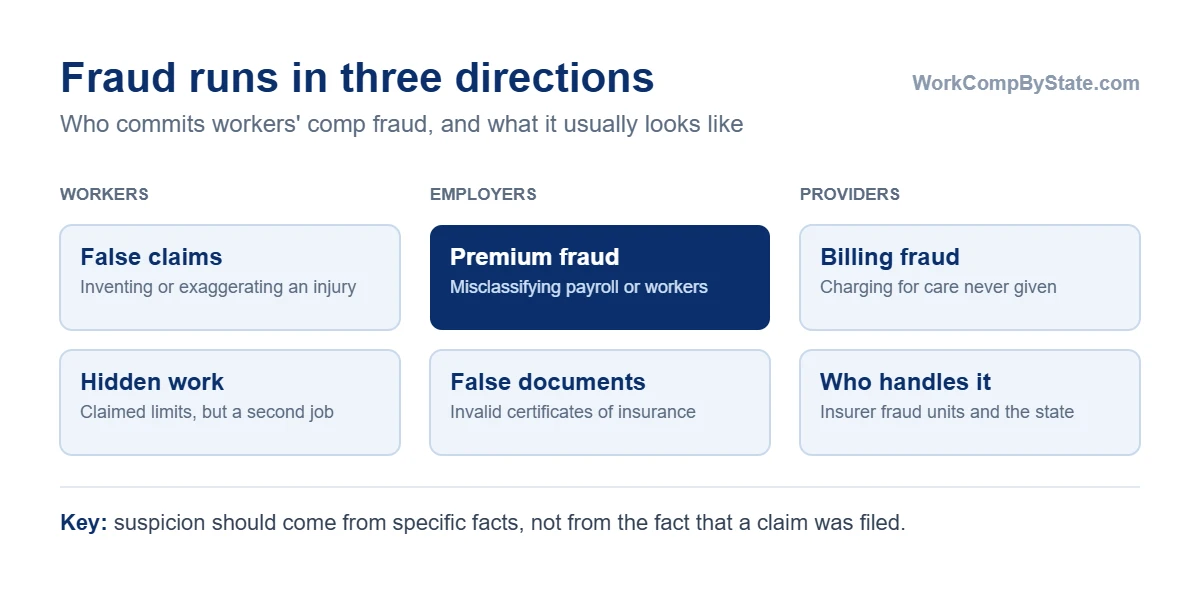
When owners hear “workers’ comp fraud,” they picture an employee faking a back injury. That happens. But fraud in this system runs in three directions: workers who exaggerate or invent claims, employers who shrink their premium with false information, and medical providers who bill for care that never happened. As an employer, you can be the victim of the first and the culprit of the second without meaning to.
This guide clears up the most common beliefs about fraud, then gives you a practical way to spot it, report it and stay on the right side of the rules yourself.
Myths and facts
Myth: Most claims are suspicious, so treat them that way.
Fact: Most claims are what they look like: a real injury, reported honestly. Treating every injured worker like a suspect slows claims, sours the workplace and can expose you to a retaliation claim. Suspicion should come from specific facts, not from the fact that a claim was filed.
Myth: Fraud is only something employees do.
Fact: State laws target employers too. Missouri’s statute, RSMo 287.128, is a good example because it lists the whole range in one place. It makes it unlawful to knowingly present a false claim for benefits, and also to knowingly misrepresent facts to get insurance at less than the proper rate, to provide an invalid certificate of insurance, or to make false statements meant to discourage an injured worker from making a legitimate claim.
Myth: Paying someone on a 1099 makes them a contractor.
Fact: The tax form does not decide it. Tennessee’s Bureau of Workers’ Compensation says plainly that a 1099 does not settle whether a worker is an employee, and uses a multi-factor test where control over the work matters most (Tennessee non-construction requirements). Wisconsin applies a nine-part test that includes having a separate business, being responsible for operating expenses and being exposed to profit or loss (Wisconsin DWD). Calling employees contractors to avoid premium is one of the most common forms of employer fraud, whether or not the owner thinks of it that way. See our guide to 1099 workers and workers’ comp.
Myth: Fraud penalties are just fines.
Fact: They can be criminal. In Missouri, knowingly presenting a false claim is a class E felony, with a fine of up to $10,000 or double the value of the fraud, whichever is greater. Misrepresenting facts to get a lower premium is a class A misdemeanor, and a repeat offense is a felony. Providing an invalid certificate of insurance is a class E felony. In Tennessee, failing to insure or misclassifying workers can bring a penalty of up to 1.5 times the estimated annual premium (Tennessee BWC).
Myth: If I suspect fraud, I can fire the employee or follow them myself.
Fact: That is how a weak suspicion becomes a lawsuit against you. Some states do say firing someone for a fraudulent claim is not retaliation (Virginia’s Va. Code 65.2-308 is one), but you need the fraud established first. Investigation is the insurer’s job. Your job is to pass along what you know.
Red flags worth passing to your insurer
None of these prove anything alone. Two or three together are worth a call to the adjuster.
- The injury was reported right after a layoff notice, a write-up or a schedule change.
- An accident supposedly happened late Friday but was first mentioned Monday, with no witnesses.
- The story of how it happened changes between tellings.
- The claimed limits do not match what coworkers see, such as heavy lifting at a second job.
- The employee is hard to reach during recovery and misses medical appointments.
- Repeated claims, or frequent switching of doctors during one claim.
What to do when something looks wrong
- Keep handling the claim normally. Report the injury, provide records and stay polite.
- Write down facts, not conclusions. “Reported injury at 8:05 a.m. Monday. Said it happened Friday at 4:30 p.m. Shift log shows he left at 3:00 p.m. Friday.” Dates, times, documents.
- Tell the adjuster in writing. Insurers have special investigation units for this.
- Do not confront, threaten or surveil. Do not post about it or discuss it with coworkers.
- Know the state channel. Many states take fraud complaints directly. In Missouri, anyone can file a complaint with the Division of Workers’ Compensation, which refers it to its fraud and noncompliance unit.
Premium fraud: an illustrative example
Workers’ comp premium is usually figured as a rate per $100 of payroll for each class code, and riskier work carries a higher rate. That structure is what tempts some owners to misreport. Here is a hypothetical case with made-up rates:
A small roofing company has $200,000 of payroll for crews working on roofs. Suppose the roofing rate is $12 per $100 of payroll, and the clerical rate is $0.30. Reported correctly, the roofing payroll costs $24,000 in premium. If the owner reports that payroll as office work, the premium on paper drops to $600.
| Reported correctly | Misreported as office work | |
|---|---|---|
| Payroll | $200,000 of roofing payroll | $200,000 listed as clerical |
| Rate per $100 (made up) | $12.00 | $0.30 |
| Premium on paper | $24,000 | $600 |
| After the year-end audit | $24,000 | $24,000 owed anyway, plus possible criminal charges |
The year-end premium audit looks at payroll records, job duties and tax filings. When it finds roofers listed as clerks, the owner owes the full $24,000 anyway, and in a state like Missouri the misrepresentation itself is a crime. If a roofer is hurt in the meantime, the claim history and the cover-up become part of the same file. There is no version of this where the owner comes out ahead. Our guide to lowering your premium legally covers the ways that do work.
A short prevention checklist for employers
- Post your injury reporting procedure and follow it every time.
- Investigate accidents the same day, with photos and witness names.
- Offer light duty when doctors allow it. People who stay connected to work tend to return sooner.
- Classify workers carefully and keep records that show why a contractor is a contractor.
- Report payroll and job duties accurately at application and audit.
- Collect current certificates of insurance from subcontractors.
Related guides
- How to file a workers’ comp claim
- Workers’ comp audits
- Workers’ comp for 1099 workers
- Can an employee sue you if they’re covered by workers’ comp?
Sources
- RSMo 287.128, Missouri fraud and noncompliance
- Tennessee BWC, non-construction requirements
- Tennessee BWC, Uninsured Employers Fund and penalties
- Wisconsin DWD, independent contractors
- Va. Code 65.2-308
Last checked against the sources above on October 2, 2026.