
Workers’ Compensation Insurance Requirements in California
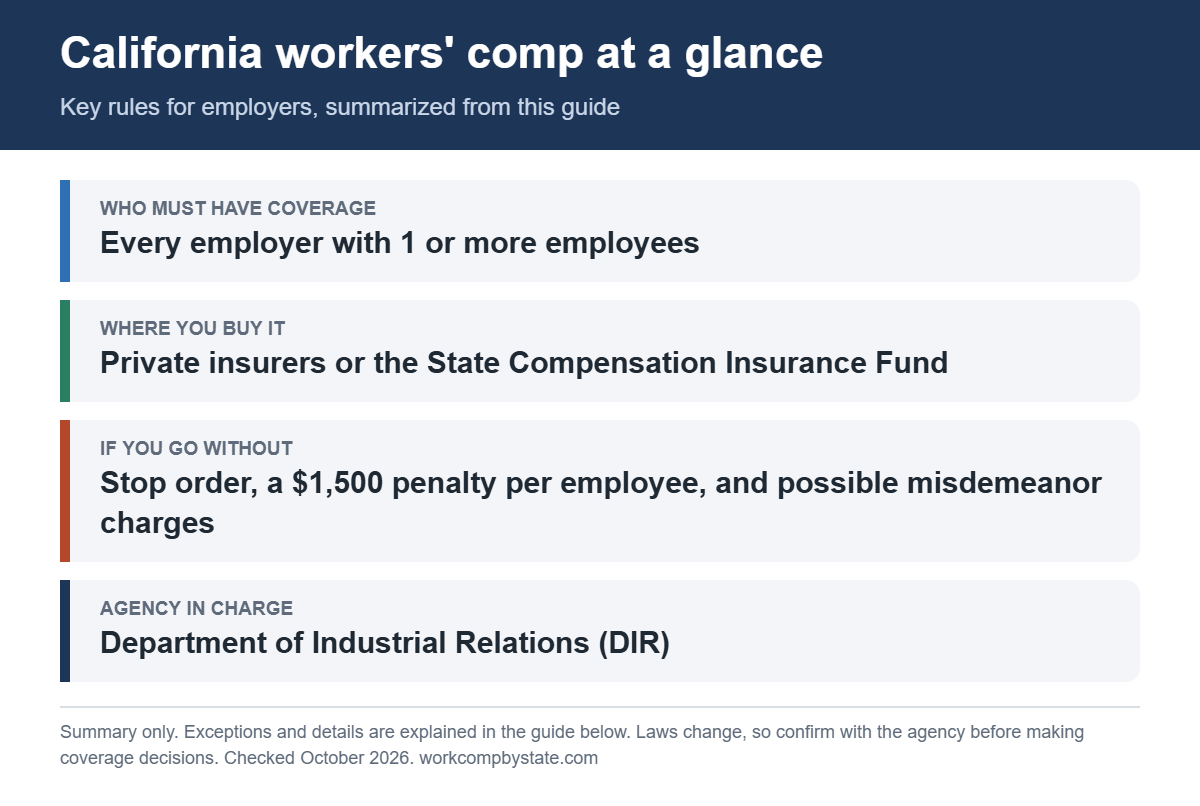
California’s rule is short: every employer except the state must carry workers’ comp, starting with the first employee (Labor Code § 3700). What makes California different from most states is how hard it comes down on employers who skip it, and how broadly it defines “employee” in the first place.
Below are the questions small business owners ask most, answered from the Labor Code and the state agencies that enforce it.
How many employees before I need coverage?
One. There is no headcount threshold, no payroll threshold and no grace period. Part-time and temporary workers count from their first day.
How do I get covered?
Section 3700 allows two options for private employers:
- a policy from an insurer licensed to write workers’ comp in California, or
- a certificate of consent to self-insure from the Director of Industrial Relations, alone or as part of a group, which requires proof that you can pay claims.
California also has the State Compensation Insurance Fund (State Fund). It is not a monopoly. It competes with private insurers and is one more place to get a quote, which can help businesses in high-risk trades. More on how the different models work in state fund vs. private insurer.
Who is not an employee for workers’ comp?
Section 3352 lists the people the law excludes. The ones that matter to most small businesses are:
- Stop order (§ 3710.1). The state can order you to stop using employee labor immediately. You must pay affected employees for up to 10 days of lost time while you comply.
- Penalty assessment (§ 3722). When the stop order is served, the penalty is $1,500 for each employee on staff at that moment. If you were uninsured for more than a week in the previous year, the state can instead charge the greater of twice the premium you should have paid or $1,500 per employee during the uninsured period.
- Criminal charges (§ 3700.5). Knowingly going without coverage is a misdemeanor punishable by up to a year in county jail, a fine of up to double the premium you avoided with a minimum of $10,000, or both. A second conviction can bring a fine of triple the premium.
- Claims paid by the state, then billed to you. If an uninsured employer’s worker is hurt, California’s Uninsured Employers Benefit Trust Fund pays benefits and then pursues the employer to recover the cost.
- Workers’ Comp Requirements by State: 50-State Comparison Table
- Penalties for Not Carrying Workers’ Comp Insurance by State
- Workers’ Comp Insurance for Roofing Contractors
- How Workers’ Comp Premiums Are Calculated
- California Labor Code § 3700: who must secure compensation
- Labor Code § 3352: persons excluded from “employee”
- Labor Code § 3710.1: stop orders
- Labor Code § 3722: penalty assessments
- Labor Code § 3700.5: criminal penalties
- CSLB: workers’ compensation requirements for contractors
| Excluded under Labor Code § 3352 | Conditions |
|---|---|
| Short-term household help | In the 90 days before an injury, the job was under 52 hours or paid $100 or less |
| Family employment in the home | A household worker employed by their parent, spouse or child |
| Some corporate officers and directors | Own at least 10% of the stock (or 1% if a close relative owns 10%), have health coverage and sign a written waiver under penalty of perjury |
| Certain volunteers | Volunteers for nonprofits and public agencies who meet the statute’s conditions |
Note what is missing: there is no general exemption for small businesses, for family members working in an ordinary business, or for seasonal staff.
Can I avoid it by using independent contractors?
Much harder in California than elsewhere. Since 2020 the state has used the “ABC test” in Labor Code § 2775 to decide who is an employee under the Labor Code, and workers’ comp is part of the Labor Code. Under that test a worker is presumed to be an employee unless the business shows all three of the following: the worker is free from your control, the work is outside the usual course of your business, and the worker has an independently established trade or business. There are many industry exceptions, but a painting company that calls its painters “contractors” is exactly the case the test was written for. See 1099 workers and workers’ comp for how misclassification usually comes to light.
I’m a licensed contractor. What does CSLB require?
The Contractors State License Board ties your license to workers’ comp. To keep an active license you must either file a certificate of workers’ comp insurance (or a self-insurance certificate) or file an exemption stating you have no employees.
Five license classifications cannot use that exemption. According to CSLB, every active C-8 Concrete, C-20 HVAC, C-22 Asbestos Abatement, C-39 Roofing and C-61/D-49 Tree Service contractor must carry workers’ comp whether or not they have employees. A law passed in 2021 (SB 216) extends that requirement to every licensed contractor. Its start date has already been pushed back once, to January 1, 2028, so check CSLB’s workers’ comp page for the current status before you renew.
What happens if I’m caught without coverage?
California has several enforcement tools, and they can be used together:
The math is harsh even for a small company. A landscaping business with four workers caught by an inspector faces at least $6,000 in penalties on the spot, before any claim, and has to stop work until a policy is in place.
How do I check a subcontractor’s coverage?
For licensed contractors, the CSLB license lookup shows whether a workers’ comp certificate or exemption is on file and the insurer’s name. Always ask for a certificate of insurance as well, because the lookup only shows what was filed.
Related guides
Sources
Last checked against the sources above on October 2, 2026. This is general information, not legal or insurance advice. For decisions about your business, consult a licensed agent or a California attorney, or contact the Department of Industrial Relations.