
Workers’ Compensation Insurance Requirements in New York
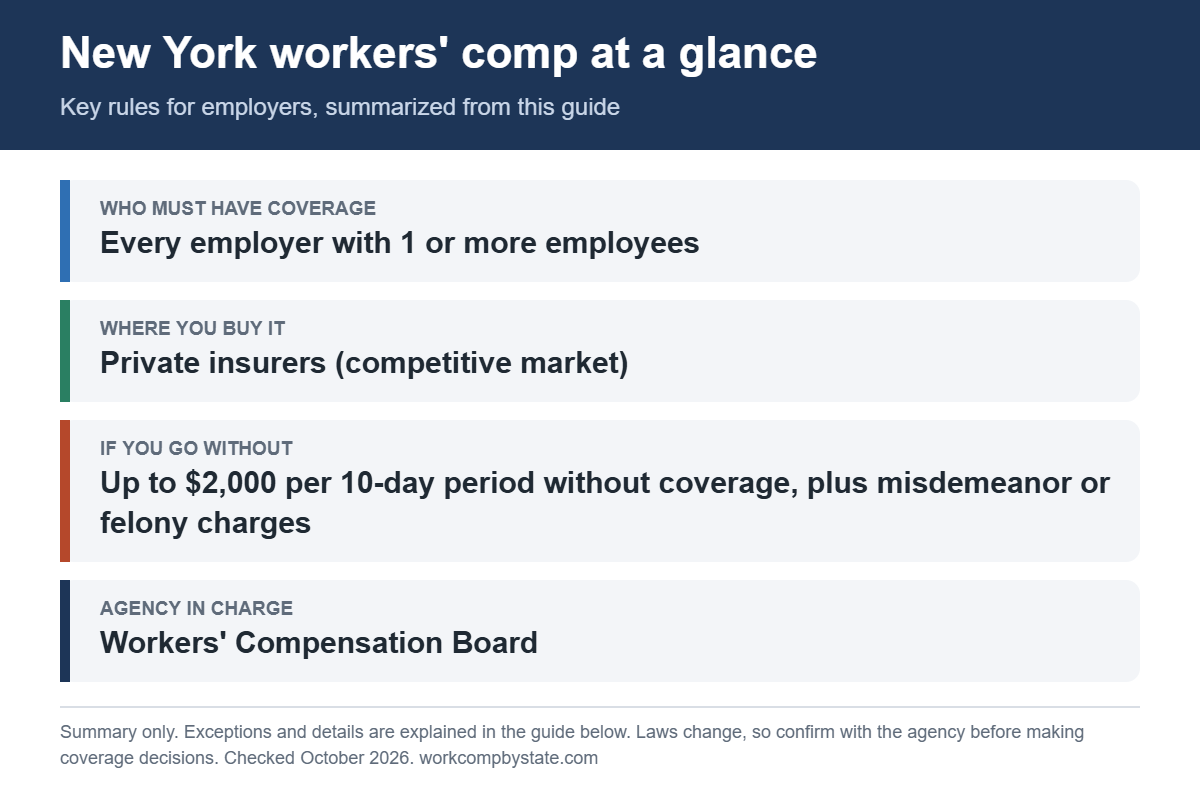
New York asks more of small employers than almost any other state. You need workers’ comp from your first employee, and on top of it you need a second policy that most other states don’t require at all: disability and Paid Family Leave benefits. The penalties for getting it wrong are among the steepest in the country, and corporate officers can be held personally liable.
What a New York employer has to carry
| Coverage | What it pays for | Legal basis |
|---|---|---|
| Workers’ compensation | Medical care and lost wages for work-related injuries and illnesses | Workers’ Compensation Law, Article 4 |
| Disability benefits (DBL) and Paid Family Leave (PFL) | Partial wage replacement for injuries and illnesses outside work, and paid leave to bond with a child or care for a family member | Workers’ Compensation Law § 211 |
Both can be bought from a private insurer or from the New York State Insurance Fund (NYSIF), which competes with private carriers. Large employers can also qualify to self-insure.
Who counts as an employee
The Workers’ Compensation Board’s employer guide is blunt: coverage must include all employees, “even part-time staff and family members,” and the Board’s definition of employee covers day labor, leased and borrowed employees, part-time workers and, in many cases, unpaid volunteers.
Household employers have a specific rule. The law lists “domestic workers… employed by the same employer for a minimum of forty hours per week” among the covered employments, so a full-time nanny or housekeeper must be covered, while occasional help below that line generally is not.
Who usually doesn’t need a policy
According to the Board, the main groups that don’t need coverage are:
- sole proprietors with no employees;
- partnerships (including LLCs, LLPs, PLLCs, PLLPs and RLLPs) with no employees other than the partners or members;
- one- and two-person corporations, where the officers hold all the stock and there are no other employees.
The day one of these businesses hires anyone, even part-time, the exemption ends.
What happens if you’re not covered
New York’s penalties come from several directions at once. Under Workers’ Compensation Law § 52:
- A civil penalty of up to $2,000 for every 10-day period without coverage, or up to twice the cost of coverage for your payroll during the gap. If you can’t produce payroll records, the Board assumes each employee, officer, sole proprietor or partner earned 1.5 times the state average weekly wage.
- A crime, not just a fine. Going without coverage for five or fewer employees in a 12-month period is a misdemeanor, with a fine of $1,000 to $5,000. For more than five employees it is a class E felony with a fine of $5,000 to $50,000. A repeat conviction within five years is a class D felony.
- Personal liability for officers. In a corporation, the president, secretary and treasurer are liable for the failure and for the civil penalty. An officer’s defense is to show they took reasonable steps and had proper internal controls to make sure coverage was in place.
- Stop-work orders. The Board can order an uninsured business to stop operating until it buys coverage.
One more rule closes a common loophole: if you deliberately understate payroll or misdescribe employee duties to lower the premium, the law treats you as if you had no coverage at all.
How fast the numbers add up
Take a small café in Queens with six part-time employees that let its policy lapse for 90 days. That is nine 10-day periods, so the civil penalty alone can reach $18,000. Because the café had more than five employees during the year, the lapse also falls into the felony range of § 52, with a possible fine of $5,000 to $50,000. A policy for those three months would have cost a small fraction of either amount.
Practical steps for a new employer
- Get quotes for workers’ comp and for DBL/PFL before your first employee starts. Some carriers sell both.
- Post the required notices of coverage at your workplace. Your carrier usually supplies them.
- Put the renewal date in two calendars. A short lapse is exactly what the 10-day penalty is designed to catch.
- If you hire subcontractors, ask each one for proof of coverage or a Board-issued exemption certificate before work begins. See certificates of insurance.
Related guides
- Workers’ Comp vs. Health Insurance: Do You Need Both?
- Do Family Members Working in the Business Need Workers’ Comp?
- Penalties for Not Carrying Workers’ Comp Insurance by State
- Workers’ Comp Requirements by State: 50-State Comparison Table
Sources
- NY Workers’ Compensation Law § 52: effect of failure to secure compensation
- NY Workers’ Compensation Law § 3: covered employments (Group 12, domestic workers)
- NY Workers’ Compensation Law § 211: disability and Paid Family Leave benefits
- NY Workers’ Compensation Board: The Employers’ Guide to Workers’ Compensation
Last checked against the sources above on October 2, 2026. General information only, not legal or insurance advice. Contact the Workers’ Compensation Board or a licensed agent for your situation.