
Workers’ Compensation Insurance Requirements in Pennsylvania
Most states ask how many employees you have before coverage kicks in. Pennsylvania asks a different question: is every person who works for you in an excluded group? If even one is not, you need a policy. That includes part-timers, and it includes your spouse or children if they work in the business, as the Department of Labor & Industry (L&I) points out.
Rather than list the rules in the abstract, this guide follows a new Pennsylvania employer through the decisions in the order they come up, from the first hire to the poster on the wall.
Before you hire: does the law apply to you?
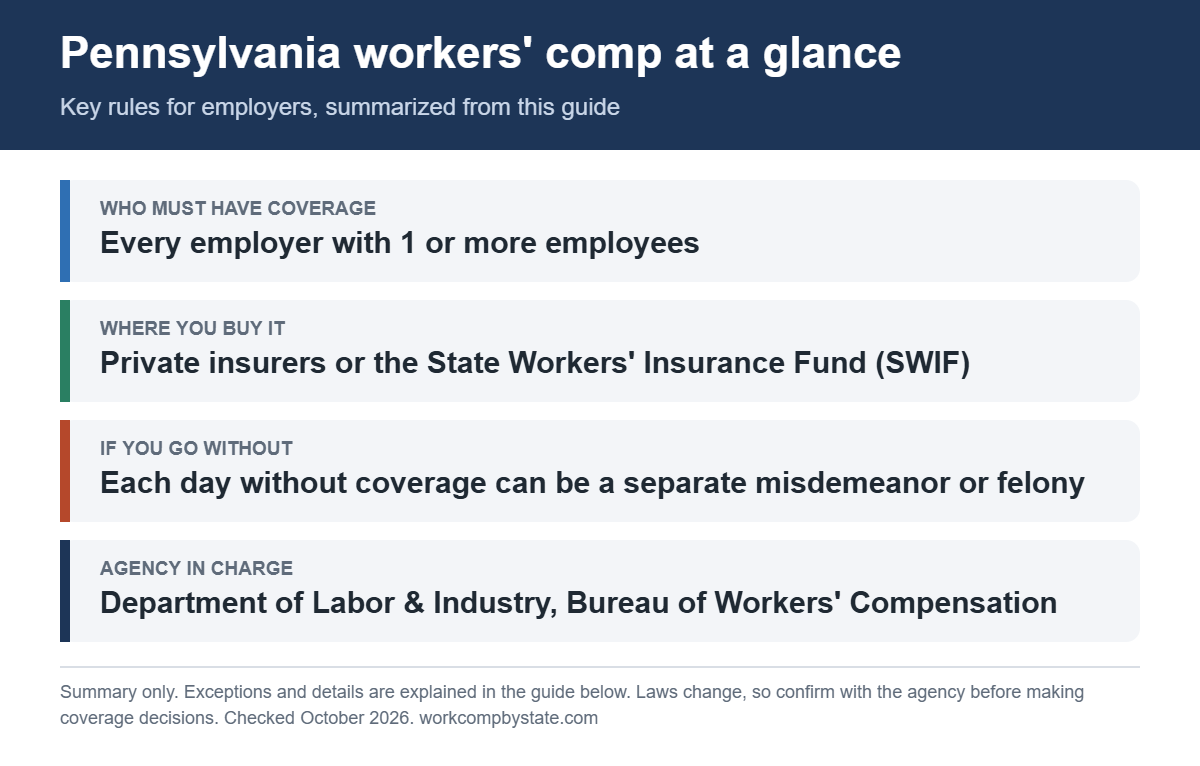
According to L&I’s compliance page, insurance is mandatory for any employer with at least one employee who could be injured or become ill from work in Pennsylvania. It also reaches employees hurt outside the state if their job is principally based in Pennsylvania, or if they were hired under a Pennsylvania contract and their job is not principally based in another state that covers them.
The only way out is if all of your workers fit one of the excluded groups. Go through your staff one person at a time and find their row in the table below. If anyone has no row, you need coverage.
| Type of worker | Excluded when… |
|---|---|
| Federal, longshore and railroad workers | Always. They are covered by federal systems instead. |
| Casual workers | The work is casual and not part of your regular business. |
| Home-based workers | They finish, repair or adapt articles you supply, on premises you do not control. |
| Agricultural laborers | Each earns under $1,200 a year from you and none works 30 days or more in the year. Special rules apply to a spouse and children under 18. |
| Domestic workers | You have not chosen to bring them under the Act. |
| Sole proprietors and general partners | Always, for the owners themselves. |
| Employees with a religious exemption | L&I has granted the exemption. |
| Executive officers | L&I has approved an exclusion (see below). |
| Real estate salespeople and insurance agents | Paid by commission only and meeting the written-agreement and independent-contractor conditions. |
If you are an officer: excluding yourself
Corporate officers count as employees unless L&I approves an exclusion, and who can apply depends on the kind of company. In a nonprofit, it is executive officers who serve as unpaid volunteers. In an S corporation, executive officers with an ownership interest. In a C corporation, executive officers who own at least 5% of the company.
The paperwork is form LIBC-509, the Application for Executive Officer Exception, plus an LIBC-513 declaration for each officer. Where you send it depends on your situation. If the company has other employees and already has a policy, you file with your insurance carrier. If the officers are the only people in the business, you file with L&I’s Compliance Section.
Your first week: buying the policy
Pennsylvania gives you three routes. You can buy from a private insurer licensed in the state, from the State Workers’ Insurance Fund (SWIF), or, if you qualify, get L&I’s approval to self-insure alone or as part of a group. SWIF competes with private insurers rather than replacing them, so it is worth a quote when private carriers are expensive for your type of work. Our comparison of a state fund vs. a private insurer explains the trade-offs.
On day one: the notice on the wall
Once you are insured, post a notice at your main place of business and at work sites, somewhere employees will see it, with the name, address and phone number of whoever handles workers’ comp claims. Your carrier normally supplies it. This small step matters more than it seems: L&I tells employees who do not see a notice and suspect their employer is uninsured to contact its Compliance Section, so a missing poster is often how an investigation starts.
Why skipping coverage is so expensive here
Pennsylvania counts penalties per day, which is what makes them severe. According to L&I’s employer information page, a misdemeanor conviction can bring a fine of up to $2,500 and up to one year in prison for each day without coverage. If the violation was intentional, a felony conviction can bring up to $15,000 and up to seven years in prison, again for each day.
The financial exposure does not stop at fines. If an uninsured employer’s worker is hurt, the state’s Uninsured Employers Guaranty Fund may pay the claim, and L&I then pursues the employer for reimbursement, including interest, penalties and attorney fees. The employer, and the people responsible for acting on its behalf, can be ordered to pay all the benefits a workers’ comp judge awards.
Two businesses, two answers
A family bakery in Lancaster
A married couple runs a bakery as a sole proprietorship, and their 16-year-old son works Saturdays. The owners are excluded as sole proprietors. Their son is not, because the family exception in the table applies only to agricultural labor. The bakery needs a policy. Our guide to family members in the business covers how other states treat this.
A two-officer IT consultancy in Pittsburgh
Two founders each own 50% of a C corporation and have no other staff. They can apply for executive officer exclusions with L&I using LIBC-509 and LIBC-513. Once approved, and as long as they hire nobody else, they do not need to insure. The day they bring on a part-time assistant, they need a policy for that person. Our article on one-person LLCs walks through a similar decision.
If you only remember three things
First, in Pennsylvania one non-excluded worker is enough, whether part-time or family. Second, officers are covered unless L&I approves their exclusion, and that approval depends on company type. Third, every day without coverage can be a separate offense. If you work in several states, our 50-state comparison shows how Pennsylvania’s rules stack up.
Based on L&I’s workers’ compensation compliance and LIBC-200 employer information pages and the Pennsylvania Workers’ Compensation Act. Last checked October 2, 2026 and reorganized October 20, 2026. General information only, not legal or insurance advice. L&I recommends asking your own attorney how the exclusions apply to specific workers.