
New Jersey Workers’ Comp Requirements: Six Real Situations, Answered
New Jersey does not have a minimum headcount. If anyone other than the owners works for your business, you need workers’ compensation insurance or state approval to self-insure. That rule is simple. Applying it is where owners get stuck, so this guide works through six situations New Jersey businesses run into, followed by the penalties and the paperwork.
The rule in one paragraph
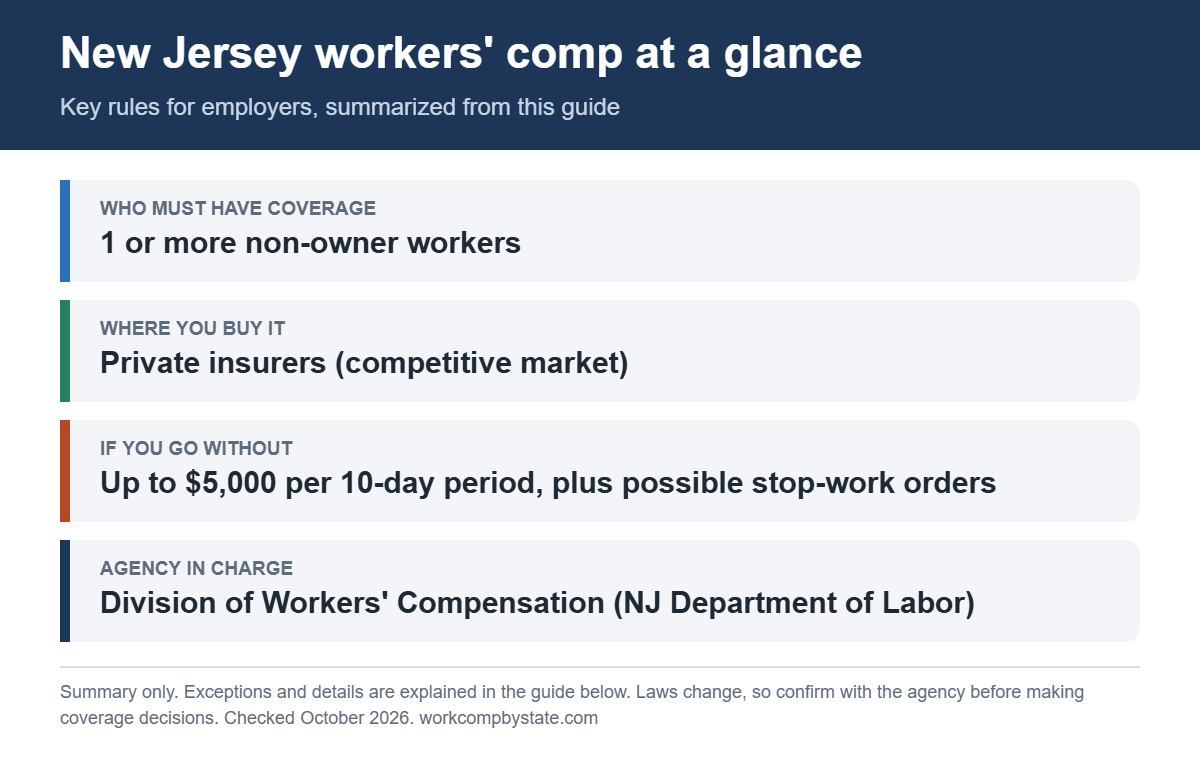
The Department of Labor and Workforce Development spells it out by business type. All corporations operating in New Jersey must maintain workers’ compensation insurance or be approved for self-insurance. Partnerships and LLCs must carry coverage as long as one or more individuals, other than the partners or members, perform services. Sole proprietors must carry it as soon as one or more individuals, other than the owner, performs services. There is no “three employee” or “four employee” floor like the ones in Georgia or Florida.
| Business type | When New Jersey requires coverage |
|---|---|
| Corporation | Always, or approval to self-insure |
| Partnership or LLC | As soon as anyone other than the partners or members performs services |
| Sole proprietorship | As soon as anyone other than the owner performs services |
Situation 1: “I’m an LLC with two members and no employees.”
You do not need a policy for yourselves. The coverage duty kicks in when someone other than the members performs services. Many two-member LLCs still buy a policy because clients, general contractors or landlords ask for a certificate. That is a business decision, not a legal one.
The moment you bring on a bookkeeper for ten hours a week, the answer changes. One worker who is not a member is enough.
Situation 2: “My corporation only has me, the owner.”
Read the Department’s wording again: all corporations operating in New Jersey must maintain coverage or be approved to self-insure. It does not carve out single-shareholder corporations the way it carves out LLC members and partners. If you incorporated, talk to your agent about how your policy treats you as an officer. Do not assume you are exempt because there is no one else on payroll.
The penalty statute also names officers directly. N.J.S.A. 34:15-79 says any officer actively engaged in the corporate business, including the president, vice president, secretary and treasurer, is liable for the failure to secure coverage.
Situation 3: “My workers are independent contractors.”
Maybe. New Jersey looks hard at this. The stop-work order rule added in 2009 targets employers who misrepresent employees as independent contractors, not only employers who never bought a policy. If you control the schedule, supply the tools and the person works only for you, expect the state to see an employee.
The state also runs a cross-match between its databases to find employers who report payroll but show no workers’ comp coverage. A business that files wage reports for people and has no policy will stand out.
Situation 4: “I let the policy lapse for a month.”
A lapse is a failure to insure for that period. The penalty is up to $5,000 for the first ten days and up to $5,000 for each additional ten-day period. A 30-day gap can therefore mean up to $15,000 in penalties before anyone gets hurt.
If someone does get hurt during the gap, you pay the medical bills and disability benefits directly. The Department notes that the state can place liens against the assets of the employer and its officers.
Situation 5: “The state issued a stop-work order.”
The Director of the Division of Workers’ Compensation can issue a stop-work order against an employer that knowingly fails to provide coverage, misrepresents employees as independent contractors, or gives false information about the number or classification of employees. The order is issued within 72 hours after the Director determines a violation.
Here is how it plays out:
- The order covers the employer and any successor firm, corporation or partnership. Closing the company and reopening under a new name does not escape it.
- You can request a hearing within 10 days. The Director must decide within 48 hours of the application.
- To lift the order, you must come into compliance and pay the assessed penalty. The Director then issues a release.
- Working while the order is in effect costs $1,000 to $5,000 for each day you are out of compliance.
Situation 6: “One of my employees just got hurt.”
Call your carrier or third-party administrator right away. In New Jersey the carrier, not the employer, files the First Report of Injury with the New Jersey Compensation Rating and Inspection Bureau. It can only do that if you tell it. A Subsequent Report of Injury follows within 26 weeks after the worker reaches maximum medical improvement.
Get the basics on paper the same day: what happened, where, who saw it, and where the worker went for treatment. Late reports are the most common reason simple claims turn into disputes.
The criminal side
Failing to provide coverage is a disorderly persons offense. If the failure is knowing, it is a crime of the fourth degree. The criminal case is separate from the civil penalties and from your liability to the injured worker. All three can happen at once.
Getting covered
You have two options. You can buy a policy from a stock or mutual carrier authorized in New Jersey, through an agent, a broker or the carrier directly. Or, if your business is large and financially stable, you can apply to the Department of Banking and Insurance for approval to self-insure.
If carriers decline you, contact the New Jersey Compensation Rating and Inspection Bureau. It handles the market of last resort and can tell you whether a policy is on file for a business.
Once insured, post the notice prescribed by the Commissioner in a conspicuous spot. For insured employers it must show the name of your carrier.
What to do this week
- List everyone who worked for the business in the last year who is not an owner, partner or LLC member.
- For anyone you pay as a contractor, write down why. If you cannot explain it in two sentences, ask your agent or an attorney.
- Check that your policy dates have no gaps, especially around renewals.
- Make sure the workplace notice shows your current carrier.
Related guides
- Do 1099 contractors need workers’ comp?
- Workers’ comp for a one-person LLC
- Penalties for not having workers’ comp by state
- New York workers’ comp requirements
- Pennsylvania workers’ comp requirements
Sources
- NJ Department of Labor, employer requirements
- NJ Department of Labor, employer and carrier FAQs
- NJ Division of Workers’ Compensation, stop-work order notice
- N.J.S.A. 34:15-79, penalties and stop-work orders
Last checked against the sources above on October 2, 2026. Laws change, so confirm with the Division of Workers’ Compensation or a licensed agent before making coverage decisions.