
Second Injury Funds and Workers’ Comp: What Employers Should Know
Most small business owners never deal with a second injury fund directly. You will not file a claim with one, and your employees probably will not either. But the idea behind these funds still shapes how some serious claims are paid, and in a few states you pay for the fund through a line on your workers’ comp bill.
This guide explains what a second injury fund is, why so many states have shut theirs or narrowed them, and how three states handle it today. It uses Missouri, New Jersey and Florida as examples because their rules are written out clearly in statute or on state pages.
The problem these funds were built to solve
Picture an employer deciding whether to hire someone who already has a permanent impairment, such as an old knee injury or the loss of sight in one eye. Under a plain workers’ comp system, if that worker later gets hurt on the job, and the new injury combines with the old one to leave them totally disabled, the employer’s policy could end up paying for the whole result. That is a much bigger bill than the new injury alone would have caused.
That risk gave employers a financial reason to avoid hiring people with disabilities. A second injury fund splits the bill:
- The employer (through its insurer) pays for the disability caused by the new work injury, considered by itself.
- The fund pays the extra amount that exists only because the new injury stacked on top of the earlier condition.
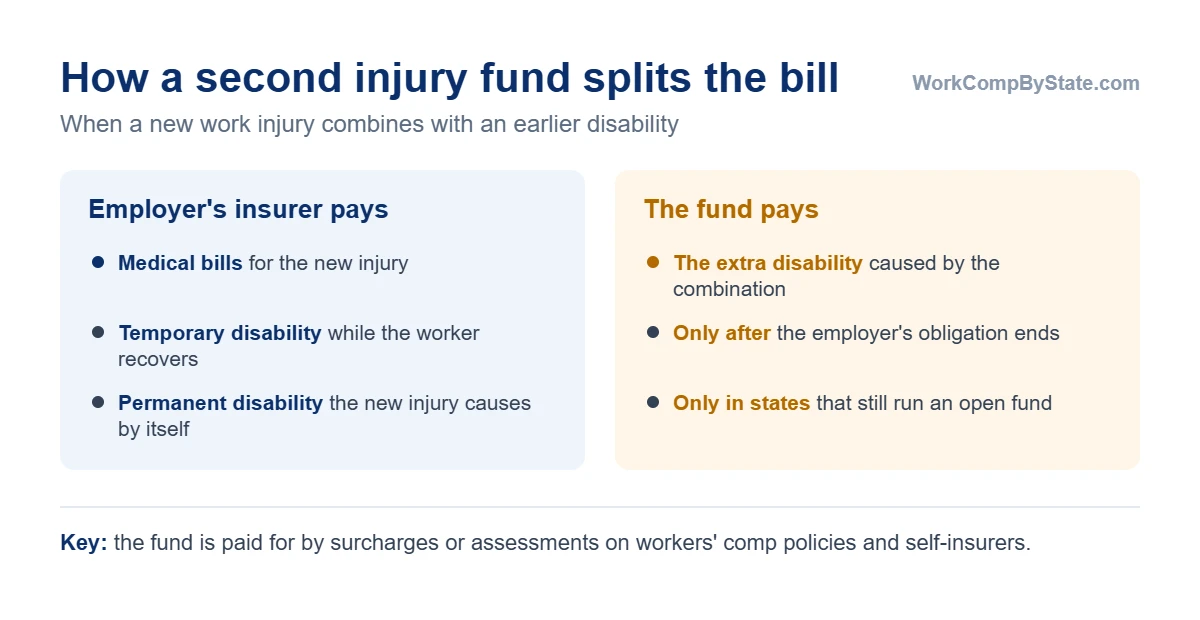
The money for the fund usually comes from assessments or surcharges on workers’ comp insurance and self-insured employers. So employers pay into a shared pool, and in exchange no single employer carries the full cost of a combined disability.
Why many states closed or limited their funds
Second injury funds were common for decades. Many states have since closed them to new injuries or cut back what they cover. A few reasons come up again and again:
- Disability discrimination law changed. The Americans with Disabilities Act of 1990 made it illegal to refuse to hire a qualified person because of a disability. The hiring incentive that justified these funds mattered less once the discrimination itself was banned.
- Money problems. Some funds promised more in long-term benefits than their assessments brought in, which left large unpaid liabilities.
- Disputes. Deciding how much of a disability belongs to the old condition and how much to the new injury invites argument, and arguments cost money in legal fees.
Closing a fund rarely makes it disappear overnight. Workers who were injured before the cutoff date can keep receiving benefits for years, so the state keeps collecting money to pay them.
Three states, three different situations
Missouri: still open, but narrowed in 2014
Missouri’s Second Injury Fund is set up in RSMo 287.220. The statute splits claims by date:
- For injuries before January 1, 2014, the older rules apply, including fund payments for some permanent partial disability.
- For injuries after January 1, 2014, no permanent partial disability claims can be filed against the fund. Permanent total disability claims are allowed only in listed situations. One example is a medically documented preexisting disability of at least 50 weeks of permanent partial disability that came from military service or an earlier compensable work injury, or that directly and significantly aggravates the new injury.
- In those cases, the employer at the time of the last injury is liable only for the disability from that injury considered alone.
The same statute also lets the fund cover certain medical and death costs for workers of uninsured employers, but only for injuries and deaths before January 1, 2014.
Missouri pays for the fund with a surcharge under RSMo 287.715. Every workers’ comp policyholder and authorized self-insurer is liable for it. Each year the Division of Workers’ Compensation sets a rate that cannot exceed 3% of net premium (or the self-insurer equivalent). The statute also allows a supplemental surcharge of up to 1% for calendar years 2014 to 2026, and that subsection expires on December 31, 2026. Insurers collect the surcharge along with your premium, and they may not keep any part of it as a fee.
New Jersey: an active fund for total disability
New Jersey’s Division of Workers’ Compensation FAQ describes a fund first set up in the 1920s to encourage hiring of people with disabilities. Here is how it works there:
- The worker must be totally and permanently disabled because of a work injury combined with a pre-existing permanent partial disability.
- The pre-existing disability does not have to be work related.
- The employer or its carrier pays first. Fund benefits begin when the employer’s obligation ends and are paid in the same amount, not on top of it.
- Benefits can last for the worker’s lifetime while they stay totally disabled and unemployed. Death and dependents’ benefits are not paid from the fund.
Florida: closed to new accidents since 1998
Florida calls its version the Special Disability Trust Fund. Under Fla. Stat. 440.49, the fund is not liable for any case where the accident causing the subsequent injury happened on or after January 1, 1998. It still reimburses employers and carriers for older subsequent injuries, and the state still assesses to fund those payments. Florida shows the typical pattern: closed to new cases, still running for old ones.
| State | Status | How it works |
|---|---|---|
| Missouri | Open, but narrowed for injuries after January 1, 2014 | No permanent partial disability claims; permanent total disability only in listed situations. Paid for by a surcharge of up to 3% of net premium, plus a supplemental surcharge of up to 1% for 2014 to 2026. |
| New Jersey | Active for total disability | For workers totally and permanently disabled by a work injury combined with an earlier partial disability, which need not be work related. Fund benefits start when the employer’s obligation ends. |
| Florida | Closed to accidents on or after January 1, 1998 | The Special Disability Trust Fund still reimburses older cases, and the state still assesses to pay for them. |
A worked example (illustrative numbers)
Here is a made-up case to show how the split works under a fund like New Jersey’s or Missouri’s.
Dana lost most of the use of her left hand in a car accident years ago. She is hired as a warehouse clerk. Two years later, she badly injures her right shoulder lifting a box at work. The shoulder injury alone would leave her with a partial disability. But with a weak left hand and a damaged right shoulder, she can no longer do any regular work, and a judge finds her totally and permanently disabled.
- The employer’s insurer pays medical bills and temporary disability for the shoulder, then the permanent disability that the shoulder injury would have caused by itself.
- Once that obligation is paid out, the fund picks up the remaining total disability benefits.
Now the cost side, also with illustrative numbers. Say a Missouri retailer pays $8,000 in annual net premium. If the division set the standard surcharge at 3%, that adds $240. If a 1% supplemental surcharge also applied that year, add another $80. The actual percentages are set each year by the division and can be lower, so check the notice your insurer or the division sends.
What this means for a small employer
- Read the extra lines on your bill. Workers’ comp invoices often include state surcharges and assessments on top of premium. In Missouri, one of them is the second injury fund surcharge. These are set by law, not by your agent, so you cannot shop them away.
- Do not let a pre-existing condition scare you off a good hire. Disability discrimination is illegal regardless of any fund. And in states with an active fund, a combined disability is not entirely your policy’s burden.
- Report injuries promptly and accurately. Whether a fund gets involved depends on medical records about both the new injury and the earlier condition. Clear records from day one help your insurer handle the claim correctly. Our guide to filing a workers’ comp claim walks through the first steps.
- Do not assume your state has a fund. Many states closed theirs or never had a broad one. Your state’s workers’ comp agency is the place to confirm.
Quick answers
Can my business file a claim with the fund? Usually not directly. Claims involve the injured worker, the insurer and the state, and are decided by a judge or the state’s workers’ comp agency.
Does the fund lower my premium? Not in any direct way you can see. The point is to shift part of certain large claims away from the employer’s insurer. Your premium still depends on payroll, class codes and your claims history, as explained in how workers’ comp premiums are calculated.
If my state closed its fund, does the surcharge stop? Not always right away. Florida, for example, keeps assessing to pay claims from before its 1998 cutoff.
This article is general information, not legal advice. Second injury fund rules change and depend on the injury date, so confirm current details with your state agency.
Related guides
- Missouri workers’ comp requirements
- New Jersey workers’ comp requirements
- Florida workers’ comp requirements
- What to do when an employee is injured
- How long a workers’ comp claim takes to settle
Sources
- RSMo 287.220, Missouri Second Injury Fund
- RSMo 287.715, Missouri Second Injury Fund surcharge
- New Jersey Division of Workers’ Compensation, FAQs for workers
- Fla. Stat. 440.49, Special Disability Trust Fund
Last checked against the sources above on October 2, 2026.