
Bundling Workers’ Comp With a Business Owner’s Policy: How to Decide
An agent offers you a package: a Business Owner’s Policy (BOP) and workers’ comp from the same insurer, one bill, a small discount. It sounds tidy. Before you say yes, it helps to know what is actually being bundled, what stays separate no matter what, and how to tell whether the package beats buying each policy on its own.
This guide walks through that decision in five questions. You can answer most of them in an afternoon with two or three quotes in hand.
First, a correction to the word “bundle”
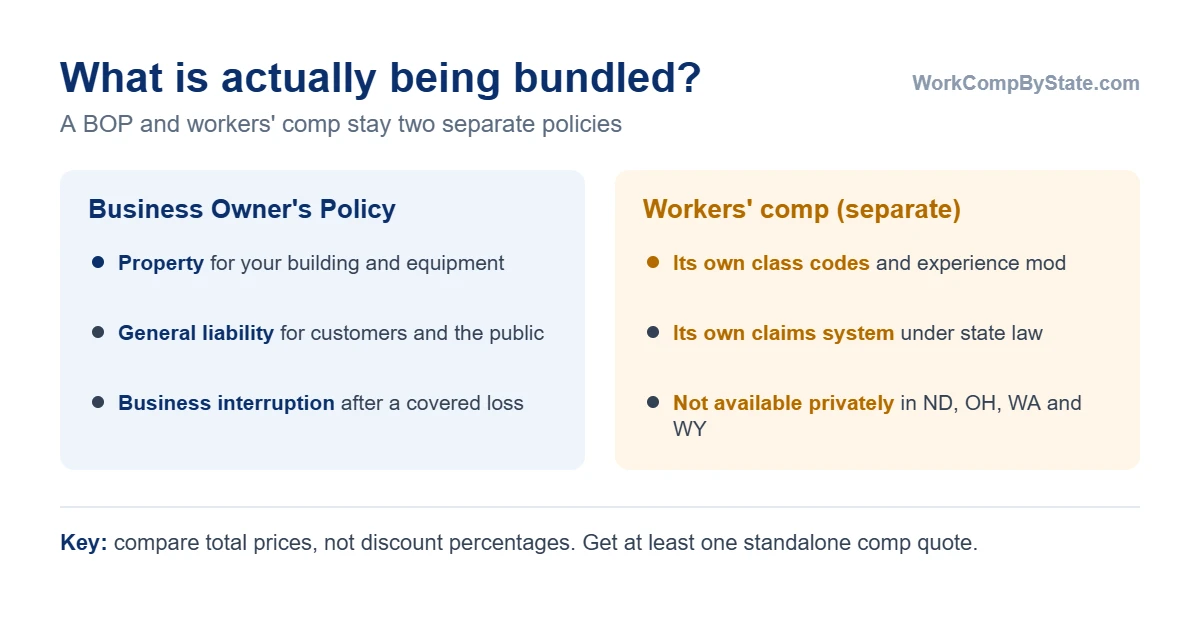
A BOP does not contain workers’ comp. The California Department of Insurance describes a BOP as a combination policy designed for small businesses that covers property, general liability and business interruption. It is written with strict underwriting guidelines and fits small “main street” businesses such as hardware stores, barbershops and accounting offices.
Workers’ comp is its own line of insurance. It has its own classification codes, its own experience modification, and its own claims system run under state workers’ comp law. In California, for example, workers’ comp classifications are set by the state rating bureau, and workers’ comp claims fall under the Department of Industrial Relations, not the Department of Insurance. Even cancellation rules sit in separate sections of the insurance code.
So “bundling” means one thing: buying a BOP and a separate workers’ comp policy from the same insurer, usually at the same time. You get two policies, two policy numbers and two sets of rules. What you may also get is a multi-policy discount, a shared renewal date and one point of contact.
The five questions
1. Is bundling even possible in your state?
Not everywhere. In North Dakota, Ohio, Washington and Wyoming, workers’ comp comes from a monopolistic state fund, so a private insurer cannot write it. Washington law, for instance, says employers must insure with the state fund or qualify as a self-insurer (RCW 51.14.010). If your employees work in one of those states, you can still buy a BOP from a private insurer, but the workers’ comp part is not up for bundling. Our monopolistic states guide covers how those funds work.
If you have employees in several states, ask whether the insurer can write workers’ comp in every one of them. A package that covers only your home state leaves a gap you would have to fill with another policy anyway.
2. Does your business qualify for a BOP at all?
BOPs are built for smaller, lower hazard operations. Insurers set limits on things like building size, revenue and type of work. A small office, shop or service business usually fits. A manufacturer, a contractor doing heavy work, or a business with large property values may be steered to a commercial package policy or separate policies instead. If you do not qualify for a BOP, the bundling question changes into a broader “should one insurer write all my lines” question.
3. Is this insurer competitive for your workers’ comp class code?
This is the question that matters most, and the one owners skip. Workers’ comp premium is driven by your class codes, your payroll and your experience mod (see how premiums are calculated). An insurer can be very good at pricing property and liability for your type of business and still have little interest in your workers’ comp class. Office and retail classes are welcome at many insurers. Roofing, tree work or trucking may not be.
The only way to find out is to get at least one standalone workers’ comp quote from a different insurer, or from your state fund where one exists, and compare.
4. What does the discount really save?
Compare totals, not percentages. A discount applied to a high price can still cost more than two lower separate prices. Ask the agent which policy the discount applies to, whether it is shown on the declarations, and whether it survives if you later move one policy elsewhere.
5. How much is one bill worth to you?
Convenience has value. One renewal date, one payment portal and one agent who knows your whole operation can save hours each year and reduce the chance that a renewal slips by. For a very small business with no office manager, that can be a fair reason to accept a slightly higher total. Just make it a choice you made on purpose.
Bundle or split: side by side
| Point | Same insurer for BOP and workers’ comp | Different insurers |
|---|---|---|
| Price | Possible multi-policy discount | Each line priced by the insurer that wants it most |
| Paperwork | Often one bill and one renewal date | Two bills, two renewal dates |
| Underwriting | Both lines must fit one insurer’s appetite | Each line judged on its own |
| Claims | Still handled separately by line | Handled separately by line |
| Monopolistic states | Not available for workers’ comp | Workers’ comp goes to the state fund |
Two illustrative cases
These numbers are hypothetical and only show the math. Real prices depend on your state, class codes, payroll and history.
A small accounting office. The bundled quote is 4,200 dollars a year for both policies after the discount. Separate quotes come to 2,000 dollars for the BOP and 2,350 dollars for workers’ comp, or 4,350 dollars in total. The bundle wins by 150 dollars and comes with one bill. Easy call.
A small roofing company. The bundled quote is 3,100 dollars for the BOP plus 21,000 dollars for workers’ comp, 24,100 dollars in total. An insurer that actively writes roofing quotes workers’ comp at 18,500 dollars. Even with a 3,400 dollar BOP from a third insurer, the split comes to 21,900 dollars. Splitting saves 2,200 dollars a year, which is far more than any convenience is worth to most owners.
The pattern holds in general: the higher your workers’ comp share of the total, the more the workers’ comp price decides the outcome.
What stays separate even when you bundle
- Claims. An injured employee files under workers’ comp. A customer who slips in your shop files under general liability. Different adjusters, different rules.
- Audits. Workers’ comp premium is based on estimated payroll and is usually trued up by a year end audit. See our guide to workers’ comp audits.
- Proof of coverage. Clients and general contractors often ask for a certificate showing both lines. Check that each policy is listed correctly; our certificate of insurance guide explains what to look for.
- Cancellation. Each policy can be cancelled or lapse on its own. Missing a combined payment can put both at risk at once, which is one real downside of a single bill.
Checklist before you sign
- Get the bundled quote with each policy’s premium shown separately.
- Get at least one standalone workers’ comp quote for the same payroll and class codes.
- Confirm the class codes match what your employees actually do.
- Ask which states the workers’ comp policy covers.
- Ask how the discount is applied and what happens to it if you move one policy.
- Compare annual totals and decide how much the single bill is worth to you.
Related guides
- How to get the cheapest workers’ comp quote
- Workers’ comp vs general liability insurance
- How much workers’ comp costs for a small business
- Workers’ comp down payments and payment plans
Sources
- California Department of Insurance, Small Business Guide to Commercial Insurance
- NAIC, Workers’ Compensation Insurance
- Washington RCW 51.14.010
Last checked against the sources above on October 2, 2026.