
How to Get the Cheapest Workers’ Comp Insurance Quote (Without Paying for It Later)
The lowest number on a quote sheet is not always the lowest cost. Workers’ comp is priced on estimates, and the insurer checks those estimates after the policy year ends. A quote that looks cheap because it uses the wrong job code or a lowball payroll figure usually comes back as a bill at audit time.
This guide is a checklist you can work through before your next quote or renewal. Each step either lowers the real price or protects you from a fake saving.
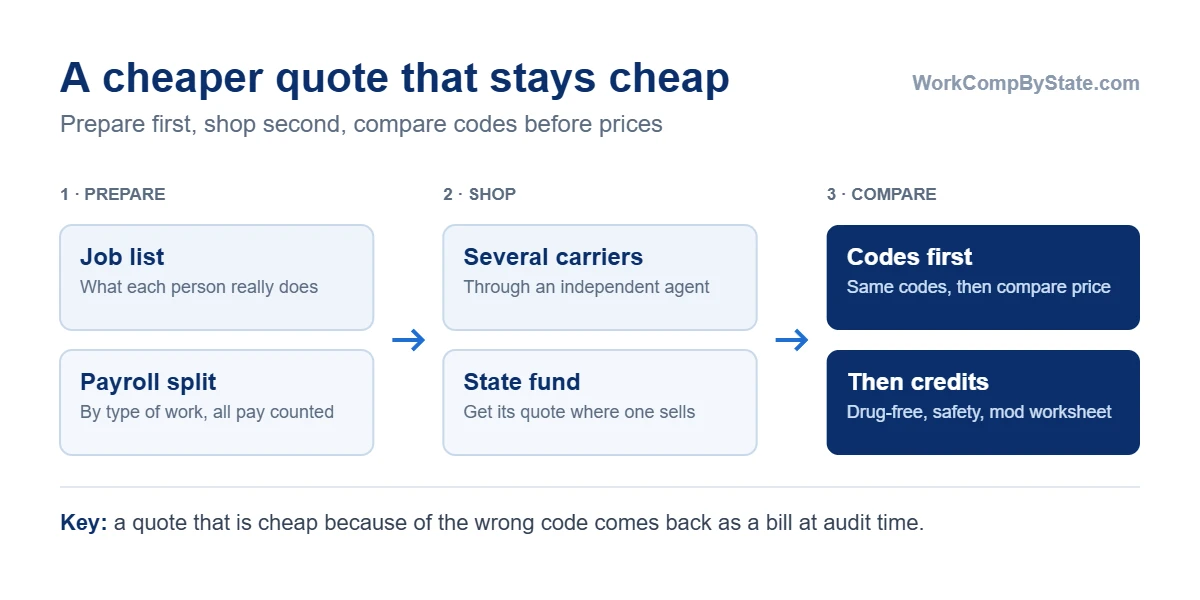
Step 1: Write down what every employee actually does
Before you call anyone, make a simple list: name, job title, and one sentence on daily tasks. Note who works only in an office, who goes to customer sites, who drives, and who climbs ladders or roofs.
This list is your best defense against a bad quote. Classification is the biggest driver of price, and the agent can only classify what you describe. Our guide on how class codes work explains the system.
Step 2: Split your payroll by type of work
If a bookkeeper or receptionist never does field work, their payroll may qualify for a much cheaper clerical class. That only works if your payroll records show the split. Ask your payroll provider whether it can tag hours or wages by job type.
Count all reportable pay. New York State Insurance Fund guidance lists items such as commissions, bonuses, holiday and vacation pay, and most overtime pay as part of remuneration. Underestimating does not save money. It just moves the bill to the audit.
Step 3: Get quotes from more than one market
Prices for the same business do differ between carriers. In New York, for example, the rating board publishes loss costs for each classification, and each insurer applies its own loss cost multiplier, filed with the Department of Financial Services, to reach its actual rate. Other states have their own versions of this system.
Practical ways to compare:
- Ask an independent agent to quote several carriers at once.
- Check whether your state has a state fund that sells coverage to private employers, and get its quote too. See our comparison of state funds and private insurers.
- If you are in North Dakota, Ohio, Washington or Wyoming, skip this step: coverage comes only from the state fund. Read our monopolistic states guide.
Step 4: Line up the class codes before you look at prices
Put the quotes side by side and compare the codes first. If one carrier used a cheaper code for the same workers, ask why. Either the other quotes are wrong, or this one will be corrected at audit. A difference in codes is not a price difference, it is a disagreement about your business.
Misclassification can also bring penalties. Tennessee, for example, says businesses that illegally misclassify employees as independent contractors or subcontractors may be assessed a penalty equal to 1.5 times the employer’s total estimated annual premium.
Step 5: Ask about every credit you might qualify for
Credits rarely appear on their own. You usually have to apply, document something, or send a certificate. Things to ask about:
- State drug-free workplace programs. Georgia’s State Board of Workers’ Compensation certifies drug-free workplaces, and certified employers receive a 7.5% reduction in their workers’ comp premiums. The certification fee is $35, and the employer must send a copy of the certificate to its carrier each year. Other states have different programs, or none.
- Safety and loss-control credits. NYSIF says it may apply credits or surcharges based on factors including loss experience, premium payment history, adherence to safe work practices, and cooperation on claims and audits. Private carriers use similar schedule credits.
- Return-to-work programs. Offering light duty helps injured employees come back sooner, which keeps claim costs down and protects your experience rating over time.
Step 6: Check your experience modification
If you have been insured long enough to be experience rated, your modification factor multiplies the whole premium. Get the worksheet, check that every claim on it is yours, and make sure closed claims show their final values. One reserve left too high on a closed claim can inflate the factor. See our experience modification guide.
Step 7: Pick a payment plan that fits your cash flow
The billing method does not change the rate, but it can change what you need up front. NYSIF, for example, requires 100% down on policies with premiums up to $499, offers 25% down plus nine equal payments for premiums of $1,000 and over, and offers a pay-as-you-go option with $0 down. Compare our guides on down payments and payment plans and pay-as-you-go workers’ comp.
A worked comparison (hypothetical figures)
A small cleaning company asks for three quotes. All numbers below are invented for illustration.
- Calling employees independent contractors to leave them off the policy.
- Reporting less payroll than you expect to pay.
- Accepting a code you know does not describe the work.
- Ignoring the audit request. NYSIF warns that missed audits or missing records can lead to an estimated audit, which can mean a higher premium than a proper review would produce.
- How to lower your premium legally
- What workers’ comp costs for a small business
- Workers’ comp audits
- Covering 1099 workers
- New York State Insurance Fund, what affects your premium
- New York State Insurance Fund, payment plans
- New York State Insurance Fund, estimated audits
- Georgia State Board of Workers’ Compensation, drug-free workplace program
- Tennessee Bureau of Workers’ Compensation, penalties and Uninsured Employers Fund
- Michigan Workers’ Disability Compensation Agency, insurance requirements
| Quote | Price | How it classifies the work | Real cost after audit |
|---|---|---|---|
| A | $3,900 | Janitorial code on all $150,000, including the office manager | About as quoted, but overpriced |
| B | $3,600 | Splits $40,000 of office payroll into a clerical code | The real low price: codes match the work |
| C | $2,700 | Office cleaning code that excludes window work, though the crew does exterior windows | Likely higher once the audit reclassifies the window payroll |
Quote C looks cheapest by $900. If the audit moves the window crew’s payroll to a higher class, the company owes the difference after the fact, possibly more than it saved. Quote B is the real low price because its codes match the work.
What to do if nobody wants to insure you
Businesses with heavy losses or very high-risk work sometimes cannot find a standard carrier. Most states have a market of last resort. Michigan, for example, uses the Michigan Workers’ Compensation Placement Facility as its assigned risk pool. Coverage there tends to cost more, so treat it as a stopgap and work on safety and claims so you can move back to the regular market.
Shortcuts that backfire
Related guides
Sources
Last checked against the sources above on October 2, 2026.