
Workers’ Comp Insurance and OSHA Compliance: What’s the Connection?
Owners often lump OSHA and workers’ comp together because both show up after someone gets hurt. They are two different systems with different jobs, different rules and different paperwork. Mixing them up leads to two common mistakes: assuming an insurance claim takes care of OSHA, and assuming that if the insurer denied a claim, the injury does not belong on the OSHA log.
This guide compares the two side by side, then walks through how one injury can be treated differently by each.
Side by side
| OSHA | Workers’ comp | |
|---|---|---|
| What it is | Federal workplace safety regulator (some states run approved state plans) | State-regulated insurance system |
| Main goal | Prevent injuries and track them | Pay medical care and lost wages after an injury |
| Who decides | The employer applies OSHA’s recording rules; OSHA inspects and cites | The insurer, and the state agency or court if disputed |
| Key question | Is this a recordable work-related case? | Did the injury arise out of and in the course of employment under state law? |
| Fault | Records do not prove a violation | No-fault: benefits do not depend on blame |
| Paperwork | 300 Log, 301 Incident Report, 300A annual summary; severe injury reports | First report of injury to the carrier; state forms where required |
The rule that separates them
OSHA answers this directly in its recordkeeping FAQ. Recording an injury neither affects a person’s right to workers’ comp nor proves a violation of an OSHA rule. Comp compensability rules differ from state to state and have no effect on whether a case goes on the OSHA 300 Log. Many cases are both recordable and compensable, but some are compensable and not recordable, and some are recordable and not compensable.
So you evaluate every injury twice: once under OSHA’s rules, once under your state’s comp rules. The answer to one does not answer the other.
One injury, four possible outcomes
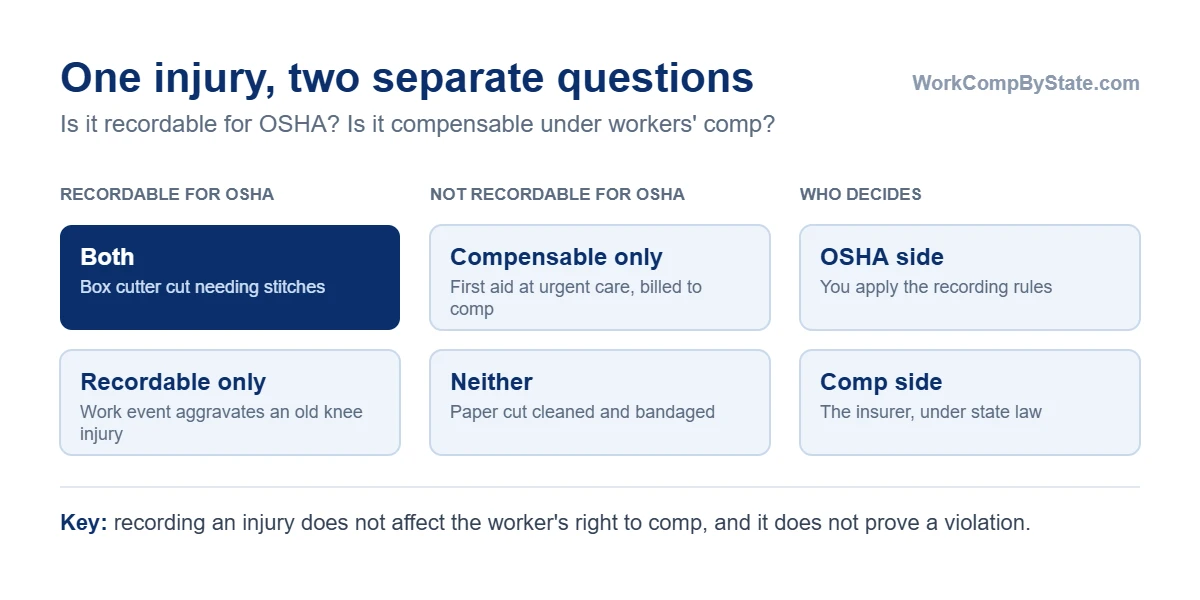
Recordable and compensable
A warehouse worker cuts a hand on a box cutter and gets stitches. Stitches are medical treatment beyond first aid, so the case is recordable, and the comp policy pays for the treatment. This is the most common combination.
Compensable but not recordable
An office worker trips and gets a bandage and an ice pack at an urgent care clinic, and the visit is billed to the comp policy. Because only first aid was given, the case may not meet OSHA’s recording criteria, yet the comp carrier still pays the bill.
Recordable but not compensable
This is the one that surprises owners. OSHA’s rule on work-relatedness, 29 CFR 1904.5, presumes an injury is work related when it results from an event or exposure in the work environment, unless a listed exception applies. It also counts a case when a work event significantly aggravates a preexisting condition, for example by causing days away from work or medical treatment that otherwise would not have happened. Picture a worker who hurt her knee playing weekend soccer, then twists it at work and needs physical therapy she would not otherwise have needed. OSHA may treat that as recordable. A comp carrier, applying state law, might decide the condition did not arise from the job and deny the claim.
Neither
A paper cut cleaned and covered with a bandage. No recording, no claim.
OSHA duties every small employer should know
Severe injury reporting applies to everyone
All employers must notify OSHA within 8 hours of a work-related death and within 24 hours of a work-related in-patient hospitalization, amputation or loss of an eye, according to OSHA’s recordkeeping page. Your comp claim does not satisfy this. You call OSHA, or report online, separately.
Injury logs, if you have more than 10 employees
The same page explains that many employers with more than 10 employees must keep OSHA forms 300, 300A and 301 (certain industries are exempt). The details:
- 7 days: enter each recordable case on the 300 Log and 301 report within 7 calendar days of learning about it (29 CFR 1904.29).
- Your insurance form can help: the same section notes that many employers use an insurance form instead of the OSHA 301, adding any information OSHA requires. This is the one place the two systems share paperwork.
- February 1 to April 30: a company executive certifies the annual summary (300A), and you post it where employee notices go, no later than February 1 and until April 30 (29 CFR 1904.32).
- 5 years: keep the log, summary and 301 forms for five years after the end of the year they cover, and update stored logs if new recordable cases come to light (29 CFR 1904.33).
- Electronic submission: establishments meeting certain size and industry criteria submit data each year between January 2 and March 2 through OSHA’s Injury Tracking Application.
Where the two systems do meet: your costs
There is no formula that turns an OSHA citation into a premium increase. The link is indirect, and it runs through claims. Injuries that a better safety program would have prevented become comp claims. Those claims feed your experience modification rate, which raises or lowers premium for businesses large enough to be rated. Fewer injuries means fewer claims, a better mod and a cheaper policy over time.
Safety work also shows up when you shop for coverage. Underwriters commonly ask about safety programs and loss history, so a written program and clean records help your agent make the case. Our guide to lowering your premium covers this in more detail.
A worked example (illustrative numbers)
A hypothetical landscaping company with 14 employees pays $30,000 a year in comp premium with a 1.00 experience mod. After two years of preventable strain injuries, its mod rises to 1.20. Applied to the same base premium, that is about $36,000, or $6,000 more a year, and mods typically reflect several years of losses, so the cost lingers. If the company adds a lifting and equipment safety program that cuts those injuries, it fixes both problems at once: fewer OSHA-recordable cases and, over time, a mod that drifts back toward 1.00. These figures are made up to show the mechanics; real mods depend on your state rating bureau’s formula and your payroll.
A short checklist
- After any injury, ask two separate questions: does OSHA need a report or log entry, and does the carrier need a claim?
- Do not wait for the insurer’s decision before logging a recordable case.
- Do not remove a case from the log because a claim was denied.
- Keep the FROI and OSHA records in the same claim folder, since one can support the other.
- Tell workers how to report injuries and that they will not be punished for doing so.
Related guides
- What to do when an employee gets injured at work
- How to file a workers’ comp claim
- Experience modification rate explained
- Workers’ comp for construction companies
Sources
- OSHA, Recordkeeping requirements
- OSHA FAQ 0-2, effect of workers’ compensation reports on OSHA records
- OSHA, 29 CFR 1904.5 work-relatedness
- OSHA, 29 CFR 1904.29 forms
- OSHA, 29 CFR 1904.32 annual summary
- OSHA, 29 CFR 1904.33 retention
Last checked against the sources above on October 2, 2026.