
Michigan Workers’ Comp Requirements: Who Needs a Policy and What Happens Without One
Michigan has a two-part test for private employers, and the second part catches people off guard. You can have a single employee and still be required to carry workers’ compensation. This guide walks through the test in the order you would apply it, then covers owners, contractors, reporting and penalties.
| Your situation | What Michigan requires |
|---|---|
| 3 or more employees at one time (part-timers count) | Full workers’ comp coverage |
| Fewer than 3, but one employee worked 35+ hours a week for 13+ weeks in the prior 52 | Full workers’ comp coverage |
| Farm: 3+ regular employees at 35+ hours a week for 13+ consecutive weeks | Full workers’ comp coverage |
| Farm: 1+ employee at 35+ hours a week for 5+ consecutive weeks | Medical and hospital coverage only |
| Below all of these | Not required (coverage can still be bought) |
Step 1: Do you regularly employ three or more people at one time?
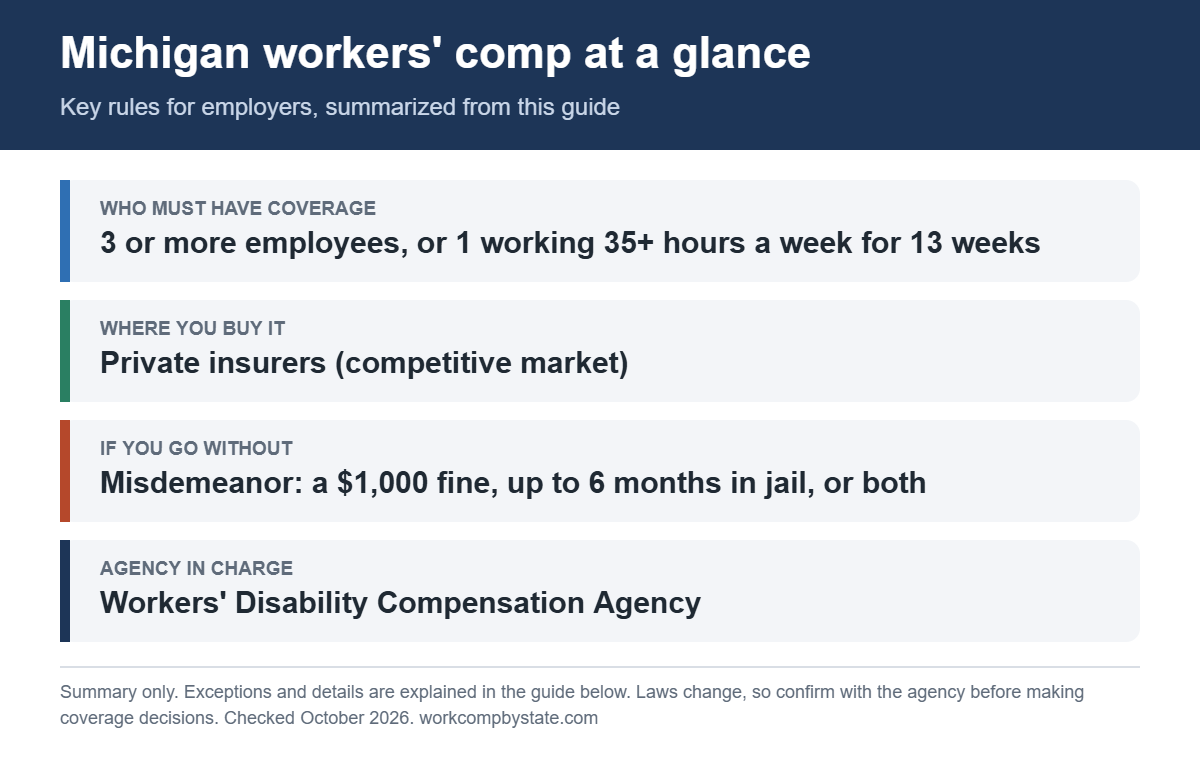
MCL 418.115 says the Workers’ Disability Compensation Act applies to all private employers, other than agricultural employers, “who regularly employ 3 or more employees at 1 time.” Part-time workers count. A coffee shop with one full-timer and two weekend baristas who are on the schedule every week regularly employs three people at once.
If the answer is yes, you need coverage. Stop here and skip to Step 4.
Step 2: If fewer than three, has anyone worked 35 hours a week for 13 weeks?
This is the part people miss. The same section covers employers with fewer than three employees if at least one of them has been regularly employed for 35 or more hours per week for 13 weeks or longer during the preceding 52 weeks.
So a one-person business with a single full-time assistant becomes subject to the Act once that assistant passes 13 weeks at 35 hours or more. The 13 weeks do not have to be your most recent 13 weeks. The lookback is the prior 52 weeks.
The practical lesson is that a new hire who starts full time will trigger coverage about three months in. Most owners find it easier to put the policy in place on day one than to track hours and remember the date.
Step 3: Are you an agricultural employer?
Farms have their own thresholds under the same section:
- Three or more regular employees working 35 hours or more a week for 13 or more consecutive weeks: full workers’ compensation coverage is required.
- One or more employees working 35 hours or more a week for 5 or more consecutive weeks: the farm must provide medical and hospital coverage only.
- Family members who live with the agricultural employer are excluded.
Agricultural employers below these thresholds are exempt.
Step 4: Figure out who is actually covered
Sole proprietors. The state agency’s FAQ is direct: if you own the business yourself, you are considered self-employed and you are not covered by the Act. Your employees are.
Partners, LLC members and small corporations. The employees of a partnership, LLC or small corporation are covered. Under Section 161 of the Act, named partners and corporate officers who are also shareholders of small, closely held corporations may exempt themselves in certain circumstances. The agency’s Insurance Compliance Division handles those requests, so contact it before assuming an exemption applies to you.
Family members. Section 161(2) allows certain family members of an employer to be excluded. The exclusion has conditions, so confirm them with the agency or your agent.
Independent contractors. This is where Michigan audits find problems. According to the agency, if a worker does not maintain a separate business, does not hold himself or herself out to and serve the public, and does not employ other workers, the worker is considered an employee. Calling someone a contractor on a 1099 does not change the answer.
The contractor trap: MCL 418.171
If you hire a contractor who is not covered, Michigan can treat that contractor’s workers as yours. Under MCL 418.171(1), the principal is liable to pay any person employed in the execution of the work the compensation it would have owed if that person had been its own employee. You can sue the contractor to get the money back, but that only helps if the contractor has money.
The defense is boring and effective. Before work starts, ask for a certificate of insurance and check it in the agency’s online coverage look-up.
How to get coverage
Most employers buy a policy from a private carrier. If carriers turn you down, the Michigan Workers’ Compensation Placement Facility, the state’s assigned risk pool, is the fallback. Larger employers can apply to the agency to self-insure. Michigan does not run a state fund that sells policies.
Reporting injuries
When an injury causes death, a specific loss (such as an amputation) or a disability of seven days or more, the employer must report it to the agency on form WC-100. Your carrier usually files it once you notify them, but the duty is yours, so tell the carrier the same day you learn about the injury.
Michigan law does not require a workers’ comp poster, according to the agency. It does encourage employers to post its employee publications, and doing so is cheap insurance against later arguments about what workers were told.
Penalties for going uninsured
An employer that fails to secure coverage under the Act’s insurance section commits a misdemeanor. The agency’s FAQ says the employer may be fined $1,000, jailed for up to six months, or both. The consequences do not stop there:
- Personal liability for officers and directors. MCL 418.641 makes the officers and directors of a noncompliant corporation individually, jointly and severally liable for the obligations the corporation fails to pay.
- Lawsuits without the usual protection. An injured employee of an uninsured employer can sue for civil damages. The exclusive remedy rule that normally shields insured employers does not apply.
Example: the 13-week trigger
A Grand Rapids bookkeeper works alone and hires an assistant on March 1 at 37.5 hours a week. There are never three employees. By the end of May, the assistant has worked 13 weeks at 35 hours or more, and the business is now subject to the Act. If the assistant slips on an icy step in June and the owner never bought a policy, the owner is personally on the hook for medical bills and wage loss benefits, and is exposed to a misdemeanor charge. If the business is a small corporation, its officers share the liability.
Quick checklist
- Count regular employees at one time, part-timers included.
- Check whether any one worker has hit 35 hours a week for 13 weeks in the last 52.
- Confirm any partner, officer or family exemption with the Insurance Compliance Division in writing.
- Collect and verify certificates from every contractor before work starts.
- Report qualifying injuries on WC-100.
Related guides
- Do 1099 contractors need workers’ comp?
- Part-time employees and workers’ comp
- Family members and workers’ comp
- Penalties for not having workers’ comp by state
- Ohio workers’ comp requirements
Sources
- MCL 418.115, employers subject to the Act
- MCL 418.171, liability of principals
- MCL 418.641, penalties
- Michigan Workers’ Disability Compensation Agency, employer FAQs
- Michigan WDCA, insurance requirements
Last checked against the sources above on October 2, 2026. Laws change, so confirm with the agency or a licensed agent before making coverage decisions.