
Tennessee Workers’ Comp Requirements: Construction vs Everyone Else
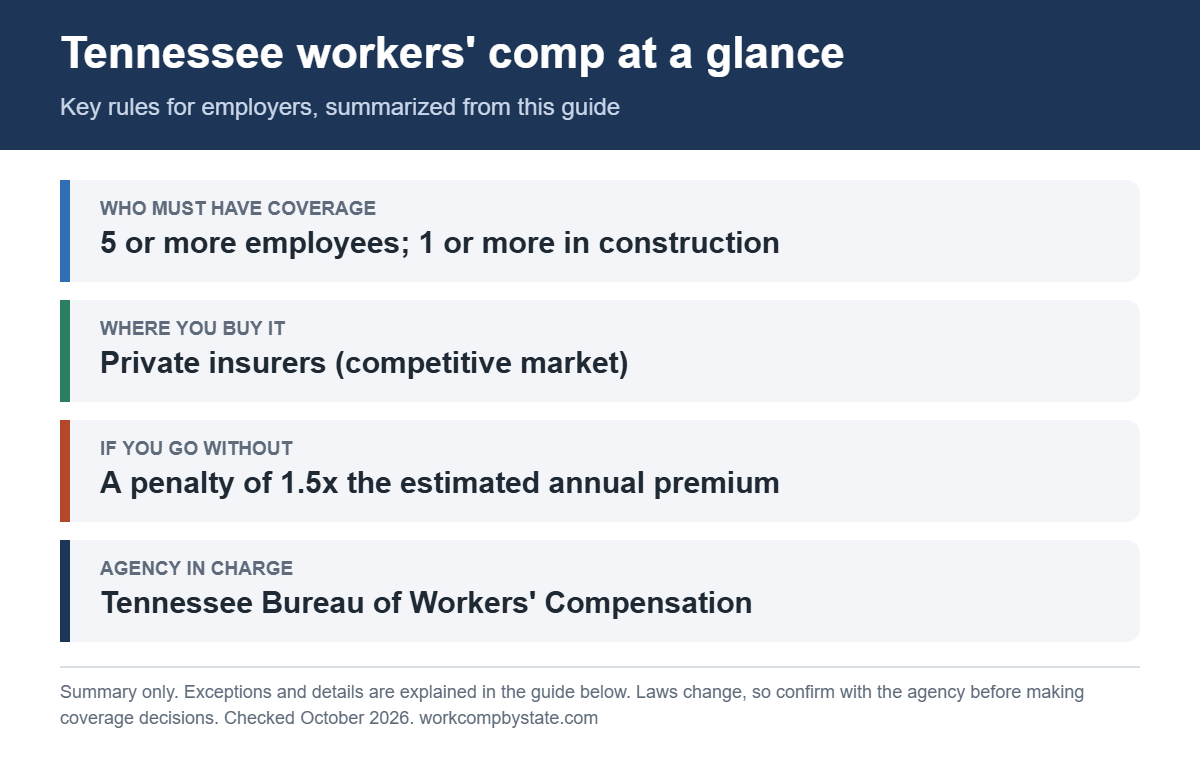
Tennessee runs two different rules depending on what your business does. If you are in construction (or coal mining), you need coverage with a single employee, and the owners are expected to be covered too unless they get an exemption. Every other business needs coverage once it has five employees. Getting your business into the right bucket is most of the work, so this guide starts there.
| Construction and coal mining | All other businesses | |
|---|---|---|
| Coverage required at | 1 or more employees | 5 or more employees |
| Who counts | Seasonal, part-time, family and “as needed” workers | Part-timers, minors, working family members and full-time corporate officers |
| Owners | Must cover themselves unless they get an exemption (covers only the named person) | Sole proprietors, LLC members and partners do not count |
| Out-of-state companies | Tennessee policy from the first day of work | Temporary work exception: up to 14 consecutive days or 25 total days a year |
Which rule applies to you?
The Bureau of Workers’ Compensation treats a business as a construction services provider if its work appears on the state’s list of contracting codes. If you are not sure whether your trade is on it, check the list before you decide which rule applies.
The test looks at the business, not the job title. The Bureau says plainly that admin staff at a construction company must be covered, because the policy requirements are set by the nature of the business, not by what each employee does. A roofing company’s office manager counts just like the crew on the roof.
Track 1: Construction and coal mining
All construction services providers with one or more employees must carry workers’ compensation for those employees. The Bureau lists who that includes: seasonal workers, part-timers, family members of the owner, and people who work only “as needed.” Coal mining employers must cover all employees as well.
Owners. This is where Tennessee differs from most states. Owners of construction businesses are required to carry coverage on themselves. They can apply for an exemption from that requirement if they meet the state’s qualifications, and approved exemptions appear on the state’s Exemption Registry.
Read the exemption carefully if you hire subs. The Bureau warns that an exemption covers only the individual named on it. It does not cover the business or any of its employees. A sub who shows you an exemption for himself and then brings two helpers to your job has not shown you coverage for the helpers.
Out-of-state contractors. A construction business from another state that works in Tennessee must carry a Tennessee policy, with Tennessee listed in section 3A, from its first day of work in the state. T.C.A. 50-6-115(e)(1) is the source. The temporary-work exception described below does not apply to construction.
Track 2: All other businesses
Non-construction employers with five or more employees must secure coverage, either with a policy from a licensed carrier or by qualifying to self-insure through the Department of Commerce and Insurance.
How to count to five
- Part-timers, minors and working family members count. The Bureau says so directly.
- Owners of sole proprietorships, LLCs and partnerships do not count. A three-member LLC with four employees has four employees for this purpose.
- Full-time corporate officers do count. They can exclude themselves from the policy, but they still count toward the five.
Worked example
A Chattanooga bakery is an S corporation with two full-time officers. It has two counter employees and a teenager who works Saturdays. That is five: two officers, two staff and one part-time minor. The bakery needs a policy. The officers can choose to exclude themselves from it, but that does not take the bakery below five.
Now change one fact: the bakery is an LLC and the two owners are members. The count drops to three, and Tennessee does not require coverage. Many owners in that position buy it anyway, because an uninsured injury can still lead to a lawsuit.
Who is outside the law entirely
The Bureau lists several categories not covered by the Tennessee workers’ comp law: non-construction businesses with fewer than five regular employees, casual employment outside your normal trade, domestic servants, farm and agricultural laborers, certain interstate common carriers already covered by federal law, government entities, and volunteer ski patrol paid only in meals, lodging or lift access. Any of them can choose to provide coverage voluntarily.
Temporary work from another state
For non-construction businesses only, an employee who works in Tennessee temporarily, no more than 14 consecutive days or 25 total days in a calendar year, may be exempt if the employer has workers’ comp coverage in another state.
Dropping below five
If your workforce falls below five, you may drop coverage, but not just by letting the policy lapse. You must file Form I-3, the Notice of Withdrawal from Coverage, and the exemption applies once the Bureau accepts it.
Employee or contractor? The seven-factor test
Both tracks use the same test to separate employees from independent contractors. The Bureau weighs:
- the right to control the conduct of the work;
- the right of termination;
- the method of payment;
- the freedom to select and hire helpers;
- who furnishes tools and equipment;
- self-scheduling of working hours; and
- the freedom to offer services to other businesses.
Control of the work carries the most weight. A 1099 instead of a W-2 does not settle the question.
Penalties
Tennessee’s Uninsured Employers Fund enforces the coverage law. Businesses that fail to carry required insurance, or that misclassify employees as independent contractors or subcontractors, can be assessed a penalty equal to 1.5 times the employer’s total estimated annual premium. The money goes toward benefits for workers hurt while working for illegally uninsured employers.
That fund is a thin safety net. It pays at most $40,000 in total to an eligible worker, split between up to $20,000 in temporary disability and up to $20,000 in medical benefits, and only after the worker has a court decision against the employer. An uninsured employer remains liable for the full claim, so anything above that comes out of the business.
Checking a sub’s coverage
Before work starts, look the subcontractor up in the coverage verification tool linked from the Bureau’s site, and check the Exemption Registry for any owner exemption. The Bureau also offers email alerts if a policy is canceled early, which is useful for long jobs.
Related guides
- Workers’ comp for construction companies
- Workers’ comp for roofing contractors
- Do 1099 contractors need workers’ comp?
- Family members and workers’ comp
- Penalties for not having workers’ comp by state
Sources
- Tennessee Bureau of Workers’ Compensation, who must carry insurance
- Tennessee BWC, construction requirements
- Tennessee BWC, non-construction requirements
- Tennessee BWC, Uninsured Employers Fund
Last checked against the sources above on October 2, 2026. Laws change, so confirm with the Tennessee Bureau of Workers’ Compensation or a licensed agent before making coverage decisions.