
Workers’ Comp for Daycare and Childcare Centers: A Setup Checklist From First Hire to First Audit
Childcare is one of the few small businesses where the law decides your minimum staff. Your state licensing agency sets how many children each adult may supervise, so a center that enrolls more kids has to hire more people. That pushes most centers past their state’s workers’ comp threshold early, often before opening day.
This checklist walks through the workers’ comp decisions in the order you will face them. Work through it once when you open, and again whenever you add a classroom.
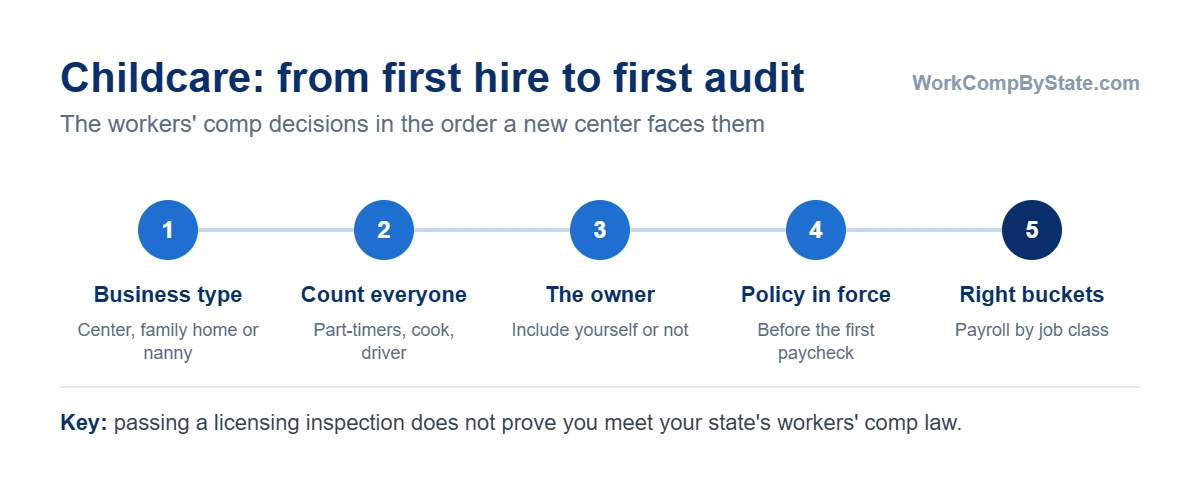
Step 1: Pin down what kind of childcare business you are
Workers’ comp treats these three setups differently:
- A childcare center. A commercial business with paid teachers, aides and often a cook or driver. Standard employer rules apply.
- A licensed family child care home. A provider caring for children in their own house. A solo owner is usually not required to cover themselves, but the first paid assistant is an employee of the business.
- A nanny hired by a family. Here the family is the employer. Several states treat household workers separately. Indiana exempts household employees from its act (IC 22-3-2-9), Missouri excludes domestic servants in a private home (RSMo 287.090), while Massachusetts requires coverage for domestic employees who work at least 16 hours a week. Those household rules are about families hiring help. Do not assume they reach an assistant in a home daycare that operates as a business. Confirm with your state agency.
Step 2: Count everyone you pay, not just lead teachers
Thresholds count heads, and part-time staff usually count. Make a list that includes floaters, substitutes on your payroll, the afternoon aide who works 15 hours a week, the cook, the van driver, the bookkeeper and any family member you pay.
Then compare the list with your state. A few examples from official sources:
- Changing tables with steps so toddlers climb up instead of being lifted.
- Adult-height chairs and work surfaces where possible.
- A written routine for wet floors in bathrooms and eating areas.
- Short training on lifting for every new hire, documented in their file.
- Is workers’ comp legally required?
- Part-time employees and workers’ comp
- Workers’ comp for nonprofits and churches
- Workers’ comp cost for small businesses
- Wisconsin DWD: Worker’s Compensation Insurance Requirements
- Tennessee BWC: How rates for insurance premiums are set
- Indiana Code 22-3-2-9
- Missouri Revised Statutes 287.090
- Indiana Workers’ Compensation Board: Compliance
- Massachusetts DIA: Workers’ compensation insurance requirements
| State | When a childcare business needs coverage |
|---|---|
| Wisconsin | 3 or more employees, or $500 in gross wages in any quarter |
| Tennessee | 5 or more employees outside construction; part-timers, minors and working family members all count |
| North Carolina, Virginia, Georgia | 3 or more employees |
| Florida | 4 or more employees outside construction |
Look up your own state on the 50-state comparison table. In Wisconsin, the $500 quarterly wage rule means even a family child care home with one part-time helper will usually need a policy.
Step 3: Decide about the owner
If you are a sole proprietor or LLC member, most states let you leave yourself off the policy. If you incorporated, officers are often counted as employees unless they formally elect out, and the rules for that election vary. Many center directors teach in a classroom every day, so the owner’s own injury risk is real. Read workers’ comp for sole proprietors before you decide to exclude yourself.
Step 4: Have the policy in force before the first paycheck
Coverage requirements usually start the day you cross the threshold, not at the end of the month. Wisconsin, for example, requires coverage on the day you employ the third person. Build the deposit into your opening budget. If cash is tight, ask about pay-as-you-go workers’ comp, which bases installments on actual payroll.
Keep the policy and the licensing file separate in your head. A licensing inspection focuses on child safety, ratios and the building. Passing it does not prove you meet your state’s workers’ comp law.
Step 5: Report payroll in the right buckets
Premiums are priced per $100 of payroll for each job classification. Tennessee’s Bureau of Workers’ Compensation explains that each class code has a set rate per $100 of payroll and riskier work carries higher rates (TN BWC). A purely clerical office worker may qualify for a lower classification than classroom staff. A driver who transports children may be classified differently too. Ask your agent which codes apply and keep job descriptions that match them.
Illustrative example (made-up numbers): A center has $240,000 in annual classroom payroll. If the rate for its classification were $1.50 per $100, the base premium would be 2,400 x $1.50 = $3,600 before experience rating, discounts or state fees. A different rate, state or payroll changes everything, so use the math to understand your quote, not to predict it. See how premiums are calculated.
Step 6: Plan for the injuries childcare actually produces
The typical claims in this work are not dramatic. They come from repetition: lifting toddlers onto changing tables, bending over low sinks, sitting on the floor and standing up dozens of times a day, slipping on wet floors, and getting bitten or scratched. Staff also catch whatever is going around the classroom.
A few low-cost habits help:
Fewer claims protect your experience modification rate, which affects premiums for years.
Step 7: Write down your injury reporting steps
Deadlines are short and state-specific. Indiana employers must report injuries needing more than first aid to the carrier within 7 days (Indiana WCB). Virginia employers report to the Commission within 10 days. North Carolina employers file Form 19 within 5 days. Post your carrier’s claim number by the staff phone and tell directors who files the report. Our guide for when an employee is injured lists the first steps.
Step 8: Watch substitutes and agency staff
If a staffing agency supplies substitute teachers, the agency usually carries their workers’ comp. Get a certificate of insurance from the agency before the first shift, and keep it current. If you pay substitutes directly, they are your employees and belong in your payroll count.
Step 9: Prepare for the annual audit
At the end of the policy year, the carrier compares your estimated payroll with what you actually paid. Centers that added a classroom mid-year often owe more. Keep payroll reports by job type so the auditor puts each person in the right class. See workers’ comp audits.
Related guides
Sources
Last checked against the sources above on October 2, 2026.