
Workers’ Comp for Retail Stores: A Walk Through Your Store’s Real Risks
Retail owners often think of their store as low risk. Most days it is. But a store has several very different work areas, and each one produces its own kind of claim. The best way to understand your workers’ comp exposure is to walk through the building the way an adjuster would, from the stockroom to the register to the parking lot.
The stockroom and receiving door
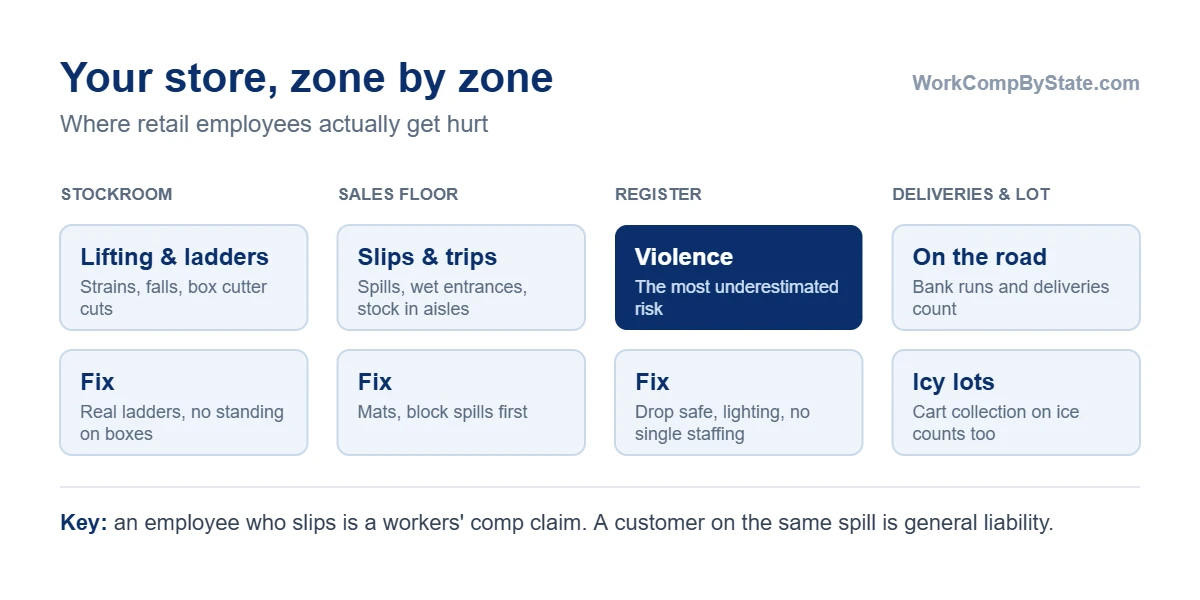
This is where most serious retail injuries start. Employees unload trucks, break down pallets, carry cases and climb ladders to reach top shelves. Typical claims:
- Back, shoulder and knee strains from lifting and carrying stock.
- Falls from step stools and ladders, or from standing on boxes “just this once.”
- Cuts from box cutters and strapping.
- Being struck by falling merchandise from overloaded shelves.
- Pallet jack and hand truck injuries, including crushed feet.
For classification, a stockroom that only supports your own store is generally rated as part of the retail operation, not as a separate warehouse business. That changes if you start storing or shipping goods for other companies, or run a fulfillment operation big enough to be a business of its own. Tell your insurer if your back room starts to look like a warehouse; see our guide to warehousing.
The sales floor
The sales floor brings slips on spills and wet entrances, trips over stock left in aisles, and strains from reaching and restocking all day. Standing shifts on hard floors add up. Simple fixes (mats at entrances, a rule that spills get blocked off first and cleaned second, and keeping freight out of aisles) prevent a lot of claims.
Remember who workers’ comp covers. If an employee slips, it is a workers’ comp claim. If a customer slips on the same spill, it is a general liability claim. The two policies do not overlap; see workers’ comp vs general liability.
| Who is hurt in your store | Which policy usually responds |
|---|---|
| Your employee | Your workers’ comp policy |
| A customer | Your general liability policy |
| A temp from a staffing agency | The agency’s workers’ comp (get its certificate) |
| A vendor rep stocking their own products | Their employer’s workers’ comp |
The register: the risk owners underestimate
Violence is the retail risk that gets the least attention and causes the worst outcomes. OSHA’s workplace violence overview says acts of violence are the third-leading cause of fatal occupational injuries in the United States. Citing the Bureau of Labor Statistics Census of Fatal Occupational Injuries, it reports that of 5,283 fatal workplace injuries in 2023, 740 were due to violent acts, and homicides accounted for 458 of them.
OSHA lists risk factors that read like a description of late-night retail: exchanging money with the public, working alone or in isolated areas, and working late at night or in high-crime areas. Workers who exchange money with the public are named among those at higher risk.
If you run a convenience store, liquor store or any shop open late, take this seriously:
- Keep limited cash in the drawer and use a drop safe.
- Keep windows clear so the register is visible from outside.
- Use good lighting, cameras and posted notices.
- Avoid single staffing at night where you can.
- Train staff to hand over money and never resist.
An employee hurt in a robbery is covered by workers’ comp. Injuries like these can include long medical treatment and time off work, and they can drive up your experience mod for years.
Deliveries, the parking lot and errands
Employees who deliver orders, make bank runs or pick up supplies are working while they drive. Their injuries in those trips are generally work related. Parking lot falls during a shift, such as collecting carts on ice, also count. If you use a gig delivery service, those drivers usually are not your employees, but a driver you schedule and pay directly may be.
Who counts as your employee in retail
Retail headcounts move up and down, and that is where small stores slip out of compliance. Thresholds vary by state:
- Missouri requires coverage once you have five or more employees (one or more in construction), and counts family members within the third degree.
- Wisconsin requires it once you have three or more employees, or once you pay $500 or more in gross wages in any calendar quarter. Part-time workers and family members count.
Part-time cashiers, holiday hires and family members who help on weekends are where owners miscount. See part-time employees and seasonal and temporary workers. Temps supplied by a staffing agency are usually on the agency’s policy, but get a certificate confirming it.
Vendor reps and merchandisers who stock their own company’s products are normally that company’s employees. Someone you pay directly to set displays or stock shelves every week is probably yours.
A worked example (hypothetical)
Corner Pantry is a made-up convenience store in Missouri. Year-round it has the owner (a sole proprietor) and three employees, so it is below Missouri’s five-employee line and carries no policy.
In November the owner hires two holiday cashiers. Now the store has five employees. Two weeks later, a night clerk is pushed into a shelf during a robbery and fractures his arm.
Corner Pantry needed coverage from the day it reached five employees. Under Missouri law, an employer who knowingly fails to insure commits a class A misdemeanor and faces a penalty of up to three times the annual premium or up to $50,000, whichever is greater. The clerk can also pursue the owner directly, and an uninsured Missouri employer loses key defenses in that lawsuit.
Compare the cost of a policy. As an illustration only, if the five employees earn $150,000 a year combined and the store’s rate were $1.80 per $100 of payroll, base premium would be $2,700 a year. Many carriers also offer pay-as-you-go billing that tracks payroll as it changes through the season.
After an injury
Get the employee care first, then report. OSHA requires employers to report a work-related fatality within 8 hours and an in-patient hospitalization, amputation or eye loss within 24 hours. Report every claim to your insurer promptly; our guide on what to do when an employee is injured has the steps.
Related guides
- Missouri workers’ comp requirements
- Workers’ comp cost for small businesses
- What happens if you don’t have coverage
- Bundling workers’ comp with a BOP
Sources
- OSHA: Workplace Violence
- OSHA: Report a fatality or severe injury
- Missouri RSMo 287.030
- Missouri RSMo 287.128
- Missouri RSMo 287.280
- Wisconsin DWD: Employer’s guide to workers’ compensation
Last checked against the sources above on October 2, 2026.