
Workers’ Comp for IT Consultants and Software Companies: Remote Teams, Founders and Field Techs
A software company has almost none of the hazards that make workers’ comp expensive. Nobody is on a roof or running a forklift. But tech companies run into a different set of problems: a team spread over several states, founders who are also officers and shareholders, contractors who work like employees, and the occasional technician who does go into the field and lift heavy equipment. This guide takes each of those in turn.
What injuries look like in tech
Claims in software and IT tend to fall into a few groups:
- Repetitive strain. Wrist, hand, elbow and neck problems from long hours at a keyboard. These develop over time, which can make it harder to show when and where the injury happened.
- Driving. Consultants and support techs who drive to client sites face ordinary traffic risk during work trips.
- Field and data center work. Installing racks, pulling cable, climbing ladders in ceilings and lifting servers. This work is physical and is often rated in a different, higher class code than desk work.
- Home office accidents. A trip over a cable during a work call, for example.
Most of these claims are small. The bigger risks for a tech company are compliance gaps: an employee in a state where you have no coverage, or a “contractor” who turns out to be an employee.
Office team, remote team and field techs compared
| Group | Main injury exposure | Coverage question to ask |
|---|---|---|
| In-office developers and staff | Repetitive strain, slips | Are they in the right clerical or office class code? |
| Fully remote employees | Repetitive strain, home office accidents | Does the policy cover the state where each person works? |
| Field, install and data center techs | Lifting, ladders, driving | Is their payroll split into the correct higher-rated class? |
| Founders and officers | Same as the role they do | Are they included or excluded, and is that allowed in your state? |
Remote employees: think in states, not offices
Workers’ comp is state law. If an employee lives and works in another state, that state’s rules may apply to their injury, regardless of where your company is incorporated or headquartered. When you hire someone in a new state, tell your insurer before their first day so the policy lists that state. See remote employees for more detail.
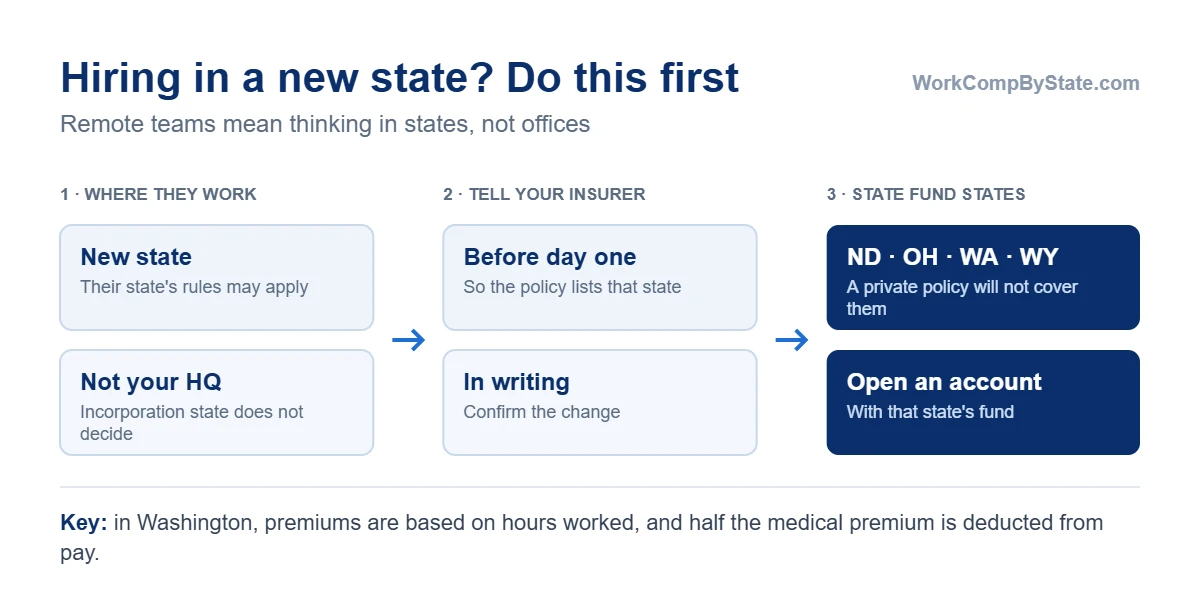
The trap is the four monopolistic states: North Dakota, Ohio, Washington and Wyoming. A private policy will not cover workers’ comp there; you buy it from the state fund. Washington’s Department of Labor and Industries says that if you are hiring employees, you get a workers’ comp account by applying for or updating your state business license. Washington also works differently in two ways tech founders rarely expect: premiums are based on hours worked per risk class, not payroll dollars, and employers deduct one-half of the medical benefits premium from workers’ pay (and may not deduct any other part). See monopolistic states.
Founders and officers: include or exclude?
Many startups have just a few people, and most of them are owners. Whether owners count depends on business type and state:
- Colorado lets corporate officers and LLC members who own at least 10 percent reject coverage using the state’s form sent by certified mail.
- Washington lets non-public corporations exempt up to eight qualifying officers (family corporations have no limit).
- Wisconsin lets closely held corporations with fewer than 10 shareholders exclude up to two officers by endorsement, and counts corporate officers as employees otherwise.
- Massachusetts lets officers who own at least 25 percent request an exemption.
Excluding yourself lowers the premium a little, but it also means your own work injury is not covered by the policy. Some clients also require that every person on their project be covered. For one-owner companies, see one-person LLCs.
A related detail: states often apply minimum and maximum payroll amounts when an officer’s pay is counted for premium. A founder drawing a very large or very small salary may be rated at a set figure. Ask your agent for your state’s officer payroll limits.
Contractors and freelancers
Tech companies use a lot of 1099 developers and designers. Many are true independent businesses with several clients. Others work full time for one company, on its sprint schedule, with its laptop and its managers. State workers’ comp tests look closely at who controls the work, who supplies the equipment and whether the person runs a real business of their own. A long-term freelancer who looks like staff may be counted as an employee at your premium audit, and their pay added to your premium. See 1099 workers.
A worked example (hypothetical)
Ledgerline is a made-up software company based in Denver, Colorado. It has two founders (each owns 50 percent), eight developers in Colorado, one support engineer in Seattle and one field tech who installs hardware at client offices around Denver.
- Founders. Both own more than 10 percent, so each may reject coverage by filing Colorado’s form by certified mail. They decide one founder stays covered because he also does on-site client work.
- Colorado staff. The eight developers go on the Colorado policy in an office class. With an assumed payroll of $1,000,000 and an illustrative rate of $0.20 per $100 of payroll, base premium is about $2,000 a year.
- Field tech. His $65,000 payroll goes in a separate, higher-rated class. At an assumed $3.00 per $100, that adds about $1,950, almost as much as the whole developer team.
- Seattle engineer. Ledgerline’s private policy cannot cover him. It opens a Washington account through the state business license process and reports his hours to the state fund.
All figures are made up for illustration; real rates depend on class codes and your state.
Related guides
- Colorado workers’ comp requirements
- Washington workers’ comp requirements
- How workers’ comp premiums are calculated
- Pay-as-you-go workers’ comp
Sources
- C.R.S. 8-41-202 (Colorado officer and member rejection)
- Washington L&I: How to get a workers’ comp account
- RCW 51.16.140 (Washington premium deductions)
- Washington L&I: Corporate officers
- Wisconsin DWD: Employer’s guide to workers’ compensation
- Massachusetts DIA: Workers’ compensation insurance requirements
Last checked against the sources above on October 2, 2026.